Why the Dolphins’ two first-round picks are ‘right kind of people’ for culture shift
With two picks in the first round, the Miami Dolphins wanted to add players who fit the violence and physicality with which they want to play.
That yielded tackle Kadyn Proctor at No. 12 and cornerback Chris Johnson at No. 27, two players on opposite sides of the ball who will likely slide in as starters by Week 1.
“Those guys — football is important to them, and they both have edge,” general manager Jon-Eric Sullivan said. “They have edge to them. They both, in a good way, reek of confidence – not arrogance but confidence. They think they’re players, and all those things were important to us as we build this thing out.”
With Proctor, the Dolphins get a solid run blocker that has the size — nearly 6-foot-7 inches and 352 pounds — to dominate at the next level if his technique improves. Two of the Dolphins’ best offensive weapons — quarterback Malik Willis and running back De’Von Achane — will sure benefit from his selection if Miami can develop him. Whether he’s a better guard or tackle will be incumbent on the coaching staff to figure out.
“I’m going to battle every day I promise you that,” the former Alabama standout said Friday afternoon, later adding that quarterbacks “run the show. If you’re not protecting them, you’re not going to win games.”
Sullivan specifically noted that Willis’ health made Proctor a priority.
“We invested in Malik, and it was important for us to protect him, to make sure that he has time to do the things that he needs to do and keep him healthy,” Sullivan said.
In Johnson, the Dolphins get a cornerback who, although he came from a smaller school in San Diego State, flashed a rare combination of versatility, footwork and athleticism necessary to be productive at the next level. His size — 6-foot, 190-pounds — won’t wow anyone but the way that Johnson uses his 4.4 speed to not only show up in the run game but also stay disciplined in coverage and attack the ball when it’s the air are a huge benefit.
“As far as using that on the field, it just helps me play the game I like to play, like being ultra-physical and ultra-patient,” Johnson said Thursday evening. “Obviously having some speed, I could be more patient where also I don’t have to panic as much as some other guys may, but God blessed me with this talent I have, and I just turn around and thank Him by using it on the field.”
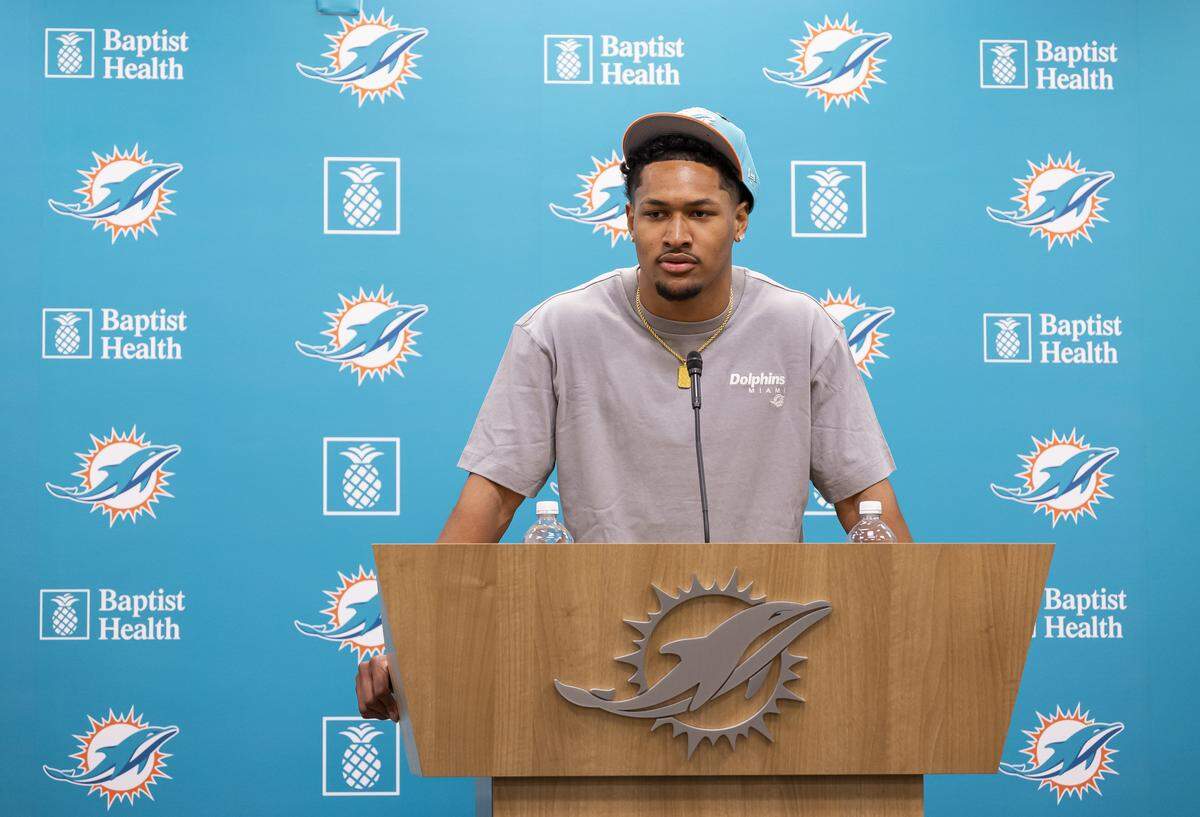
Throw in the way that the people at SDSU rave about him and the pick made sense.
“The coaches at San Diego State couldn’t have said better things about him,” Sullivan said. “His care factor is high; he was a team captain there. He’s a leader, he works. The intangibles, along with the athletic traits, along with the fact that he’s a good football player, led to the conviction of why we did what we did.”
Sullivan felt the same way about Proctor, whose struggles with his weight have been well-documented.
“It’s important that we had the right kind of people here and Proctor is in that,” Sullivan said. “He didn’t hide from it, and we feel like he’s going this way and so do the people who’ve been around him over the last couple years. These are young people. Young people make mistakes.
“There are certain things you won’t forgive, but a guy who has battled his weight a little bit here and there and has gotten together and played really good football,” Sullivan continued, “you’ve got to give guys their due and see where they’re going, not where they’ve been all the time in my opinion.”
Proctor, who admitted to showing up to training camp as a freshman at 400 pounds, noted that he’s since gotten a handle on his weight. Two of the main factors that helped him do so were HOTWORX, which uses heat during training to further activate sweat glands, and knowing when not to eat.
“You got to go to HOTWORX or do something that you find enjoyable instead of — you know, I didn’t like walking on a treadmill seven days a week for two months straight like that,” Proctor said, later adding “that’s kind of how I lost 20, 30 pounds because I was going there, day in and day out, and I was finding success from it. But I would say another thing, not eating after 7 p.m. is probably the biggest thing because you’re not giving your body enough time to digest. I found out when I don’t eat after 7 p.m., I come in, I have a good weigh in, and it just felt good.”
For the Dolphins to actually build this culture that they want, both Proctor and Johnson will have to lead the way. Johnson, specifically, actually has experience in that area. A four-year player at SDSU who didn’t start until his junior season, Johnson helped set the standard in position room. He might have to do that and then some in the very near future.
“That experience was great,” Johnson said. “Just being able to be in that role, being able to have people follow me but it also didn’t come easy. You got to instill your character into the guys around you. You can’t just run around saying certain things to guys because that’s not going to resonate with people. Once you connect with guys at a different level that’s when you get some culture changes.”
This story was originally published April 24, 2026 at 6:48 PM.