The praise, the problem, the possibilities with Dolphins safety
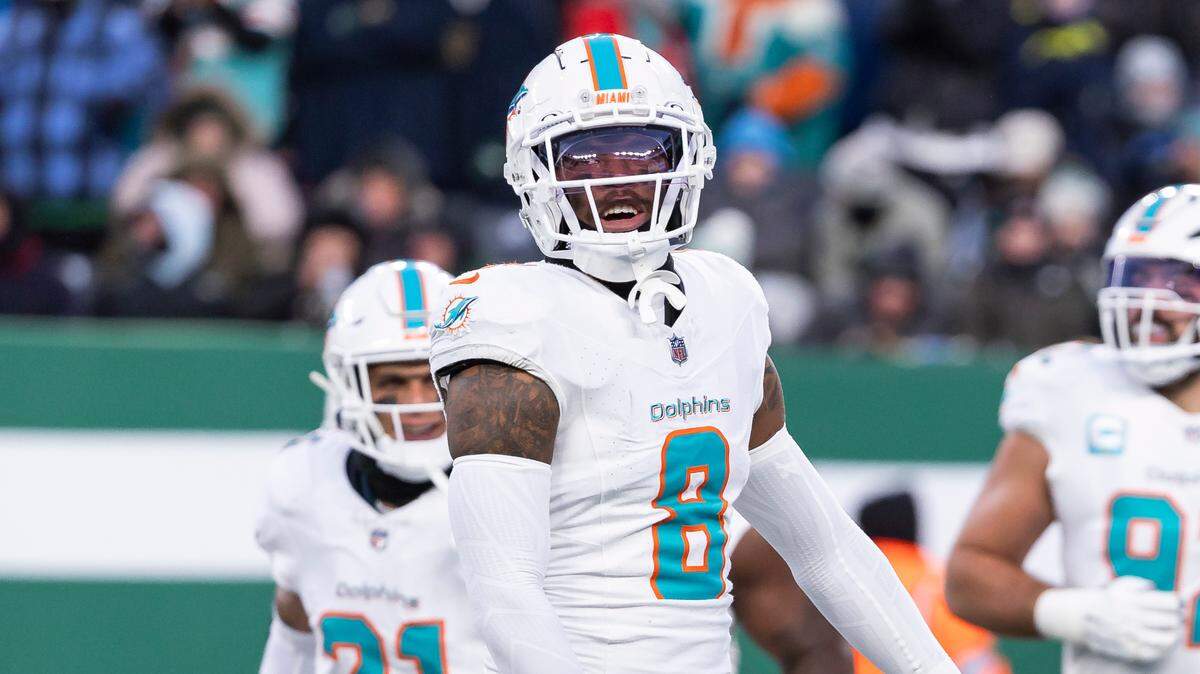
A position-by-position series breaking down each of the Miami Dolphins’ units, assessing where the team stands heading into the 2025 offseason, and examining what could possibly be done through free agency and the NFL Draft.
SAFETY
▪ Praise: There is nothing to praise about this unit.
They played like hot, smelly trash for most of 2024, with the season-opening performance from Jevon Holland, where a forced fumble he produced put the team in position to win the Jaguars game, as the lone exception.
The Dolphins went an entire season where the safeties didn’t pull down an interception, which is mind blowing.
Jordan Poyer, a free agent addition Miami signed to replace two departing starters, led the team among defensive backs with 98 tackles (51 solo), which ranked second among all Dolphins last season.
But Poyer’s performance last season, where he allowed 30 of 50 passes in his area to be completed and gave up two touchdowns, clearly indicated that this 12-year veteran has lost a step.
And Holland wasn’t much better.
The four-year starter played most of the season like he was trying to avoid a major injury so that he can cash in as a free agent this offseason. That type of guarded, cautious performance is understandable considering Holland broke a bone in his hand, and then played through a knee injury.
Despite nursing those injuries Holland only missed two games, and finished the season with 62 tackles, one sack, one forced fumble and four pass deflections. Those are decent numbers, but Holland wants more than a decent contract.
▪ Problem: The Dolphins will likely go into this offseason shopping for two new starting safeties because Poyer, who will turn 34 in April, is clearly past his prime.
If he returns it should be as a role player, or backup based on his limited range, which the Dolphins made the best of all season.
This defense needs a safety with more range and versatility for it to thrive.
As for Holland, the Dolphins are in a tough spot with this former second-round pick because the franchise has spent four seasons developing him, yet will likely allow him to test the free agent market without any restrictions.
That’s the wisest approach considering his production the past four seasons — 301 tackles, five sacks, five interceptions and five forced fumbles — doesn’t match the possible price tag since some analytical sites have him viewed as a top-10 free agent in the 2025 class.
ProFootballFocus.com, which is an analytical site some teams use, rate Holland as the NFL’s third-best free agent this offseason, behind only Cincinnati receiver Tee Higgins and Kansas City offensive guard Trey Smith.
The Dolphins could use the franchise ($19.6 million) or transition tag ($15.6 million) to lock Holland in for another season, or scare off bidders. But taking that route would be a death sentence to Miami’s offseason spending. That’s why Miami didn’t take that approach with Christian Wilkins last offseason, and he signed a $24 million-a-season deal with the Las Vegas Raiders, getting drastically overpaid.
Expect the same type of defection to happen to Holland, who is represented by the same agent as Wilkins, unless the safety market deflates.
▪ Possibilities: Fortunately for the Dolphins, there will be a ton of free agent safeties hitting the market, and the safety draft class appears to be top-heavy.
That means if Miami doesn’t want to break the bank on Holland, offering him a megadeal in the neighborhood of what New England gave Kyle Duggers (four years, $58 million) or Atlanta gave Jessie Bates (four years, $64 million), they can sign someone such as Jacksonville’s Andre Cisco. Cisco, a 24-year-old three year starter, has averaged 67 tackles and pulled down eight interceptions the past three seasons, or San Francisco’s Talanoa Hufanga, who has started 37 games the past four seasons for the 49ers.
Or Miami can go the vintage safety route and target someone in their 30s such as Justin Simmons, Tyrann Mathieu, Quandre Diggs or Vonn Bell. There is some risk involved with going that route (see Poyer’s struggles for example), but a veteran could serve as a bridge player while a youngster such as Patrick McMorris, last year’s sixth-round pick, develops.
The Dolphins will likely be in position to select Georgia’s Malaki Starks with the 13th overall pick since safeties aren’t viewed as a priority position in the draft. But Miami can’t bank on that before free agency. However, there are five other safeties — South Carolina’s Nick Emmanwori, Penn State’s Kevin Winslow Jr, Notre Dame’s Xavier Watts, Michigan’s Rod Moore and Ohio State’s Lathan Ransom — who are viewed as top 100 talents in the 2025 draft before their combine performances are scrutinized. Teams typically address safeties in the second and third day of the NFL Draft.
This story was originally published January 31, 2025 at 10:56 AM.