The praise, the problem, and possibilities with the Dolphins’ offensive line
A position-by-position series breaking down each of the Miami Dolphins’ units, assessing where the team stands heading into the 2025 offseason, and examining what could possibly be done through free agency and the NFL draft.
OFFENSIVE LINE
▪ The praise: Terron Armstead delivered one of his better NFL seasons in his accomplished 12-year career when healthy.
The five-time Pro Bowler spent the first two months of the season being recognized, and rated by various analytical sites as one of best offensive tackles in football, if not the best. Unfortunately, his right knee betrayed him at the end of the season, which has become the norm for this 33-year-old.
Newly acquired center Aaron Brewer, who signed a three-year deal worth $21 million last offseason, proved that he’s one of the NFL’s top-eight centers by becoming a reliable pass blocker and turning up the volume on his run blocking.
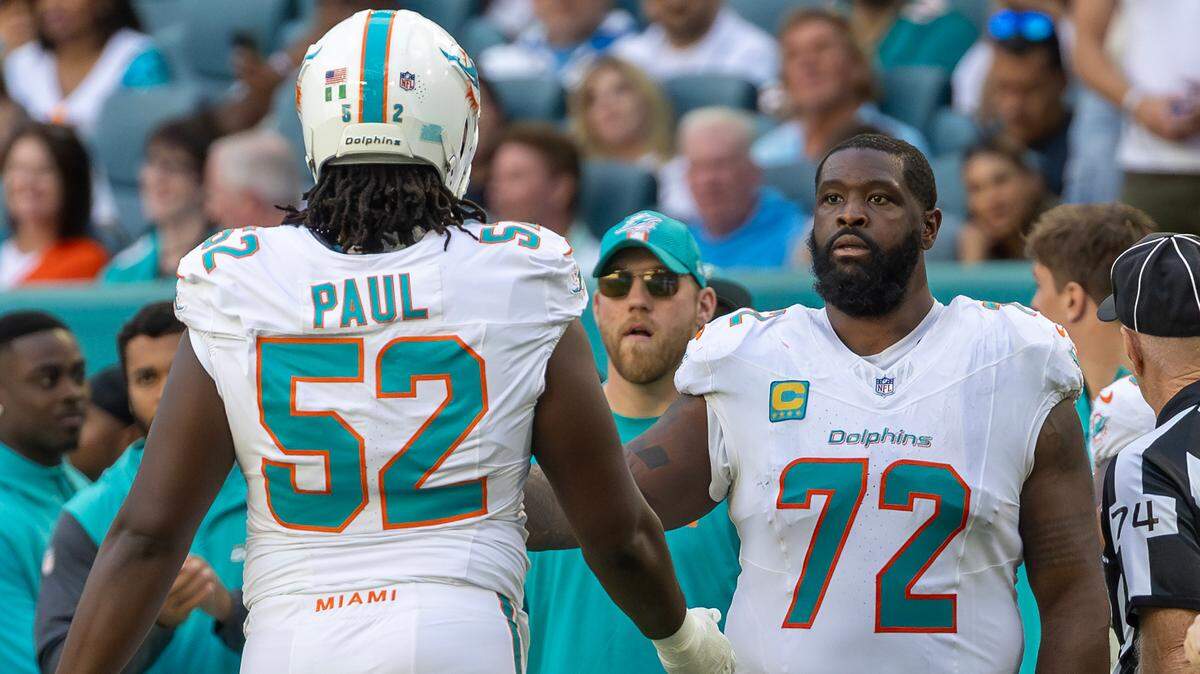
And Patrick Paul, a 2024 second-round pick, played 337 offensive snaps as a rookie, cutting his teeth as an NFL offensive tackle, which will ultimately benefit him down the road because it helps speed up his development. That’s critical considering he’s viewed as Armstead’s understudy and eventual replacement.
During quarterback Tua Tagovailoa’s first absence, which was caused by a concussion he sustained in Week 2, the Dolphins developed a forceful rushing attack. For a five-game stretch of the season Miami averaged 157.2 rushing yards a game, which helped the offense balance out.
Then the Dolphins lost Austin Jackson, the team’s starting right tackle, to a meniscus knee injury in the Nov. 3 loss to Buffalo and the run game vanished. From that point, the Dolphins had a six-game stretch where the team averaged 3.0 yards per carry, and the offensive line consistently got pushed around in games. There were only three games (Green Bay, Cleveland and the second Jets game) where the Dolphins had a respectable rushing attack, gaining more than 100 rushing yards.
▪ The problem: The Dolphins finished 2024 ranked 21st in rushing yards per game (105.6), and 28th in yards per carry (4.0), which is a drastic drop-off from the 2023 season when Miami ranked sixth in rushing yards per game (135.6) and first in yards per carry (5.06). The top priority this offseason should be to figure out how to get back to that level of run game productivity.
That journey starts with figuring out Armstead’s status for 2025. The Dolphins can clear $15 million in cap space if the 33-year-old retires, or gets released with a June 1 designation. The Dolphins are clearly a better team with Armstead, and it’s possible he could take another salary reduction, like the $7 million pay cut he took last offseason to remain in Miami.
That decision becomes complicated if Armstead decides he wants to venture out, and possibly join a contender to make a legitimate title run.
With or without Armstead, whom the Dolphins have expressed a desire to retain, Miami has to upgrade the guard spots because all three starters from last season — Robert Jones, Liam Eichenberg and Isaiah Wynn — struggled in 2024. All three are free agents, and it’s possible one, or maybe more could return. But Miami would be making a massive mistake if it didn’t try to upgrade the interior of the offensive line via free agency or the 2025 NFL Draft.
▪ The possibilities: Butch Barry worked miracles in 2023, transforming an injury depleted unit into one of Miami’s most reliable groups. But the Dolphins offensive line coach dropped the ball in 2024, and probably because he became too attached to the players he was coaching.
The Dolphins need an attitude adjustment, one that can make the team tough and physical, and that mission should start with an overhaul of the offensive line. Targeting free agents such as Mekhi Becton (Eagles) and James Daniels (Steelers) could present an immediate upgrade at guard. Problem is, a quality starting guard will likely cost upward of $8 million a season, if not more.
It might be cheaper and more cost efficient to double down on guards in the draft, targeting players such as Arizona’s Jonah Savaiinaea, Texas’ Cameron Williams and Kelvin Banks, LSU’s Will Campbell, Ohio State’s Donovan Jackson and Josh Simmons, Georgia’s Dylan Fairchild and Alabama’s Tyler Booker are all viewed as top-75 prospects in the 2025 NFL Draft before medicals are scrutinized and Combine workouts are performed. The Dolphins should own 10 picks in the upcoming draft, and three of them are top-100 selections. Six of them are top-150 selections. Hopefully at least two will be used to upgrade the offensive line by adding Year 1 starters, and not developmental projects.