
Where Dolphins rookies stand: Two waiting their turn explain what changed for them
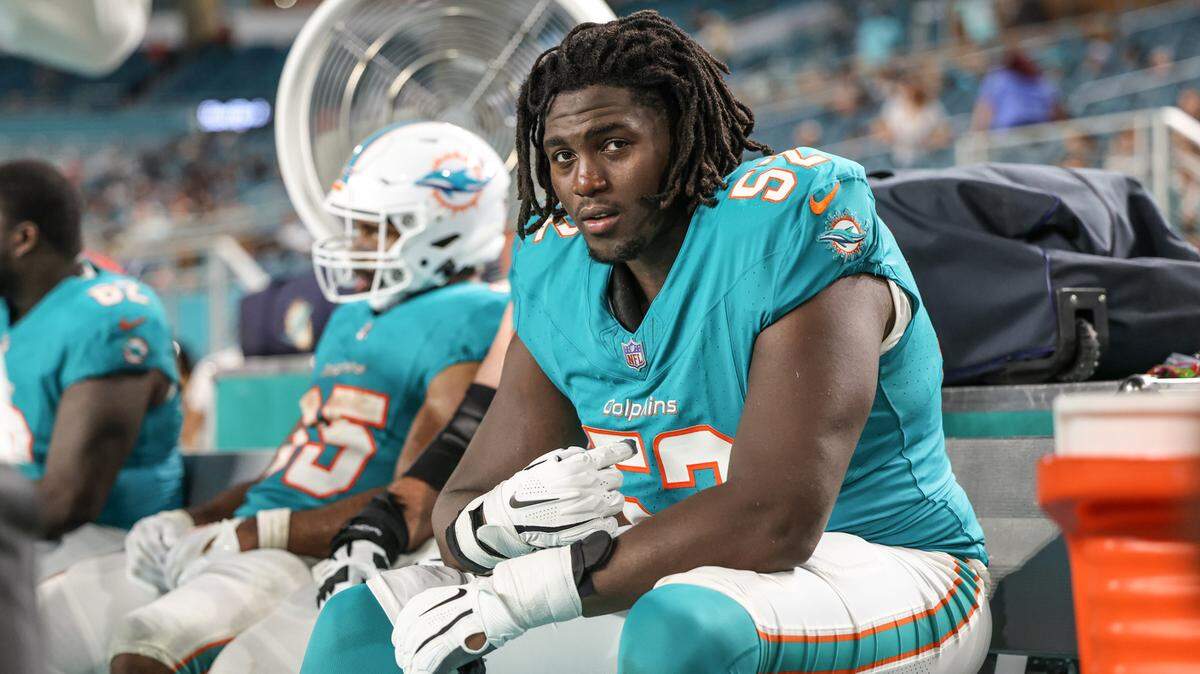
The very early read on the Dolphins’ rookie class? Incomplete.
And that’s not a particular surprise at this stage of the season.
Only two of the seven have played offensive or defensive snaps: first-round pick Chop Robinson and fourth-round running back Jaylen Wright.
Sixth-round receiver Malik Washington has missed the first two games with a quadricep injury.
Sixth-round safety Patrick McMorris is on injured reserve, and the Dolphins must decide whether to make him one of a maximum eight players who can be brought back from injured reserve.
Seventh-round receiver Tahj Washington is out for the year with an injury sustained before training camp.
Second-round pick Patrick Paul -- who has played seven special teams snaps but no snaps on offense -- seems only a break-glass-in-case-of-emergency option as the No. 4 offensive tackle on the roster.
And fifth-round edge rusher Mo Kamara has been a healthy scratch for the first two games.
As for Robinson, the early returns have been modest: 40 defensive snaps, two tackles (including one for loss) and three quarterback pressures in 16 pass rushing snaps.
But this is impressive: Pro Football Focus rates him second best among 20 players who have appeared on defense for the Dolphins in two games, behind only linebacker Jordyn Brooks.
Wright was a healthy scratch in Game 1, was active in Game 2 because of Raheem Mostert’s chest injury but ran for just 4 yards on five carries.
As for Paul, coach Mike McDaniel opted instead to use veteran Kendall Lamm when Terron Armstead left in the second half of the Buffalo game with a shoulder injury.
“I think he’s definitely capable,” McDaniel said of Paul, explaining that decision. “...If t was a different opponent in a different situation, I think I would’ve been more open-minded to [playing Paul].
“In that situation, I think when you are coming off the bench as a rookie for the first time in a division game where there’s a lot of frustration based upon how we were coming into the game as a team with our expectations and then what was happening; I get fearful if I can help it from setting people up in positions of failure.”
Paul said he has worked only at left tackle — and not taken a single snap at right tackle — in practice since joining the Dolphins.
His biggest area of improvement since joining the team?
“My run game [blocking],” he said. “That was a big emphasis during the predraft process. There were a lot of questions about it. In college I wasn’t very productive in the run.”
What did offensive line coach Butch Barry do to help him in that area? “I would say the approach, the mentality, homing in on the actual technique of it all. He has a blueprint of what it’s supposed to look like, and I’m there following the blueprint step by step.”
He said in pass protection, he has improved with hand usage — a priority all offseason.
“Offensive line play is nothing but repetition,” he said. ”It comes with years and years of experience. Like [Barry] told me before, if you keep doing it, it’s going to stick.”
Paul allowed one sack in preseason — as many as he allowed in 565 pass-block snaps at Houston last season, when he had Pro Football Focus’ highest pass-blocking grade among all FBS tackles. He allowed just two sacks in 1,053 pass-block situations during his final two college seasons, after allowing three sacks in 2021.
What could Paul get away with at Houston as a pass protector that’s harder to get away with now?
“In college you can just body people [and get away with] lack of technique,” Paul said. “When I went back and watched my college tape in the predraft process, it was like I was beating people on sheer size.
“In the NFL, they’re technicians. These people are paid to rush the passer. They’re not going to stop once you get your hands on them. They’re going to counter a second time and get there whatever way is possible. It’s a big change.”
Paul, who is 6-7 and 331 pounds, played all of his college snaps at left tackle — 964, 901 and 777 the past three seasons. He made 42 starts in college.
He said he has benefited from attending Tuesday sessions that Terron Armstead arranges for the offensive linemen. On Tuesdays, typically an off day for teams, the offensive linemen come to the facility and work on technique.
“It’s good; he goes through drills that are very specific to what we do on a daily basis,” Paul said. “It’s a big camaraderie thing. He’s manning all of it and getting us right. We [then] eat together, here or sometimes out.”
Kamara, who had 56 tackles (17 tackles for loss) and 13 sacks last season and was named Mountain West Defensive Player of the Year, is the team’s fifth outside linebacker, behind Jaelan Phillips, Emmanuel Ogbah, Quinton Bell and Robinson.
If everyone stays healthy, he could end up sixth when Bradley Chubb returns to form from a Dec. 31 ACL injury.
The biggest difference from rushing in college at Colorado State to rushing in the NFL?
“A lot of people’s techniques are much more defined in the NFL,” Kamara said. “I’ve got to increase my technique. The talent is a tad bit better.
“I’ve got to use my hands way more and do a much better job at that. That’s my biggest thing right now because I am a speedy guy. Another thing is in college, I could watch the ball. I’m used to looking at the bottom of the ball, seeing it move.” He said he can’t get away with that in the NFL.
This story was originally published September 17, 2024 at 10:14 AM.
