Dolphins film study: A dilemma for Miami’s defense and play clock issues
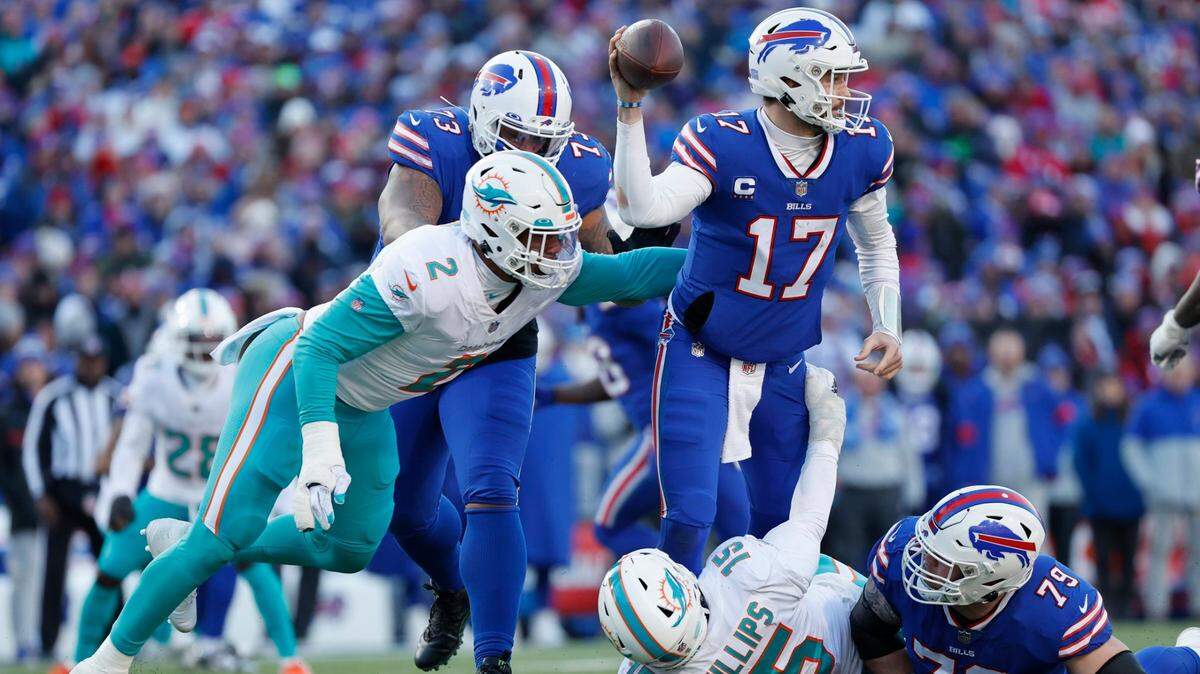
The performance of the Dolphins’ defense in Sunday’s season-ending loss to the Buffalo Bills was a microcosm of what was an up-and-down year for the unit.
Facing quarterback Josh Allen for the third time, defensive coordinator Josh Boyer rotated between an assortment of strategies and had varying degrees of success. Some of his most aggressive play calls, such as the Cover 0 blitz on third-and-15 in the first quarter, were countered effectively. The Dolphins sent eight rushers and Buffalo matched it by keeping all but three eligible receivers to block; Allen found wideout Stefon Diggs 1-on-1 downfield with cornerback Xavien Howard for a 52-yard completion.
But blitzing also led to one of the biggest plays of the game, safety Eric Rowe’s strip-sack and defensive lineman Zach Sieler’s fumble recovery touchdown in the third quarter that gave the Dolphins a 24-20 lead. Rowe was hidden over the tight end and the Bills did not account for him coming off the edge after the snap.
As the game progressed, Boyer dialed back the blitzing, shifting to more zone coverages and fewer blitzes. Both of Allen’s second-quarter interceptions came against zone looks. Howard’s pick was in a Cover 3 defense, while safety Jevon Holland’s came breaking from a deep-half alignment in Cover 4.
Buffalo adjusted, though. On Allen’s 23-yard touchdown pass to wide receiver Gabe Davis in the third quarter, the Dolphins were in a 2-high defense, with Holland and Rowe each occupying deep halves of the field. The Bills ran a Flat-7 route combination on the left side of the field to put Howard in a bind and isolate Davis on Rowe. Diggs ran a flat route to the sideline from the slot, holding Howard underneath, while Davis ran a corner route in between Howard and Rowe. Davis beat Rowe to the corner of the end zone and Allen found him for the score.
Allen was blitzed on 19 dropbacks, according to TruMedia, completing eight of 15 passes for 149 yards, one touchdown and one interception (82.4 passer rating). He was also sacked four times. He wasn’t blitzed on 27 dropbacks and completed 15 of 24 passes for 203 yards, two touchdowns and one interception (99.8 passer rating), while being sacked three times.
Though the Bills scored three 34 points, Allen’s three turnovers were tied for the most he’s had in a game all season. Injuries hampered the Dolphins’ secondary this season, leaving blitz-heavy looks not as effective as years past. Speculation has mounted about potential coaching changes along the defensive staff, which could bring about an overhaul to Miami’s aggressive defensive philosophy. But Sunday’s game was a reminder that a variety of approaches, used in the right situations, are needed to limit a player of Allen’s caliber.
Play clock problems
The Dolphins used all three of their second-half timeouts because of issues getting out of the huddle in a timely fashion. Miami was out of timeouts with 4:13 remaining in the game and unable to avoid a delay of game penalty that pushed the offense back 5 yards for an unsuccessful fourth-down try on its final possession.
Both rookie quarterback Skylar Thompson and head coach Mike McDaniel took the blame for the slow operation. This issue was prevalent throughout the season, regardless of the quarterback playing. According to nflpenalties.com, the Dolphins ranked second in the NFL with eight delay-of-game penalties, including in the postseason.
According to a review of data from play index site nflfastR, 31.9 percent of the Dolphins’ plays in the first, second and third quarter this season, including the wild-card round, were snapped with three seconds or fewer on the play clock, the league’s second-highest rate (Fourth quarters were excluded from the sample to account for clock-draining strategies in end-of-game situations). Only the Green Bay Packers had a higher rate.
The Dolphins ran 69 plays against the Bills on Sunday and 33 came within three seconds on the play clock (47.8 percent), according to nflfastR.
The Dolphins switch through multiple personnel groupings and use pre-snap motion at the highest rate in the NFL, which explains why they often run plays with the play clock winding down. However, McDaniel noted the communication in calling plays is something he will have to improve in his second season as a full-time play-caller.
“There was compounding variables to that, things that you can’t really change in hindsight,” McDaniel said. “There are some things that, as I mentioned before, that I need to work out with the staff. The bottom line is I need to work it out with the staff. So if it became a problem in crunch time, that’s ultimately my responsibility. It wasn’t necessarily for a lack of direction. It was more just really working on the nuances of communication, which starts with me.”