Dolphins film study: What the possible absence of Tua Tagovailoa means for Miami’s offense
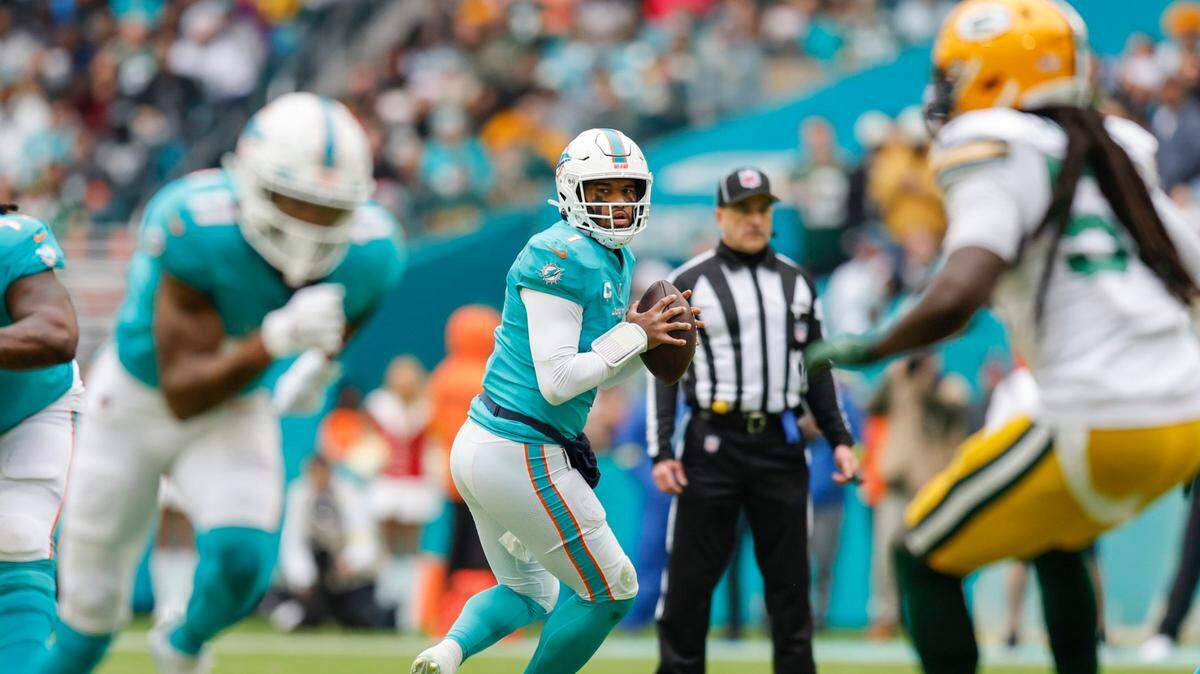
One of the best halves of football Tua Tagovailoa has had recently — a 9-for-12, 229-yard, one-touchdown performance against the Green Bay Packers — was quickly negated by a disastrous fourth quarter.
Three consecutive interceptions from the Dolphins quarterback sunk Miami in a 26-20 loss, the team’s fourth consecutive loss.
Whether Tagovailoa will be able to rebound against the New England Patriots on Sunday remains to be seen. On Monday, Dolphins coach Mike McDaniel announced Tagovailoa had been placed in the NFL’s concussion protocol after reporting symptoms.
McDaniel did not announce a starter for the key road game in Foxborough, Massachusetts; Miami can clinch a playoff berth with a win and a New York Jets loss to the Seattle Seahawks. If Tagovailoa is able to play, he and McDaniel will have to find solutions to the issues that led to the fourth-quarter collapse. If backup Teddy Bridgewater has to step in, McDaniel has to figure out how to keep an offense that has been one of the league’s most efficient units this season functioning.
“You just know that someone goes into the protocol and you have to be ready to really do whatever with that,” McDaniel said Monday. “I know Teddy will prepare as though he’s starting and we’ll see as the week goes.”
Tagovailoa’s three-interception quarter brought back questions — and concerns — about the state of a Dolphins offense that has regressed amid four consecutive losses. Analysts claimed Tagovailoa’s late-game struggles told the story of a quarterback not reading defenses post-snap and instead locking onto certain players. Comments from Packers coach Matt LaFleur aligned with those beliefs.
“We knew [Tua is] a guy that’s going to anticipate, he’s going to let the ball go,” he said after the game. “But if you can read the QB the right way, that also gives you some opportunities defensively.”
McDaniel pushed back when asked about these assertions.
“I think I’d be careful [with] the absolute anything,” he said. “I think the bottom line is in the National Football League, players and coaches shouldn’t be surprised when outcomes aren’t what we’re going for in the first place. So you turn the ball over, you throw three interceptions and you have a fumble; a lot of conclusions can be drawn. It’s fair to draw them, but in my experience, absolutes in those regard or making it that simple; it’s a team game and you have to assess each and every decision, how did it happen? I know there’d be couple throws in particular that he’d love to have back. I know there’s at least one decision that appears to be pretty poor that other guys on the offense would take 100 percent accountability for, so a lot goes into it and I don’t think it’s always that simple.”
Tagovailoa said his first interception was a bad pass that he attempted to get over a Green Bay defender to wide receiver Tyreek Hill. Running back Raheem Mostert accepted the blame for the second pick, saying he ran the wrong route. But on the third and deciding interception, Tagovailoa appeared to stare down tight end Mike Gesicki running a corner route to the sideline from the slot. Cornerback Rasul Douglas, lined up opposite Hill on the boundary appeared to be running with Hill across the field before stepping away and returning to the flat, where he undercut Tagovailoa’s pass. Hill was open over the middle of the field, though it’s unclear where he fell in Tagovailoa’s progression.
“[Douglas] baited them onto that throw,” Green Bay safety Adrian Amos said. “It was a China 7, [corner] route, and he got it.”
Should Bridgewater end up starting, the Dolphins have an experienced quarterback, though one who hasn’t operated Miami’s offense anywhere near the efficiency of Tagovailoa. But Bridgewater’s brief playing time this season has mainly come off the bench. After Tagovailoa was knocked out of the Week 4 game against the Cincinnati Bengals because of a concussion in the second quarter, Bridgewater completed 14 of 23 passes for 183 yards, one touchdown and a late interception on a potential go-ahead drive.
His first start of the season, Week 5 against the New York Jets, was upended after one play; an independent certified athletic trainer (ATC) situated in an upstairs booth said he stumbled and showed signs of ataxia — abnormality of balance/stability, motor coordination or dysfunctional speech — the new “no-go” symptom that bars a player from returning to the game.
Bridgewater returned to the field the next week against the Minnesota Vikings after rookie Skylar Thompson sustained a thumb injury in the second quarter. He completed 23 of 34 for two touchdowns and two interceptions in the 24-16 loss.
Despite the losing streak, Tagovailoa’s expected points per added (EPA) per play, a measure of efficiency that accounts for situational factors such as down, distance and field position, only trail the Chiefs’ Patrick Mahomes among qualified passers, according to analytics website RBSDM.com.
Bridgewater, who has just 60 passing attempts this season, would rank 22nd out of 34 quarterbacks with his small sample size. In his stints this season, Bridgewater has thrown the ball downfield just as aggressively as Tagovailoa. Bridgewater’s average depth of target is 9.3 yards, while Tagovailoa’s is 9.7 yards, though Bridgewater’s accuracy and anticipation could put a cap on the ceiling of the Dolphins’ passing game.
A full week of first-team reps in practice should help Bridgewater as McDaniel has often emphasized the importance of timing in Miami’s offense. And similar to the team’s early-season prep to play without Tagovailoa, Bridgewater’s best friend against a Patriots defense allowing the fifth-fewest points could be a reliable running game and blocking, neither of which he was afforded against the Bengals and Vikings. Two of the team’s three-highest allowed pressure rates this season came against Cincinnati and Minnesota, according to TruMedia. And in those matchups, Miami averaged 3.9 yards per carry.
“I mean, that’s one of the reasons you go and aggressively pursue a player like Teddy Bridgewater,” McDaniel said.