Dolphins draft preview: Is there room for another running back on the roster?
At the NFL Scouting Combine in February, Dolphins coach Mike McDaniel spoke about the importance of the running back position to him. The Dolphins then reaffirmed those comments by signing two veteran backs, Chase Edmonds and Raheem Mostert. With their additions, the return of Myles Gaskin and Salvin Ahmed, and the game-planning of McDaniel, who devised one of the most unique rushing offenses with the San Francisco 49ers, the Dolphins are hoping to improve a unit that ranked 30th in rushing yards. Could there be room for another player in a crowded backfield?
What do the Dolphins need?
The Dolphins’ additions to the backfield, which also includes fullback Alec Ingold, indicate the team likely won’t have a running back among one of their top draft needs. However, McDaniel’s past as run game coordinator and then offensive coordinator with the 49ers suggest the Dolphins’ rushing offense will be more reliant on a committee than a bell cow. With only Edmonds signed past the 2022 season, the Dolphins could opt to add a young back who fits in McDaniel’s zone running scheme.
In the zone scheme, running lanes aren’t predetermined and are instead located by the running back as the offensive line moves laterally and the play develops. An ideal back would have the patience to allow the play to materialize, the vision to find the hole plus the footwork and quickness to cut into the lane, accelerate and make the most out of the run.
Here are the running backs the Dolphins could target in the draft:
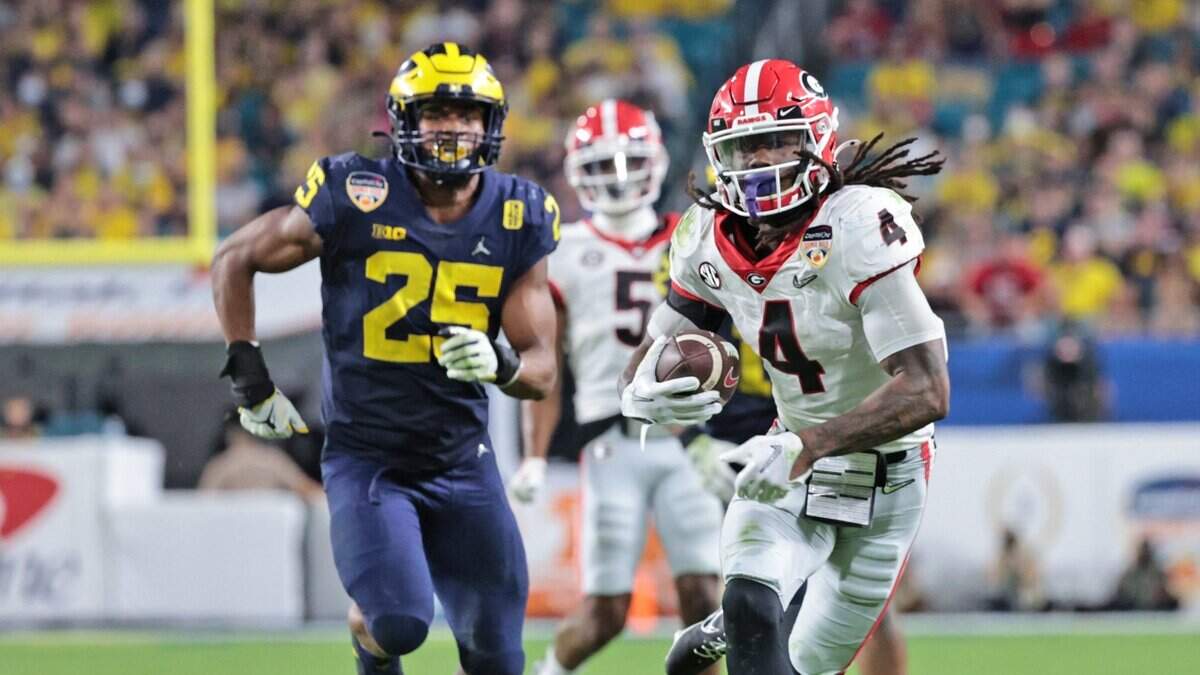
Georgia’s James Cook
Why he’d fit: Cook, a former standout at Miami Central, wouldn’t project as your typical running back but a do-it-all Swiss Army knife. He has excellent route-running skills and would slot as a unique piece in a McDaniel offense that he has said will be tailored to the skill set of his players.
Why he might not: Cook doesn’t have the ideal size to handle a rigorous workload in the NFL and wasn’t known for breaking tackles in college. His slimmer build also gives him some trouble in pass protection.
Projection: Round 3-4
South Dakota State’s Pierre Strong
Why he’d fit: Strong was extremely productive in South Dakota State’s zone scheme, finishing with more than 4,500 rushing yards over four seasons. He’s an explosive runner who recorded 76 runs of 15 or more yards, according to Pro Football Focus.
Why he might not: Any time you come from a Football Championship Subdivision program, the level of competition and how that will translate to the NFL comes into question. Strong had some production as a receiver but ball security, from fumbles to drops, was an issue at times.
Projection: Round 4
Georgia’s Zamir White
Why he’d fit: White paired with Cook in the backfield at Georgia, serving as a powerful, physical runner who could break tackles. There’s a speed element to White’s game, too — he ran a 4.4 40-yard dash at the combine — and he has a good feel for cutback lanes, along with the ability to hit them quickly.
Why he might not: With Cook serving as the team’s primary third-down back, White doesn’t have much college production as a receiver. While fast, White’s not as elusive as other backs in the draft and he has a history of knee injuries that may need to be vetted.
Projection: Round 4
Baylor’s Abram Smith
Why he’d fit: Smith, 5-11 and 213 pounds, is a physical, straight-line runner who played in a zone scheme at Baylor. He comes into the NFL with extensive special teams experience and is regarded as an unselfish, team-first player after switching from running back to linebacker in the middle of his college career.
Why he might not: Smith isn’t an elusive back, doesn’t offer much upside as a receiver — he caught 14 passes in college — and needs to improve his technique in pass protection. The position switch limited him to just one full season — his senior year — of production at running back.
Projection: Round 5
LSU’s Tyrion Davis-Price
Why he’d fit: Davis-Price, who had a predraft visit with the Dolphins, is a physically imposing back who offers a combination of size — 6-0, 211 pounds — and speed, running a 4.48 40-yard dash at the combine. He churns out yards, fighting through tackles, and is proven in pass protection.
Why he might not: Davis-Price is not known for making defenders miss in the second level and his feel for running lanes can be inconsistent. He also didn’t produce much as a pass-catcher and had some troubles with ball security.
Projection: Round 5-6
This story was originally published April 25, 2022 at 8:41 AM.