
Former Heat star Bosh said he’s ‘lucky to be alive’ after waking up in blood
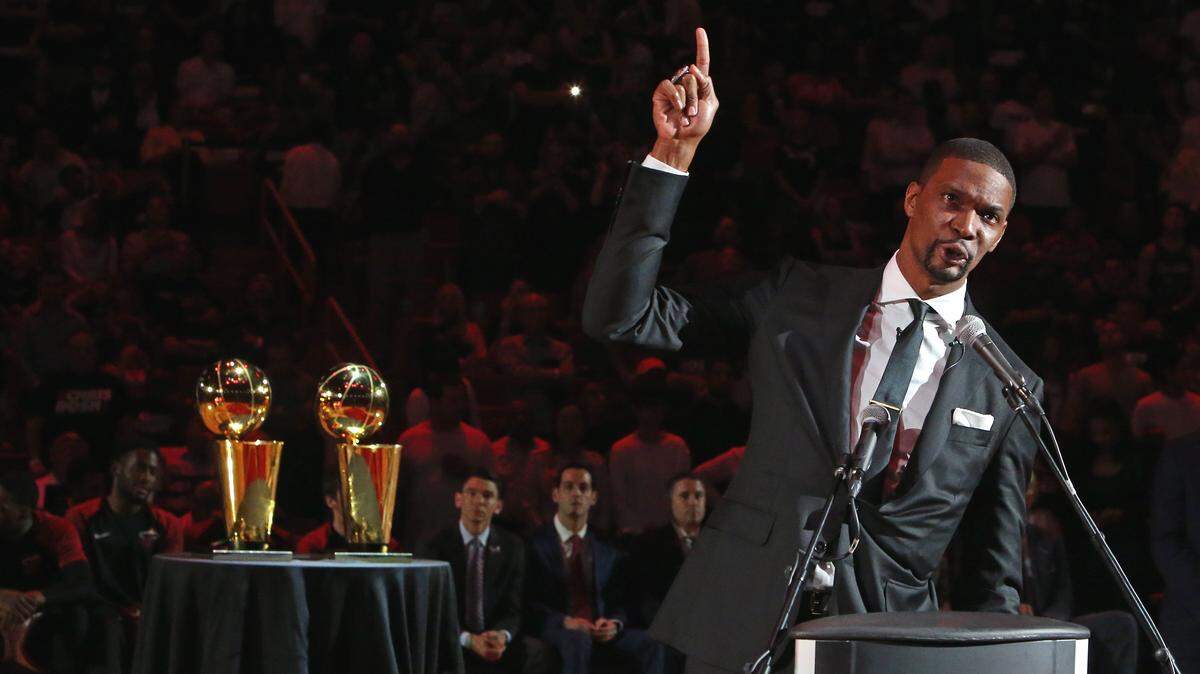
Former Heat All-Star Chris Bosh, whose NBA career ended prematurely because of blood clots, said Wednesday that he’s “lucky to be alive” after recently collapsing and waking up in his own blood.
In a video posted on X, Bosh did not say what caused the medical emergency — or whether it was related to his history of blood clots — but said “I went to the darkness and I came back. I have no recollection. I have no memory other than coming back here.”
An associate reached Wednesday said Bosh had not shared any medical details with him. The Heat has maintained a good relationship with Bosh but also had no information on the nature of his health scare.
Bosh, 41, taped the video from behind the wheel of a car; he had visible bruises under his eyes.
“So, I woke up covered in my own blood,” Bosh said. “It was crazy. It was fast. It was instant. There was no warning. I didn’t have any time to prepare for it. I was getting ready to go on a date with my wife. And the next thing you know I was on the ground. I won’t get into specifics. But you can kind of see, I’m still recovering. I’m not going to try to hide that one in case I look different. But it was a scary thing, and it came fast.”
Bosh spoke of perspective gained from the incident.
“It made me really have a different outlook on life in how things go, what we do for ourselves, what we do for our family, how we live our lives,” he said. And no matter what it is, make sure you don’t wait. That’s the thing that I get from this. Don’t wait to take action because it could come fast, it could come quick. And I’m lucky to be alive, and I feel great about that.
“Now, I’m thinking about how I live my day-to-day life. That’s really it. But don’t wait. Don’t wait to take action. You might be wanting to get a promotion. You might want to try out for the team. You might want to go on that vacation. It might be so many different things that people want to do that we want to do that we never do.
“So that’s what I get from all of this. Don’t wait for it. You might want to start a business. Don’t wait, just do it. You might hit the deck. I don’t know, I’m lucky. I came back. It was just darkness. It wasn’t anything else.”
Bosh —-who won two championships and appeared in four NBA Finals playing alongside LeBron James and Dwyane Wade during the team’s Big 3 era — was essentially forced to retire after being diagnosed with multiple blood clots in 2015 and 2016.
After James left the Heat to return to the Cleveland Cavaliers, Bosh re-signed with the Heat on five-year, $118 million contract in July 2014. But after playing in the 2015 All-Star Game, Bosh was admitted to a Miami hospital after experiencing chest pains and difficulty breathing. He was diagnosed with a blood clot on one of his lungs and was ruled for the season.
Bosh returned to begin the 2015-16 season and averaged 19.1 points in 53 games, but a blood clot in his leg sidelined him for the final two months of the regular season and the Heat opted not to bring him back for the playoffs out of caution. He never played another NBA game after a Feb. 9, 2016, appearance against San Antonio.
Bosh wanted to resume playing at the start of the 2016–17 season, and the organization was cautiously optimistic he would be cleared for training camp.
But clotting issues persisted, Bosh failed a physical in September 2016, and Heat president Pat Riley announced that Bosh’s career with the team was over. The Heat, concerned about the risks of Bosh playing while taking blood-thinning medication, agreed in May 2017 to pay Bosh his full salary for 2017-18, but without it counting against the salary cap.
In June 17, the NBA ruled that Bosh’s blood clotting issues were a career-ending illness, which allowed the Heat to remove his contract from its salary cap once they officially released him, which happened two days later.
Bosh attempted to return to the NBA in February 2018, but no team signed him, and he gave up those efforts after a year.
The Heat retired Bosh’s No. 1 jersey on March 26, 2019. Since then, he briefly dabbled in broadcasting for ESPN.
Bosh, an 11-time All Star, averaged 19.2 points and 8.5 rebounds in 893 NBA games over 15 seasons.
When the Heat’s “Big 3” came together in July 2010 in one of the most-ballyhooed set of transactions in NBA history, Bosh, Wade and James each accepted $15 million less than the maximum permitted in multiyear contracts, leaving Miami with enough cap room to retain Udonis Haslem and facilitate their partnership under NBA salary cap rules.
Bosh opted out of the final two years of his original six-year, $110.1 million deal to become a free agent in July 2014. He considered overtures from Houston and others before re-signing with Miami.
This story was originally published February 25, 2026 at 3:56 PM.
