After trade of Highsmith and signing of Smith, where do things stand for Heat’s roster?
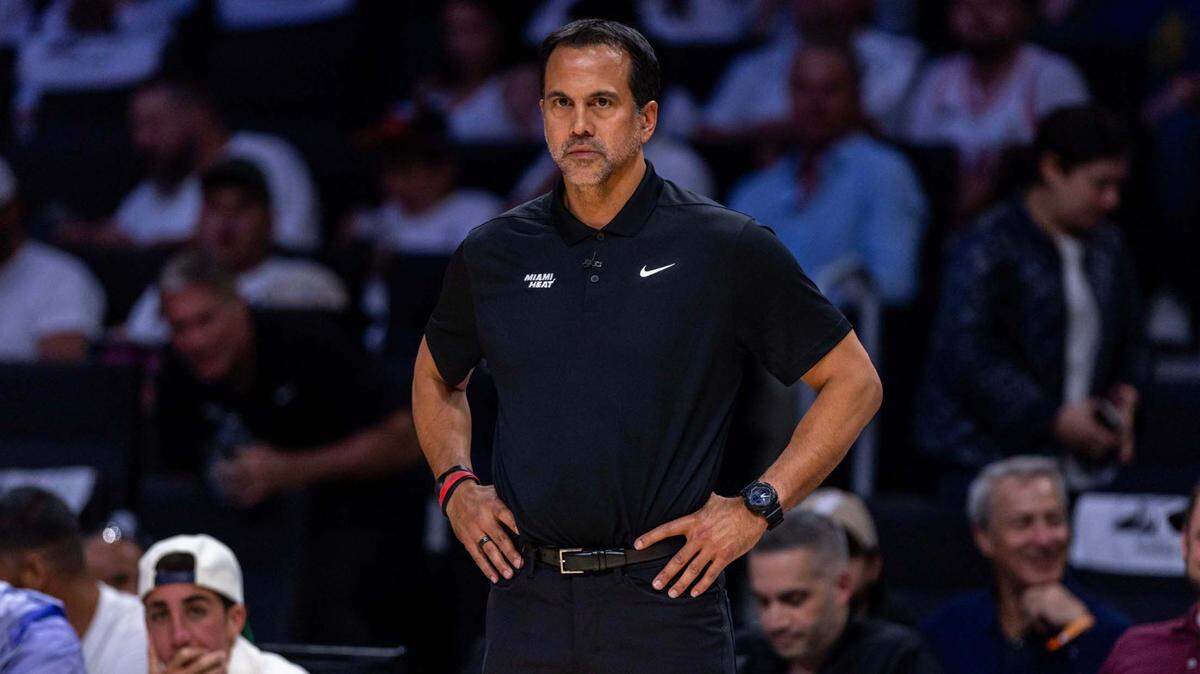
After being eliminated in the first round of the playoffs in each of the last two seasons and finishing last regular season with a losing record for just the sixth time in team president Pat Riley’s 30 seasons with the organization, the Miami Heat continued to shake up its roster last week.
First on Friday, the Heat traded forward Haywood Highsmith and a 2032 second-round pick to the Brooklyn Nets for a heavily protected 2026 second-round selection in a move that shed enough salary to bring Miami out of luxury-tax territory.
Then on Saturday, the Heat used its newfound room under the luxury tax to retain guard Dru Smith on a three-year contract worth $7.9 million. Only Smith’s first-year salary of $2.4 million is fully guaranteed, with the second and third years of the deal including conditional guarantees.
Following the trade of Highsmith and the signing of Smith, the Heat has 14 players on standard contracts for this upcoming season — one below the NBA regular-season limit of 15 players on standard deals.
The Heat also currently stands about $1.7 million under the luxury-tax threshold and about $7.2 million below the punitive first apron of $195.9 million that it can’t cross until the end of this upcoming season following last month’s trade for guard Norman Powell.
After finishing as a luxury tax team in each of the past two seasons, the Heat was determined to escape the luxury tax for this upcoming season in order to avoid the onerous repeater tax that’s triggered when a team crosses the luxury-tax threshold in four straight seasons or four times during a five-season period.
With the Heat six weeks from opening training camp on Sept. 30 at Florida Atlantic University in Boca Raton, here’s an explainer on where things stand for Miami’s roster ...
Q: Can the Heat fill the 15th spot on its standard roster before the season without crossing the luxury tax line?
A: No, the Heat doesn’t currently have enough space under the luxury tax threshold to add a 15th player to a standard contract before the start of the season while still avoiding the tax.
With the Heat just about $1.7 million below the luxury tax line, Miami would need to wait until early December to sign a 15th player to a prorated standard minimum deal that would keep it out of tax territory unless a move is made to change the salary-cap math.
Q: What can the Heat do to create enough room under the luxury tax to add another player to a standard deal before the start of the season?
A: A trade to shed salary (like the one the Heat pulled off involving Highsmith last week) would work.
But a trade isn’t the only way, as the Heat can also use the waive-and-stretch provision on a player such as Rozier to create more room below the luxury tax. Waiving and stretching Rozier would lower his cap hit from $26.6 million this upcoming season to about $8.3 million over each of the next three seasons, but the downside of that would be that he would go from an expiring salary to one that would be on Miami’s books for the next three years, albeit on a smaller number. The deadline to waive and stretch a player is Aug. 29.
The Heat could also just waive Rozier and create an additional $1.7 million of room below the tax line because only $24.9 million of Rozier’s $26.6 million salary for this upcoming season is currently guaranteed. This would give Miami enough space under the luxury tax threshold to add another player to a standard contract before the start of the season.
Q: Can the Heat just begin the season with only 14 players on standard contracts instead of the NBA regular-season limit of 15 players on standard deals?
A: Yes, NBA teams are allowed to carry 14 players on standard contracts during the regular season. NBA rules only prohibit teams from carrying fewer than 14 players on its standard roster for more than two consecutive weeks at a time and a total of 28 days during the regular season.
But there is one disadvantage that comes with having just 14 players on standard deals, as those NBA teams’ three two-way contract players can only be on the active list for no more than 90 NBA games combined. However, if the Heat signs a 15th player at any point during the season, that number moves from 90 to 150 NBA games.
Q: Where does the Heat’s roster stand right now?
A: Following Friday’s trade, the Heat’s preseason roster currently includes 17 players signed to contracts (including two-way contracts and Exhibit 10 deals).
The 14 players signed by the Heat to standard contracts for next season are Bam Adebayo, Tyler Herro, Andrew Wiggins, Rozier, Powell, Davion Mitchell, Simone Fontecchio, Nikola Jovic, Kel’el Ware, Jaime Jaquez Jr., Kasparas Jakucionis, Pelle Larsson, Smith and Keshad Johnson.
The Heat’s two-way contract players are forward Myron Gardner and center Vlad Goldin, with the third two-way slot still open to sign another developmental prospect. Two-way contracts, which pay half the NBA rookie minimum and do not count toward the salary cap or luxury tax, allow for players to be on their NBA team’s active list for as many as 50 regular-season games with other game action having to come in the G League.
The only player the Heat currently has signed to an Exhibit 10 contract is guard Ethan Thompson. Exhibit 10 deals essentially represent an invite to training camp and provide a financial incentive for that player to join the organization’s G League affiliate.
While 18 players (15 on standard contracts and three on two-way contracts) is the regular-season limit, NBA teams are allowed to carry up to 21 players during the offseason and preseason (including up to three two-way contract players).
Q: With the Heat so thin at center, what are Miami’s options to bolster its depth at that position?
A: The only centers on the Heat’s current standard roster are Adebayo and Ware, and there’s a real chance both are in the starting lineup to begin the season. Yes, the Heat could stagger their minutes to use them as their two centers throughout most games. But what if there’s an injury or foul trouble?
Goldin, an undrafted rookie who stands at 7-foot-1 and 250 pounds, is the Heat’s third center, but he’s on a two-way deal. Goldin brings size, but he’s also inexperienced and unproven in the NBA.
To add more depth, the Heat could use its one open two-way contract slot to sign another big man. Only players with fewer than four years of NBA experience are eligible for two-way deals
The Heat could also make a trade, waive and stretch a player or waive Rozier to change the salary-cap math and create enough room under the luxury tax line to add another center on a standard contract. Among the bigs still available in free agency are Kai Jones (who worked out for the Heat last week), Trey Lyles, Precious Achiuwa and Thomas Bryant.