
What if Heat loses Butler next summer? Where that would leave Heat, according to cap rules
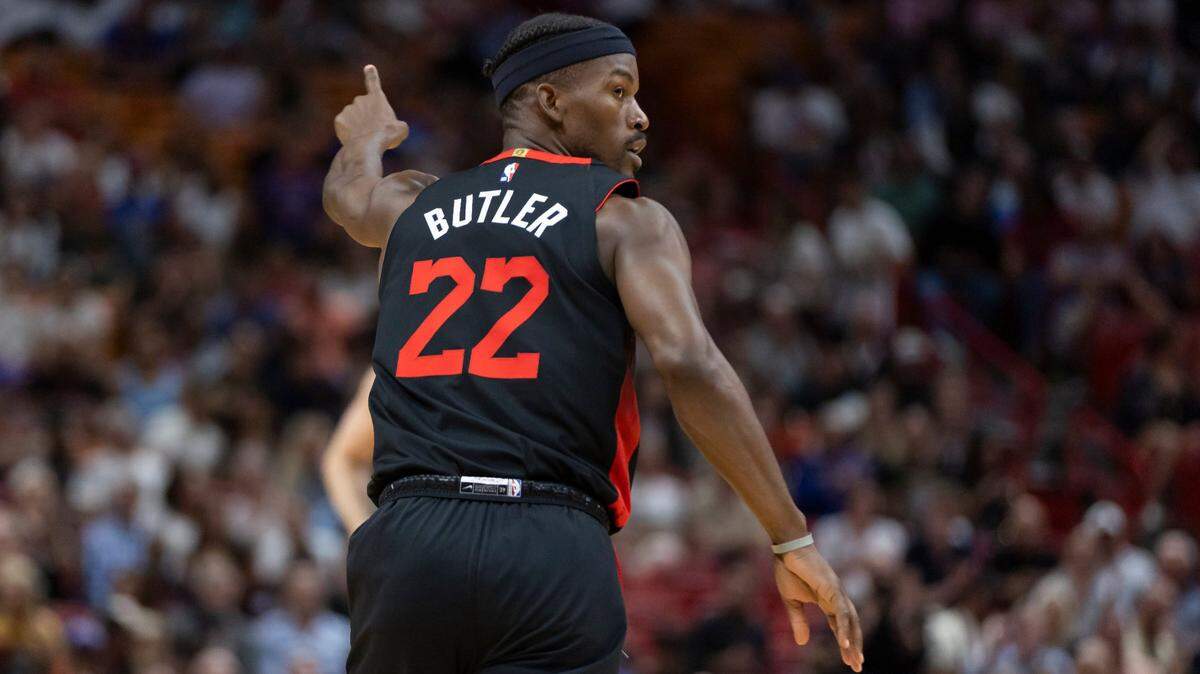
Part 1 of a series
The Heat will be taking a risk if it goes past next February’s trade deadline with Jimmy Butler on its roster, in light of Butler’s intentions (at least for now) to opt out next summer and not sign an extension with anybody in the next 12 months.
(To be clear, Butler has not said this publicly, but The Athletic reported that’s his intention and the Miami Herald and others have been told likewise.)
Very few teams (aside from teams in rebuilds) could realistically clear out the cap space to sign Butler to a max deal or anything close to it without the Heat’s assistance to help facilitate a sign-and-trade. So a sign-and-trade is the more likely outcome if Butler leaves the Heat next summer. The chances of the Heat losing Butler for nothing aren’t high, though not out of the question.
But here’s the problem if the Heat ultimately loses Butler for nothing: Miami wouldn’t have the cap space to come close to adequately replacing him.
With its current roster, the Heat would have no more than $13 million in cap space to replace Butler if he leaves in free agency next July. Realistically, Miami likely would have a bit less than that.
Here’s how the math works:
If Butler carries through with intentions to become a free agent next summer (with the Heat holding no right to match offers), Miami would have 10 players under contract for 2025-26 if it doesn’t trade one of the 10 in the months ahead: Bam Adebayo ($37.1 million), Tyler Herro ($31 million), Terry Rozier ($26.6 million), Duncan Robinson ($19.9 million), Jaime Jaquez Jr. ($3.9 million), Nikola Jovic ($4.4 million), Kevin Love ($4.1 million), Haywood Highsmith ($5.7 million), Pelle Larson ($1.9 million) and Kel’el Ware ($4.5 million).
That adds up to $139.1 million. Cap holds - required by the NBA to fill open roster spots up to 12 - would add another $2.4 million to Miami’s cap, leaving the Heat at $141.5 million in commitments.
The 2025-26 cap is projected to be $154.6 million, per ESPN’s Bobby Marks.
So that’s just $13 million in cap space -- not nearly enough to add an All Star -- if Butler simply signs elsewhere. Miami could create $10 million more in space by waiving Duncan Robinson, who has only $9.8 million guaranteed in 2025-26. But waiving Robinson would be poor asset management and likely not worth the net loss.
That $13 million is actually comparable to the $13.5 million exception that teams above the cap (but below the tax line) would have in the summer of 2025.
So what could the Heat realistically get with $13 million in space? Likely nobody who would move the needle. But here are three bits of good news in the Butler-bolt scenario:
▪ No serous title contender would have the ability to sign Butler into space next summer without moving significant money. A few promising teams would. (More on that in part 2.)
▪ If Butler surprisingly leaves for nothing and Miami uses cap space, the Heat would have an $8.4 million room exception given to teams that use cap space. The Heat could use that exception after spending up to the cap.
▪ Miami would be more than $50 million below the first apron and could do a sign-and-trade for a 2025-26 free agent.
Players in line to become free agents in 12 months who are not max players but could command something well above the minimum include Lakers guard D’Angelo Russell, Milwaukee Bucks players Brook Lopez, Bobby Portis and Khris Middleton; Atlanta center Clint Capela; Boston center Al Horford; Nets wing Ben Simmons; Oklahoma City guard Alex Caruso; Cavaliers guard Caris LeVert; Detroit guard Tim Hardaway Jr.; Indiana guard T.J. McConnell; Minnesota center Naz Reid; Clippers guard Terance Mann and center Ivica Zubak; Washington guard Malcolm Brogdon.
Players who could command deals closer to the max next summer, if they don’t sign extensions first, include Dallas guard Kyrie Irving (if he opts out of $43.9 million for 2025-26); Knicks players Jalen Brunson and Julius Randle; New Orleans forward Brandon Ingram; Denver guard Jamal Murray, Denver forward Aaron Gordon (if he opts out of $22.8 million for 2025-26); Indiana center Myles Turner, and Utah center Lauri Markkanen. In this no-Butler scenario, the Heat wouldn’t have nearly enough cap space to sign any players from this group into cap space but would have the ability to make sign-and-trades for any of them, should they be available and wish to come to the Heat.
Keep in mind that the Heat potentially would have $24 million in cap space next summer if it hadn’t given Love $4.1 million guaranteed in 2025-26 and another $5.7 million to Highsmith, who had no two-year offers on the table when he agreed to a two-year, $11 million deal with Miami on Monday.
Because Miami will have Butler’s Bird rights and can exceed the cap to re-sign him, it’s certainly very conceivable, if not likely, that the Heat could do a sign-and-trade involving Butler for a player under contract to another team, or involving one of the aforementioned free agents (such as Randle, hypothetically).
But in these types of sign and trades, the return to the team trading the player usually isn’t nearly as good as the quality of the player being signed. As an example, the 76ers received only Josh Richardson in the four-team sign-and-trade that sent Butler to Miami.
Golden State received only 2025 and 2031 second-round picks in the sign and trade that sent Klay Thompson to Dallas.
So sign-and-trade scenarios, while allowing Miami to get similar salary back, likely won’t bring an All Star player back to Miami.
Keep in mind that teams over the first apron can’t make sign-and-trades, which would eliminate that route as an option for some teams to acquire Butler.
And what if Butler -- who wasn’t given the contract extension that his representation originally sought this summer -- doesn’t want to help the Heat and decides to sign into another team’s cap space? That’s possible but unlikely.
Either way, the Heat likely needs to seriously explore trading Butler if Miami is at or barely above .500 near the trade deadline and if Heat executives and ownership decide that they don’t want to give Butler a lucrative extension into his late 30s.
This story was originally published July 8, 2024 at 4:01 PM.
