East finals preview: How does new Celtics starting group change things? A key for Heat and more
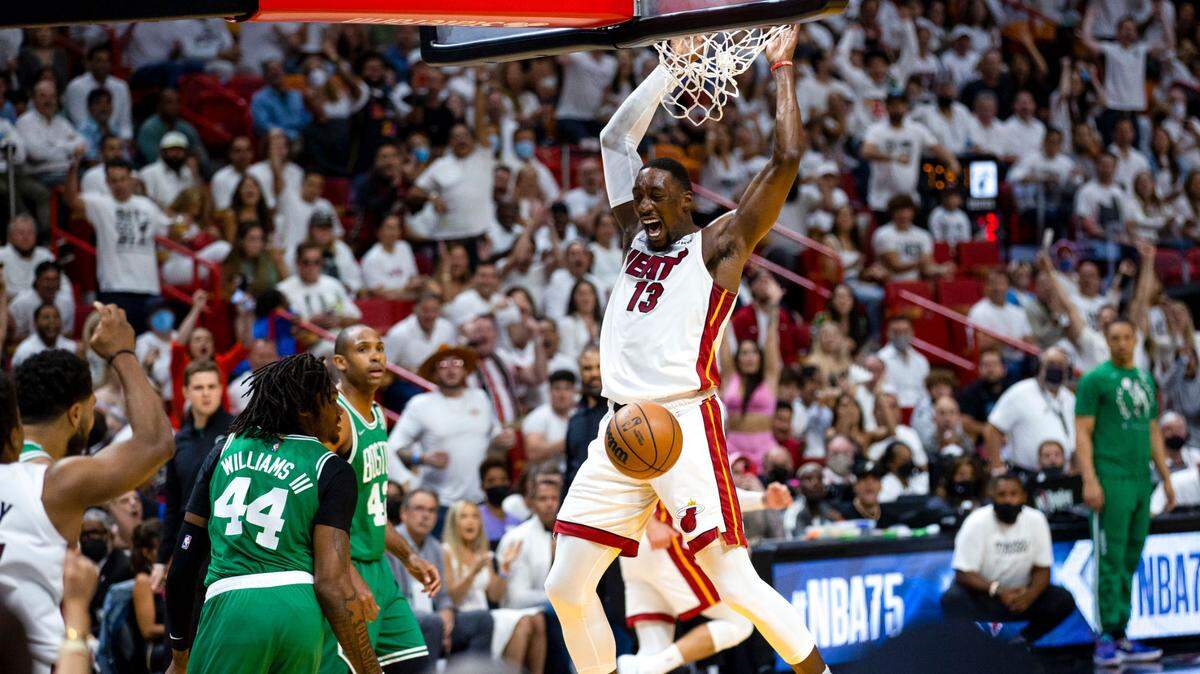
The Miami Heat and Boston Celtics have been here before. Three times in four years to be exact.
The eighth-seeded Heat and second-seeded Celtics are about to meet in the Eastern Conference finals for the third time in the last four seasons. Game 1 is Wednesday at TD Garden (8:30 p.m., TNT).
The Heat and Celtics split their regular-season series 2-2 this year.
Here are five questions surrounding the matchup, with answers on what to expect in the Heat-Celtics series:
Will the Celtics start big or small?
The Celtics have opened games with a small starting lineup of Marcus Smart, Derrick White, Jayson Tatum, Jaylen Brown and Al Horford for most of the regular season and playoffs. It has been a successful combination, outscoring opponents by 12.2 points per 100 possessions in 432 minutes in the regular season and 1.3 points per 100 possessions in 156 minutes in the postseason.
But the Philadelphia 76ers found some success against this group in the second round, using the dynamic pick-and-roll duo of Joel Embiid and James Harden to take advantage of the Celtics’ lack of size. In the 75 minutes this lineup logged in the second round, the Celtics were outscored by 9.3 points per 100 possessions.
So Boston made an adjustment, moving the 6-foot-9 Robert Williams into the starting lineup for the 6-4 White for the final two games of the series after falling into a 3-2 hole.
The changed ended up working to slow the Harden-Embiid pick-and-roll, as the Smart-Tatum-Brown-Williams-Horford lineup outscored the 76ers by 19.8 points per 100 possessions in 47 minutes together in the second round. More importantly, the Celtics won both games they used this new starting lineup to rally from a 3-2 deficit to take the series.
On Tuesday, Celtics coach Joe Mazzulla said he will stick with the double-big lineup for the start of the East finals.
This decision makes the matchups a bit cleaner for the Heat’s preferred starting lineup of Gabe Vincent, Max Strus, Jimmy Butler, Kevin Love and Bam Adebayo
Love could start on Horford and Adebayo can guard Williams, leaving Butler and Strus to guard Tatum and Brown and Vincent to defend Smart. Or the Heat could use a strategy it deployed during last year’s East finals, having Strus defend Horford to allow Adebayo to guard either Brown or Tatum.
But if the Celtics go back to the small starting lineup at some point in the series, Love would likely still begin the game on Horford but that would leave Adebayo to potentially open as Tatum’s primary defender. That would take Adebayo away from the rim and prevent him from serving as a help defender.
“There’s notable versatility on both rosters and styles of play that each team can get to something a little bit different based on what’s the need for that series or that game,” Heat coach Erik Spoelstra said.
What should be the Heat’s biggest concern against the Celtics?
Keeping up with the Celtics’ elite three-point shooting.
Boston closed the regular season with the second-most made threes in the NBA behind only the Golden State Warriors, recording the league’s sixth-best team three-point percentage (37.7 percent) on the second-most attempts (42.6 per game).
The Celtics are also shooting an NBA-best 39.5 percent from beyond the arc in this year’s playoffs.
And when Boston makes a high percentage of its threes, it usually wins. The Celtics are 36-2 this season when they shot 40 percent or better from three-point range and 29-28 when they shoot under 40 percent from deep.
Considering the Heat gives up a lot of three-point attempts because its defensive scheme is built to limit opportunities around the rim, the Celtics’ three-point shooting could help decide many of the games in this series.
On the other side, the Heat finished the regular season with the NBA’s fourth-worst team three-point percentage (34.4 percent) but has been better in the playoffs with a team three-point percentage of 36.8 percent. Miami will need to be an efficient three-point shooting team in this series to keep up with Boston.
What is an underrated aspect of the matchup that could help the Heat win the series?
Forcing turnovers. The Heat’s defense is at its best when its disruptive and forcing turnovers, creating easy points for itself.
The Heat closed the regular season with the NBA’s fourth-highest opponent turnover rate (percentage of opponent possessions that end in a turnover) at 16.3 percent.
Meanwhile, the Celtics don’t usually commit many turnovers. Boston finished the regular season with the NBA’s seventh-lowest turnover rate (percentage of a team’s own possessions that end in a turnover) at 13.1 percent.
Something has to give.
“That’s where we find our strength on defense and we’ll keep being the aggressor,” Strus said of the importance of forcing turnovers. “That’s what we’ve built this whole playoff run on is our defense and rebounding. We have to keep doing that if we want to win.”
In last season’s East finals, the Celtics averaged just 12.3 turnovers per game in their four wins against the Heat and 19.3 turnovers per game in their three losses to the Heat.
“They’re a good ball control team and we’re at our best when we’re disruptive,” Spoelstra said.
Can the Heat continue to win the non-Jimmy Butler minutes against the Celtics?
The Heat has won more than a few games this postseason because of Butler’s greatness, but the Heat has also earned a bunch of playoff wins during this run because of how it has fared in the time Butler has spent on the bench.
The Heat has outscored teams by an eye-opening 14.7 points per 100 possessions when Butler hasn’t been on the court in this year’s playoffs. In the regular season, opponents outscored the Heat by 2.7 points per 100 possessions when Butler wasn’t playing.
Can the Heat continue to dominate the non-Butler minutes against a very talented Celtics roster? Probably not to that level, but it will be important for Miami to at least survive when Butler isn’t on the court.
The Heat’s bench, led by Kyle Lowry and Caleb Martin, has been a revelation this postseason. Miami’s reserves combined to outscore the New York Knicks’ bench 183-90 in the second round.
Will injuries help determine the winner of this series?
It could, but that would probably be bad news for the Heat because the Celtics enter the East finals as the healthier team.
The only player on the Celtics’ injury report is expected to be forward Danilo Gallinari, who has not played this season after tearing his ACL in August.
The Heat, though, are down two rotation players. Miami enters the conference finals without starting guard Tyler Herro and reserve guard Victor Oladipo.
The Heat lost Herro to a broken right hand in Game 1 of the first round and he’s not expected back until the NBA Finals, at the earliest. Oladipo will miss the rest of the playoffs after tearing the patellar tendon in his left knee in Game 3 of the first round.
Herro’s scoring and shot creation would be useful against a quality Celtics defense. Herro closed the regular season as the Heat’s third-leading scorer behind only Adebayo and Butler.
Oladipo’s defense could have also been a factor in this series. In last year’s East finals against the Celtics, Oladipo spent 87 possessions as Brown’s primary defender and 57 possessions as Tatum’s primary defender.
Then there’s the nagging injuries Adebayo (hamstring and shoulder) and Butler (ankle) are dealing with. Both Adebayo and Butler are expected to be available for the start of the conference finals, but all eyes will be on how healthy they look.