
Here’s how James Jones, a quiet kid from Miami Gardens, became GM of the Phoenix Suns
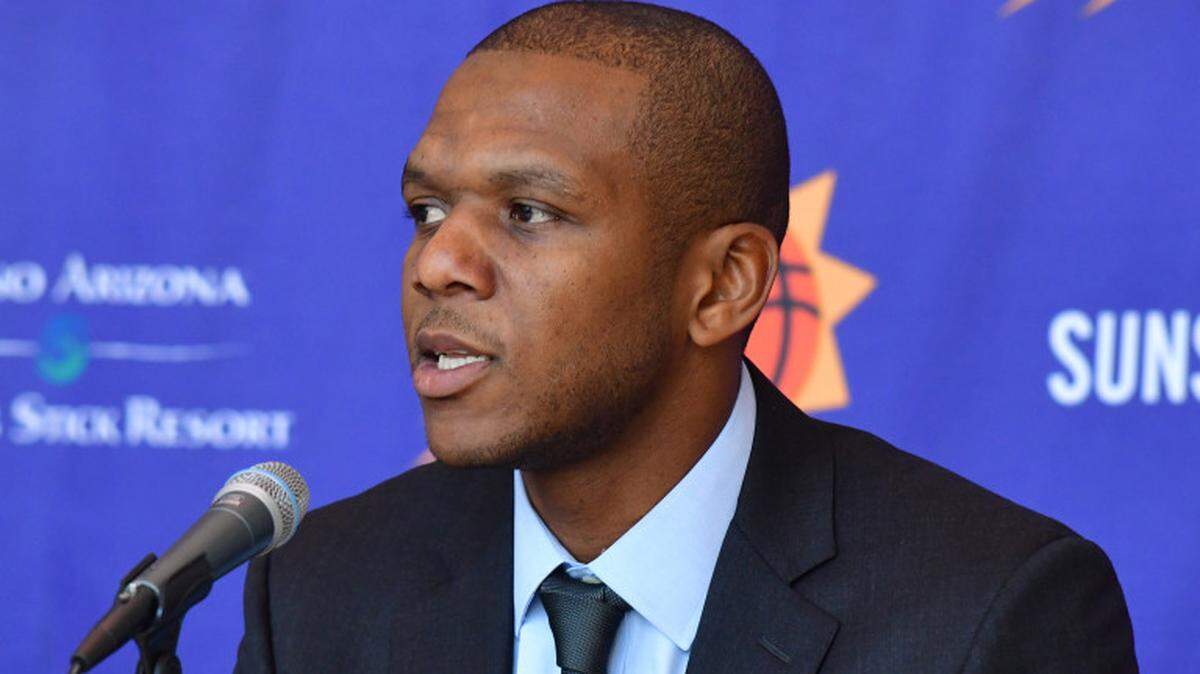
There were signs that James Jones was destined for something special when he was a tall, lanky kid in Miami Gardens playing on the big baskets behind North County Elementary and later as a scholar-athlete at American High and the University of Miami.
But nobody — least of all Jones himself — imagined that by age 40 he would have a finance degree, three NBA championship rings, a job as general manager of the resurgent Phoenix Suns and be a leading candidate for 2021 NBA Executive of the Year.
“If you had asked me, a young Black kid from Miami Gardens, if I want to be an NBA general manager, I would not have thought that was possible,” Jones said. “There were lots of players who looked like me, but not GMs. I hope me being in this position lets some kid in Miami know that they have a chance. It’s possible.”
However, he said, it would not have been possible without tough love from his mother, Jennifer Jones Harris, a no-nonsense corrections officer in the Miami-Dade prison system who spent her days hearing excuses from wayward men and women and refused to accept any of that from her son.
The moment she saw a “C” in civics on James’ ninth-grade progress report, she gave him an earful. Although he was already inching toward 6-8 and towered over his mother, he respected her every word and wanted nothing more than to please her and his father, Earl Harris, also a corrections officer.
“My grades were slipping and my mom said, ‘You have two options: You can play basketball and get straight A’s, or you can quit basketball and get straight A’s. Those are your only two options,’ ” recalled Jones. “My grades were non-negotiable.
“She parented me consistently tough. Never wavered. She was going to do everything in her power to make sure I walked straight. It’s easy in Miami to get distracted. Her coming home every night from that environment in the jails impacted how she parented me. She wanted our home to be the other extreme.”
Harris concedes she was “considered controlling at times,” but feels it was necessary to create a safe, nurturing environment for James and his brother, Brandon, and sisters Jade and Silver.
“There was a time when James was a preteen and some older cousins started to veer on a different path, so I put some distance between them or invited them more into my world as opposed to him spending time with them away from my house,” she said.
She organized movie nights, pizza parties and barbecues. She and her husband took the kids fishing, bike riding and paddle boating.
“I wanted to create positive atmospheres for them to enjoy life and have a full childhood,” Harris said. “I think that is so, so, so super important. We were the family that would play kickball in the street, paint our faces with the spray cans, hopscotch, everything I did as a young person with my parents I made sure I brought that into James’ life. All the kids came to our house with their bicycles, I bought them all pizza because — call it controlling — I wanted to make sure I created a safe space.”
UM coaches impressed with Jones’ character
As soon as then-UM basketball coach Leonard Hamilton met Jones on a recruiting visit, he knew the kid was unusually grounded.
“What people need to understand about James Jones is that he is a product of an unbelievable relationship with his mother and father,” Hamilton said. “James also has a tremendous moral compass as a result of his religious beliefs, going to church and Bible studies.”
Hamilton recalls that as a freshman, Jones blessed the food before every team meal.
“Obviously, James was exceptionally bright, but the character he brought to our team is one of the reasons he is where he is,” Hamilton said. “He has the ‘It’ factor, that special thing you can’t really put your finger on. I wouldn’t be surprised if he owns an NBA team someday.”
When his teammates were partying on South Beach and in Coconut Grove on Friday and Saturday nights, Jones was at his apartment studying with his then-girlfriend, now-wife Destiny, who went on to get her master’s degree and become a mental health counselor. She put her career on hold to raise their three children, Jadynn, 16, J.D., 13, and Jodie, 11.
“I have the best therapist in the world,” Jones said. “I wouldn’t be where I am without Destiny.”
Perry Clark replaced Hamilton and coached Jones his final three seasons as a Hurricane. His senior year he averaged 16.9 points and six rebounds per game and made second-team Academic All-American.
But it wasn’t Jones’ on-court contributions Clark remembers most.
“James was humble and caring and had a good way of relating with people,” Clark said. “He was selfless, always put himself second in the room, which was very unique for a college athlete. He worried about teammates Leroy Hurd and Darius Rice and tried to guide them.”
When Jones sensed a teammate was going through a tough patch, he would alert Clark in a diplomatic way without betraying their confidence. When Clark had questions about team matters, he sought Jones’ advice.
Jones said he learned about teamwork from his mother.
“Being the son of a corrections officer was eye-opening because my mom was rehabilitating lives and helping people improve. You want to talk about a teammate. That’s the ultimate teammate, someone whose job is to help you get better,” Jones said.
“It translates to the basketball court. That’s how I’ve always viewed myself. I have to help people be their best. My mom did it in real-life situations and I’m doing it for basketball teams, first as a player and now as a GM.”
He learned about being an elite athlete from his aunt, Lisa Jones, who led the American High girls’ basketball team to a state title and played at the University of Miami, and her husband, Ricky Gutierrez, a Major League Baseball shortstop.
Jones also credits Hamilton and Clark for preparing him for the NBA.
“Coach Ham stressed the consistency of intensity, defense and teamwork,” Jones said. “He insisted we be of high character, be accountable. Those core values. He gave me the blueprint. And then Coach Clark came in and doubled down on it.”
Jones was selected by the Indiana Pacers with the 49th pick in the 2003 NBA Draft. He spent two seasons with the Pacers, went to the Phoenix Suns, then the Portland Trail Blazers, and in 2008 joined the Miami Heat, where he stayed until 2014. He spent the final three seasons of his career with the Cleveland Cavaliers.
LeBron James: Jones ‘the greatest teammate I’ve ever had’
He won two titles with Miami, one with Cleveland and made it to seven NBA Finals in a row from 2011 to 2017 alongside LeBron James, who took Jones with him to the Cavs and called him “the greatest teammate I’ve ever had.”
Jones also spent nine years as treasurer of the NBA Players Association, a position he said prepared him for the front office.
“I helped negotiate a couple of CBAs [collective bargaining agreements], and that whole experience gave me a broader perspective, allowed me to understand the business inside and out from the players’ perspective and management side,” Jones said.
Shane Battier, a Heat teammate, said: “I am super proud of J.J., one of the brightest teammates I ever had on any level. He wasn’t the most athletic guy in the world but put a long time in the NBA just by working his butt off, being intelligent, perceptive, and an unbelievable shooter. It is not surprising to see his success.”
When Jones retired in 2017, Cavaliers teammate Kevin Love posted a tribute to him on Instagram. It read:
“I’d like to tribute the best teammate I’ve ever had, James Jones aka Champ. You taught me more than you know the past 2 years — what it takes to win, how to be a better teammate, how to balance the good/bad off the court, and most importantly ... putting team first. Sacrifice for the better of the team … You’ve been to 6 straight Finals. You’ve been the constant presence we needed in the locker room. You’re the ultimate workhorse. The lessons you taught me will stay with me for the rest of my career and life after basketball.”
Suns’ turnaround under Jones
After retirement, Jones planned to move the family back to their house in Southwest Ranches and dabble in business. When Suns owner Robert Sarver called offering him a job as director of basketball operations, he could not pass it up. Before long, he was named interim GM. In April 2019, he got the full promotion.
He fired coach Igor Kokoskov and hired Monty Williams, who is a candidate for NBA Coach of the Year. In just two years, the Suns went from the second-worst record in the NBA (19-63) to the second best. He acquired point guard Chris Paul. After failing to qualify for the playoffs for a decade, Phoenix finished second in the Western Conference this season.
“LeBron saw the same thing in James that we saw,” Clark said. “He is steady as a rock. Everybody likes stability in their life, and James is always stable. That’s what he brought to Phoenix. The hiring of Monty Williams, who is extremely stable and an unbelievable person. Going and getting Chris Paul, another stable person. James has done a really good job. Nobody who knows him is surprised. We are all extremely proud.”
Jones gets letters and emails from young Black men and women who want to enter sports management. He is touched every time and feels a sense of duty to encourage them.
Jones’ mother hopes their story inspires others.
“We parents have to be role models, have to stick to our guns, and keep our kids occupied and safe, and sports can be a great outlet,” she said. “Secondly, to the young Black males, James has shown that anything is possible, but it’s not necessarily easy. It comes from inside. Do you want to do good for your parents, your neighborhood, your team, your country? Those are questions he inspires them to answer. If he can do it, they can do it. He came from a regular old part of town, little old regular Miami Gardens.”
This story was originally published May 28, 2021 at 9:02 AM.