
Five takeaways: A 5-8 start has Heat saying it’s time ‘to start looking in the mirror’
Five takeaways from the Miami Heat’s 124-114 loss to the Philadelphia 76ers (9-6) on Monday at AmericanAirlines Arena.
1. The Heat (5-8) is allowing a favorable early season schedule go to waste. Eight of Miami’s first 13 games have come at home, and it’s posted a 3-5 record over those eight at AmericanAirlines Arena. That includes Monday’s home loss to a shorthanded 76ers team (without newly-acquired Jimmy Butler) to close out a disappointing 1-3 homestand. To make matters worse, the Heat has already dropped three games to losing teams this season to the Magic, Hawks and Wizards.
What’s next for the Heat? 10 of Miami’s next 16 games will come on the road, starting with a two-game trip that begins Wednesday in Brooklyn against the Nets.
“It’s definitely time to start looking in the mirror,” Josh Richardson said. “It shouldn’t have gotten to this point, but it’s definitely time to start cracking down and problem solving.”
Through 13 games last season, the Heat stood at 6-7 and went on to finish with a 44-38 record to make the playoffs. Through 13 games in 2016-17, the Heat stood at 4-9 and went on to finish the year on a 30-11 run to end with a 41-41 record.
So, 5-8 isn’t the end of the world. History shows the Heat can regroup and avoid a complete collapse. But Miami needs to start playing better fast.
“There’s definitely a sense of urgency,” Hassan Whiteside said. “Let’s go and try to get two away wins and just keep moving from there. I think that’s what it’s all about.”
2. The turnovers weren’t as big of an issue for the Heat, until the second half happened. Miami entered averaging the fifth-most turnovers in the league with 16.8 per game. And the problem has been really bad lately, with the Heat committing 43 turnovers over its previous two games — both losses.
Miami wasn’t much better Monday, with 15 turnovers. The second half was especially sloppy, as the Heat committed 12 turnovers over the final two quarters after finishing the first half with just three.
What were the 12 turnovers in the second half? Here’s a rundown: 1. Richardson stepped out of bounds, 2. Bam Adebayo offensive goaltending, 3. Adebayo offensive foul, 4. Kelly Olynyk offensive foul, 5. Goran Dragic bad pass, 6. Wayne Ellington bad pass, 7. Richardson bad pass, 8. Olynyk offensive foul, 9. Richardson bad pass, 10. Tyler Johnson bad pass, 11. Olynyk bad pass, 12. Rodney McGruder lost ball.
“There was some costly ones, momentum changing ones that a two-possession game and all of a sudden you’re able to execute, we’re not even sure what would have happened,” Heat coach Erik Spoelstra said. “We got derailed a couple times that we weren’t even able to get to our action. That probably can be a little bit deflating, when they go on the other end and score a layup or three on that.”
These miscues led to too many lost possessions that allowed the 76ers to take nine more shots than the Heat in the second half. So even though Miami actually shot a better percentage (48.4) than Philadelphia (45 percent) over the final two quarters, the 76ers finished with three more makes to win the second half 60-52.
The Heat has a small margin for error without a perennial All-Star on its roster, and that margin shrinks with every turnover. Since the start of 2016-17 (the first season the core of this group played together), Miami is 5-17 in games it has committed at least 18 turnovers. As the numbers show, Miami gives itself a much better chance at winning games with fewer mistakes.
3. Miami center Hassan Whiteside ran into foul trouble, and it slowed him down against Philadelphia center Joel Embiid.
After struggling in the Heat’s first-round playoff series against the 76ers last season, Whiteside recorded 12 points and nine rebounds in the first half of Monday’s game against Philadelphia. But Whiteside picked up his fourth foul with 10:48 remaining in the third quarter and watched the rest of the period from the bench. Whiteside never regained his rhythm once he returned to begin the fourth (one point and two rebounds in the final quarter), finishing the night with 13 points and 11 rebounds in 22 minutes.
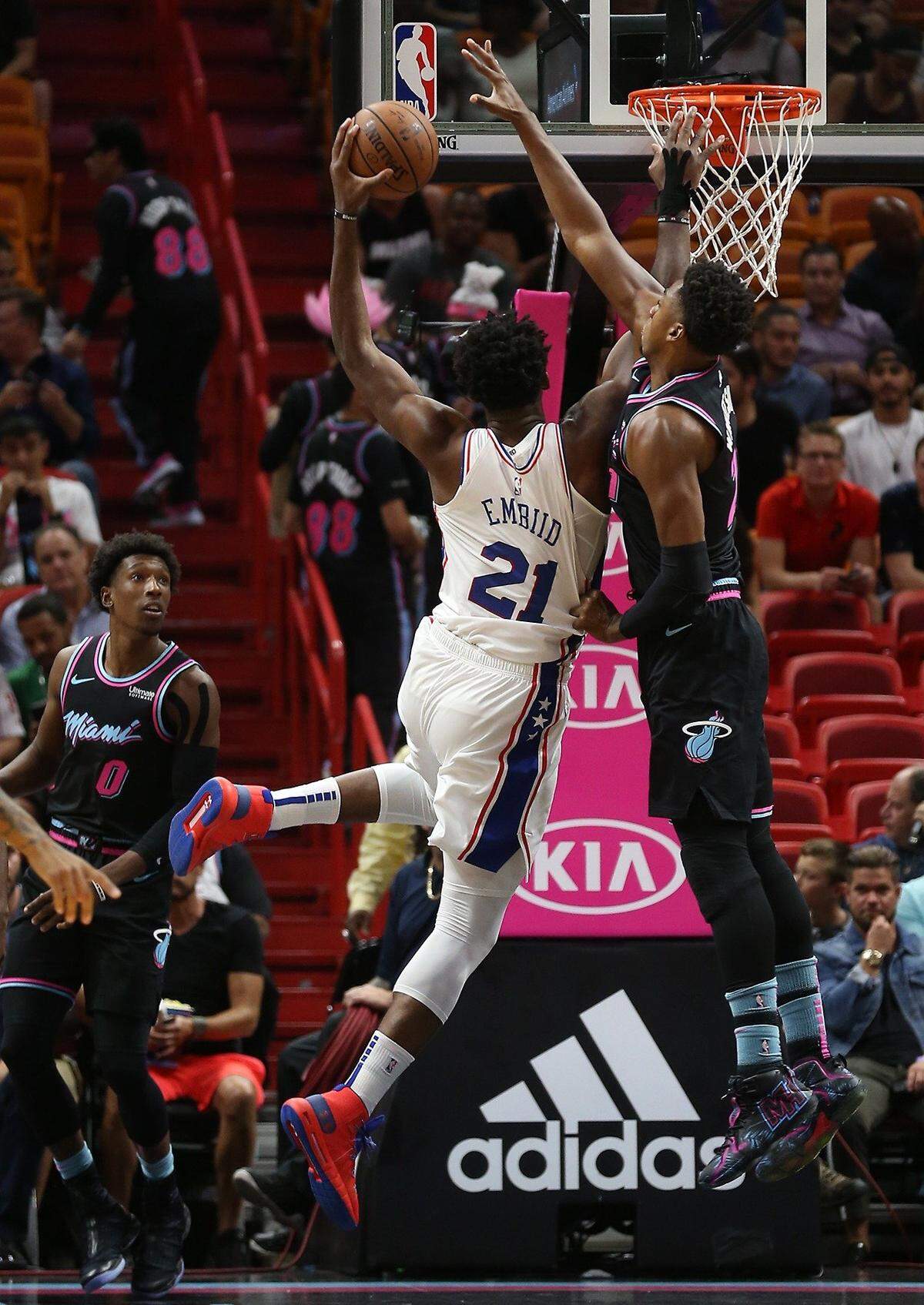
“It was tough,” Whiteside said of his foul trouble. “It’s like that some nights. It’s really out of my control.”
Considering Whiteside averaged just 5.2 points and six rebounds in 15.4 minutes in Miami’s five-game first-round playoff series against Philadelphia, Monday was a step forward for the 29-year-old. But considering Embiid finished with 35 points and 18 rebounds and won the game, Whiteside’s counterpart had the better night.
“It’s frustrating, especially when you’re not out there because everybody’s going to act like it was on you just because I’m a more-known center,” Whiteside said of Embiid’s stat line. “It’s frustrating, but it’s on to the next. It’s not me versus him or them. They got the better of us tonight.”
4. The good news for the Heat is Goran Dragic looked like himself Monday. After going scoreless in Saturday’s loss to the Wizards, the Heat’s point guard turned in a more Dragic-like performance against the 76ers with 22 points on 8 of 15 shooting.
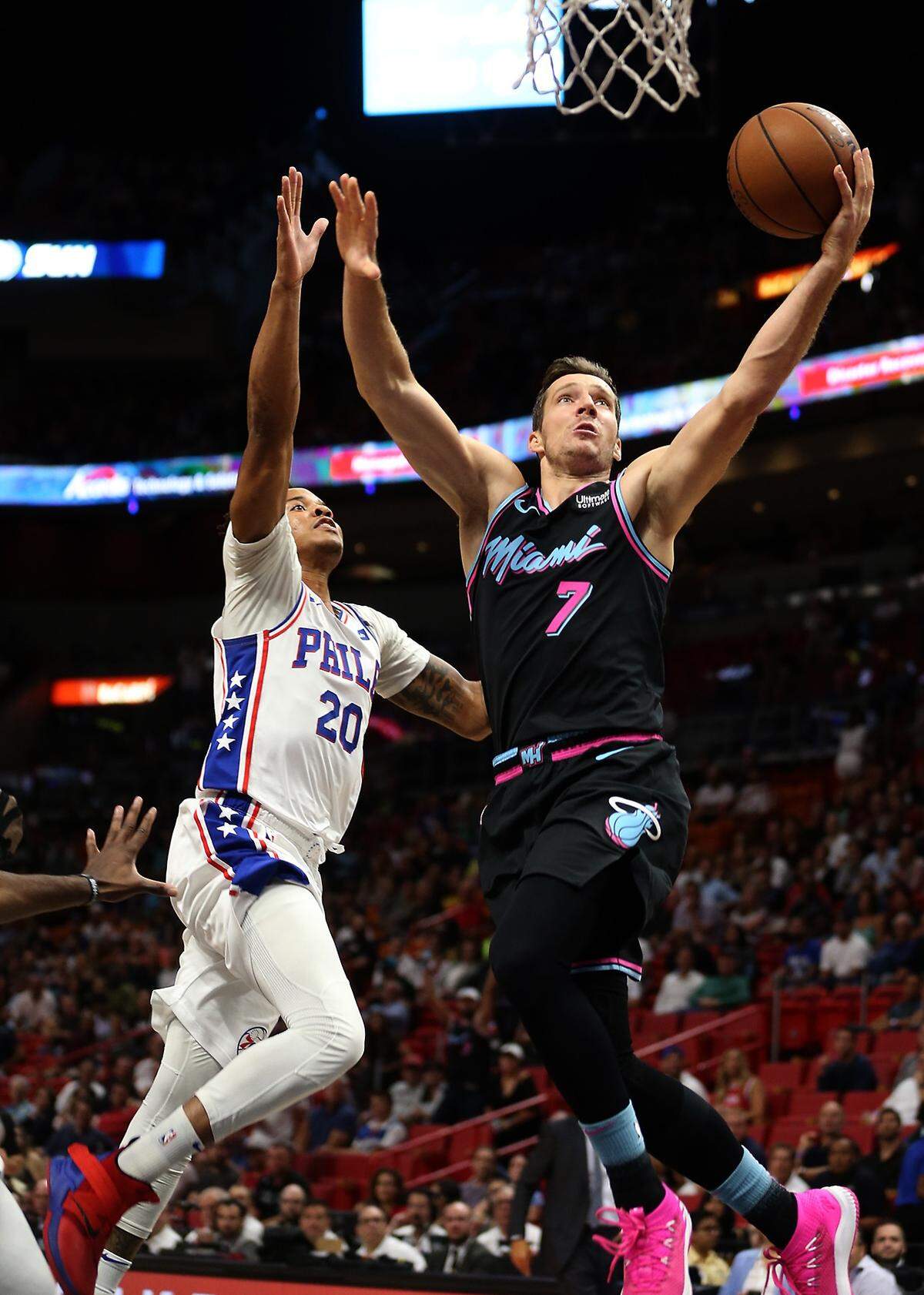
This is encouraging for Miami, with Dragic working his way back from a right knee injury that forced him to miss two games last week and a right foot injury that kept him out of the Heat’s loss to the Hawks on Nov. 3. He looked healthier and more active Monday, even though he is playing through some pain.
The Heat needs Dragic to be good because its offense has struggled without him. Entering Monday, Miami had recorded a team-best offensive rating of 111.6 (points scored per 100 possessions) with Dragic on the court and a team-worst 100.5 when he’s not playing this season.
5. This game included a lot of fouls for both teams, but the choppiness seemed to benefit Philadelphia more. The Heat was called for 30 fouls and the 76ers were called for 24. But the fact that foul trouble took Whiteside out of the game and Embiid ended the night with 23 free-throw attempts gave Philadelphia a clear advantage when it came to the whistles. Whiteside played just 8:29 in the second half.
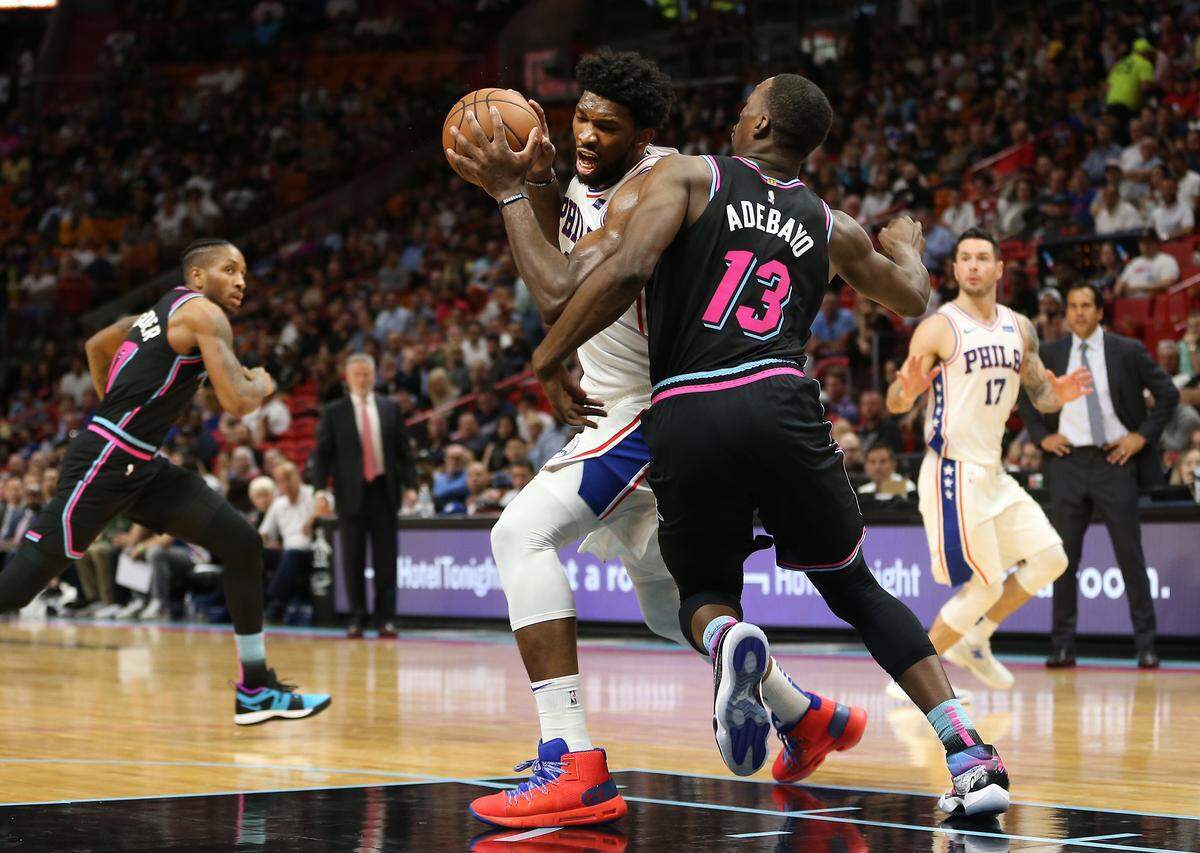
At the end of the night, Embiid logged 36 minutes of playing time to Whiteside’s 22. Those 14 additional minutes that Philadelphia had its starting center on the court really helped to change the game.
“We had to go deeper into the rotation. It was choppy,” Spoelstra said of all the fouls Monday. “That’s just the way it goes sometimes. It felt like a handful of those, they were good, hard defensive possessions with technique. But it probably just disrupted the rhythm in the game, particularly when we were up a handful of points. It got them back into it and got them into a rhythm, and we had to go a little bit deeper into the rotation. But we still had opportunities.”
This story was originally published November 12, 2018 at 10:13 PM.