
Pitch Perfect: FIFA teams with turf gurus to create fields for Club World Cup, World Cup
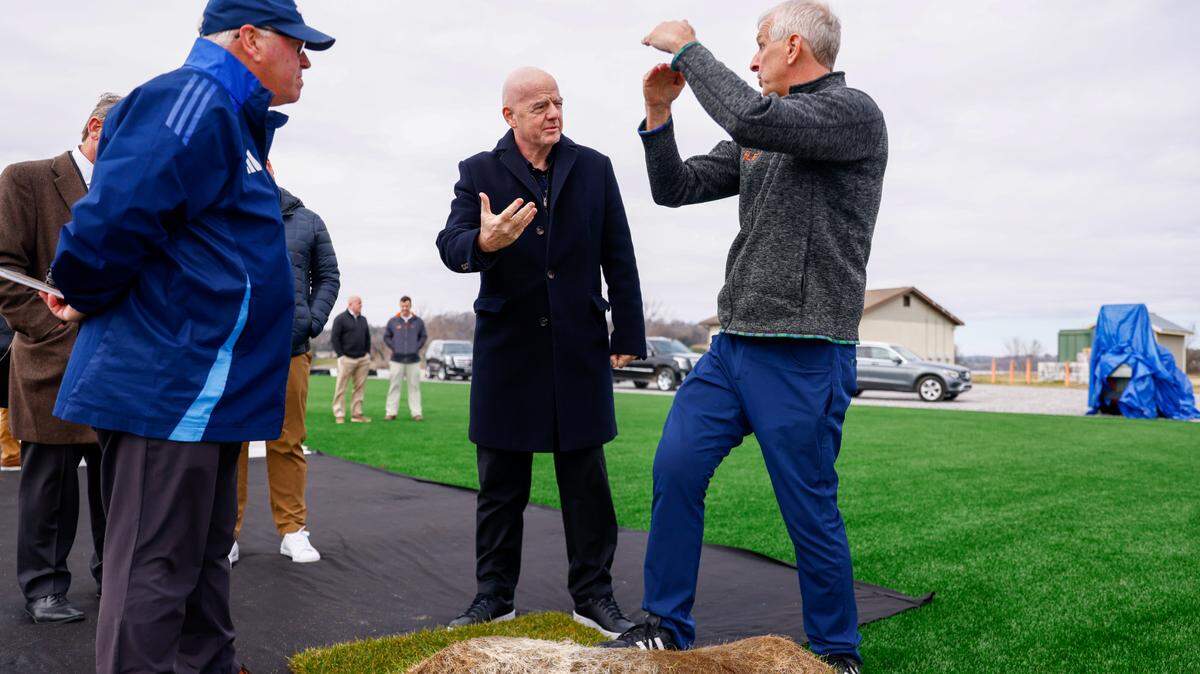
When Lionel Messi and the rest of the world’s elite players step on the fields for the upcoming FIFA Club World Cup this summer and the 2026 World Cup, they expect perfect playing surfaces.
That means expertly groomed natural grass. No artificial turf. No visible seams. No divots. They want their stage to be world-class, and FIFA’s Pitch Management Team is doing all it can to make sure they get their wish, going so far as testing the fields using a foot lower extremities “fLEX” machine that mimics the impact of a player’s cleat on the grass.
FIFA teamed with turf scientists at Michigan State University and the University of Tennessee to develop consistent fields for stadiums across three host countries — United States, Canada and Mexico — and four time zones in 16 cities with diverse climates for 104 games.
Sod farmers at both schools have been researching and growing the ideal blend of grass that will work at outdoor stadiums and indoor stadiums. Artificial turf at eight U.S. stadiums will be replaced by natural grass for the two tournaments, transported by refrigerated trucks.
A state-of-the-art shade house was built at the UT Institute of Agriculture’s East Tennessee AgResearch and Education Center to replicate conditions inside a domed stadium. The sod specialists are producing a hybrid grass by weaving synthetic fibers into natural grass and laying it on drainage trays that will lock together to form the field.
Meanwhile, in East Lansing, Michigan, MSU’s turf science facility has a 23,000-square-foot asphalt pad to replicate laying turf on stadium floors.
Their goal is to eliminate the bouncy, trampoline effect players complained about at a few venues during the 2024 Copa America, including the Mercedes-Benz Stadium in Atlanta, one of five venues that has a roof.
Stadiums that already have natural grass and good drainage systems, such as Hard Rock Stadium, are easier to transform for FIFA tournaments. Hard Rock is among the venues for the 2025 Club World Cup, and will host the opening match between Inter Miami and Al Ahly on June 14.
The two scientists leading the effort are Tennessee’s John Sorochan and Michigan State’s Trey Rogers, longtime professors of turfgrass management, who worked together to install grass into the Pontiac Silverdome outside Detroit for the 1994 World Cup.
That revolutionary project made international headlines, especially during the Sweden vs. Brazil game, which was played in sweltering heat because it was unseasonably hot that day and the stadium did not have the proper cooling mechanisms to absorb the humidity generated from the grass field.
Technology has gotten much better since then.
“The Silverdome wasn’t designed to host or have living grass inside of it, but now you got stadiums like NRG Stadium [in Houston] that are built to have natural grass, and their HVAC systems are a lot more robust to accommodate those things,” Sorochan explained.
The biggest challenge, Sorochan said, is to maintain uniformity across the venues throughout the monthlong tournaments.
“We will have 104 matches, across 16 stadiums and with five indoors, at different altitudes, different countries, two different types of grasses and try to make them play the same,” he said. “When an athlete’s running and cutting, if they’re playing in Miami, and they go to Mexico City or Boston, they don’t feel that it’s different under their feet, and when the ball strikes the surface and comes to them, it feels the same.”
They are using high-speed cameras to test how the ball bounces on the turf and the fLEX machine to simulate a foot strike of a player running and either stopping or accelerating on the surface.
“We can change the mass, or the weight of the player running and cutting, but we can also change the cleat pattern, we’re using a standard cleat, and we’re doing 168 pound or 75 kilo simulated athlete, because that’s the average weight of the last two Men’s World Cups,” Sorochan said.
“Miami might have a slightly lower mowing height than the northern grasses in Boston and in Vancouver and in Toronto, but the ball is going to bounce the same and play the same, knowing that they’re two different kinds of grasses, but they will play the same.”
Alan Ferguson, the FIFA Senior Pitch Management Manager, knew this would be a challenge.
“With venues in the USA, Mexico, Canada, we knew we weren’t in that sort of one cap fits all solution that we had in Qatar, that we were going to have to use at least three or four, four different grass types, that some of the stadiums were completely covered,” he said. “So, trying to bring a uniformity across 16 fantastic stadiums, but 16 very challenging environments, has probably been the biggest challenge for the group.”
FIFA president Gianni Infantino recently visited the Tennessee turf facility and was impressed with what he saw.
“The quality of the surface, the grass, has always been of paramount importance to me,” he said. “Our team investigated and found the best people in the world to help us and it’s fair to say that with Alan Ferguson, we had this vision and joined forces to do something where the focus is the World Cup and the Club World Cup, but from which the whole world will benefit.”
This story was originally published April 15, 2025 at 6:13 PM.