
A major behind-the-scenes change Marlins have made with hitters and how it has helped
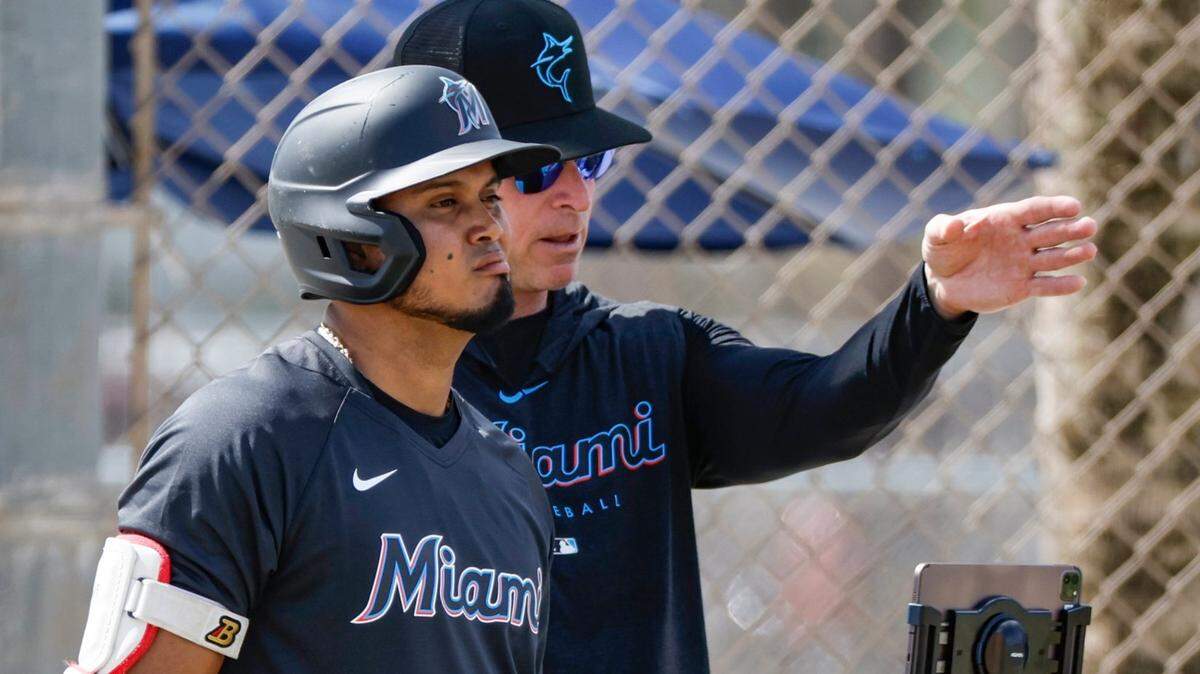
If you go searching for what has changed for the better about a Marlins team that has gone from losing 93 games a year ago to one that entered the week with the National League’s third-best record, there are a handful of factors evident to anybody paying attention:
They have perhaps the best contact hitter in baseball (Luis Arraez), the best rookie pitcher in baseball (Eury Perez), one of the best power hitters in the National League (Jorge Soler) and a reliable bullpen.
But if you’re looking for more subtle changes that have made a difference, here’s one that has gone under the radar: This new Marlins coaching staff is doing a far better job preparing hitters, players say.
Manager Skip Schumaker and his hand-picked hitting coach (Brant Brown) and assistant hitting coach (John Mabry) have revolutionized the way Marlins hitters do their homework on opposing pitchers.
First baseman Garrett Cooper has never seen anything like it in seven years in the game, including his rookie season with the Yankees.
Before every game, Marlins hitters meet with Brown and Mabry to discuss that day’s starting pitcher. That’s not unusual.
But Brown and Mabry also give each position player a personalized report detailing how the opponent’s pitchers will attack them specifically and how they should respond. That’s a dozen or so reports a day, 36 in a three-game series, nearly 2,000 in a season.
“Every player has their own personalized plan on a piece of paper,” Cooper explained, marveling at the work that Brown and Mabry have put into this. “We go through everything — their pitches, their tendencies, what they would use on you specifically. Each person has a detailed plan of attack.
“They’re going to attack Jazz [Chisholm] one way, they’re going to attack Jorge Soler one way, they’re going to attack Arraez one way.”
Brown and Mabry will show players video of their past at-bats against that day’s pitcher.
“And if they’ve never faced that guy, they show video of a guy with a similar fastball, a similar slider,” Cooper said. “They find pitchers who throw the exact same miles per hour, with the same extension. It’s just so much more detailed.”
The hitters’ 20-to-30-minute meetings before each game also have changed.
“We had a meeting every day before, but it wasn’t as detailed with the pitch types and what you should look for in each count,” Cooper said.
“They cover everything — how the pitcher is going to attack you if you have runners in scoring position, if it’s a double play possibility. There’s so much more information that we didn’t have in the past.”
And the planning doesn’t stop when the game starts. When a reliever enters, Brown or Mabry huddle up with the batters in line to face them, showing them video and discussing how to attack.
“When they bring in a reliever, there’s a plan every single second,” Cooper said.
Shortstop Jacob Amaya, recently sent back to Triple A after a brief Marlins stint, was struck by the level of detail in preparation.
“It’s pretty wild,” Amaya said. “You have paper on the walls, four TVs in the [batting] cages. You’re looking at what that pitcher is doing against lefties, righties. You just be quiet and listen.”
The Marlins have become better at situational hitting, and Cooper is convinced the new approach has made a difference.
Entering this week’s seven-game homestand against St. Louis and Philadelphia, the Marlins had gone from 27th in baseball in batting average last season (.230) to seventh best (.260).
They have gone from among the worst to above average in two key metrics: hitting runners in scoring position (.229 last season to .257, 14th of 30 teams) and hitting with runners scoring position and two outs (from .208 to .238, which is 13th).
Arraez’s presence naturally has a lot to do with that; he’s hitting an unfathomable .460 with runners in scoring position. But others also have improved in that area. Bryan De La Cruz hit .195 with runners in scoring position last season, compared with .238 this season.
What’s more, seven of the 11 hitters who have received the most at-bats this season have improved their overall batting average, nearly all seven by a significant amount.
Who has most benefited from the more detailed pregame planning?
Cooper cites De La Cruz and Jesus Sanchez.
De La Cruz’s average and on-base percentage have jumped from .252 and .294 in 2022 to .276 and .323, Sanchez’s from .214 and .280 last season to .247 and .315 this season.
“You see how much more damage [Sanchez] is doing to the opposite field this year,” Cooper said. “Brownie and the coaching staff have made it easier for them to transition into having a plan every day now.”
Schumaker and Cooper also referenced a philosophical change in the message conveyed to Marlins hitters:
Accentuating the batters’ own “strengths and not attacking the pitcher’s strengths,” Schumaker said, talking about where Sanchez and De La Cruz have improved but also addressing the new mantra for Marlins hitters.
“Brownie has been really good at identifying what you’re able to attack and how they’re going to pitch you and not to try to hit against the pitchers’ strengths but try to bring them into your strengths.”
As Cooper said, “if the pitcher has a slider that’s maybe in the zone only 30 percent of the time, we try to eliminate [swinging at that] as best we can.”
