Northwestern’s 1995 title forever changed Miami football. It still fuels Central’s dynasty
Throughout the season, the Miami Herald will bring you different stories about high school football in Miami — the culture, the players, the coaches, the people and the history — to explain why football means so much to this city.
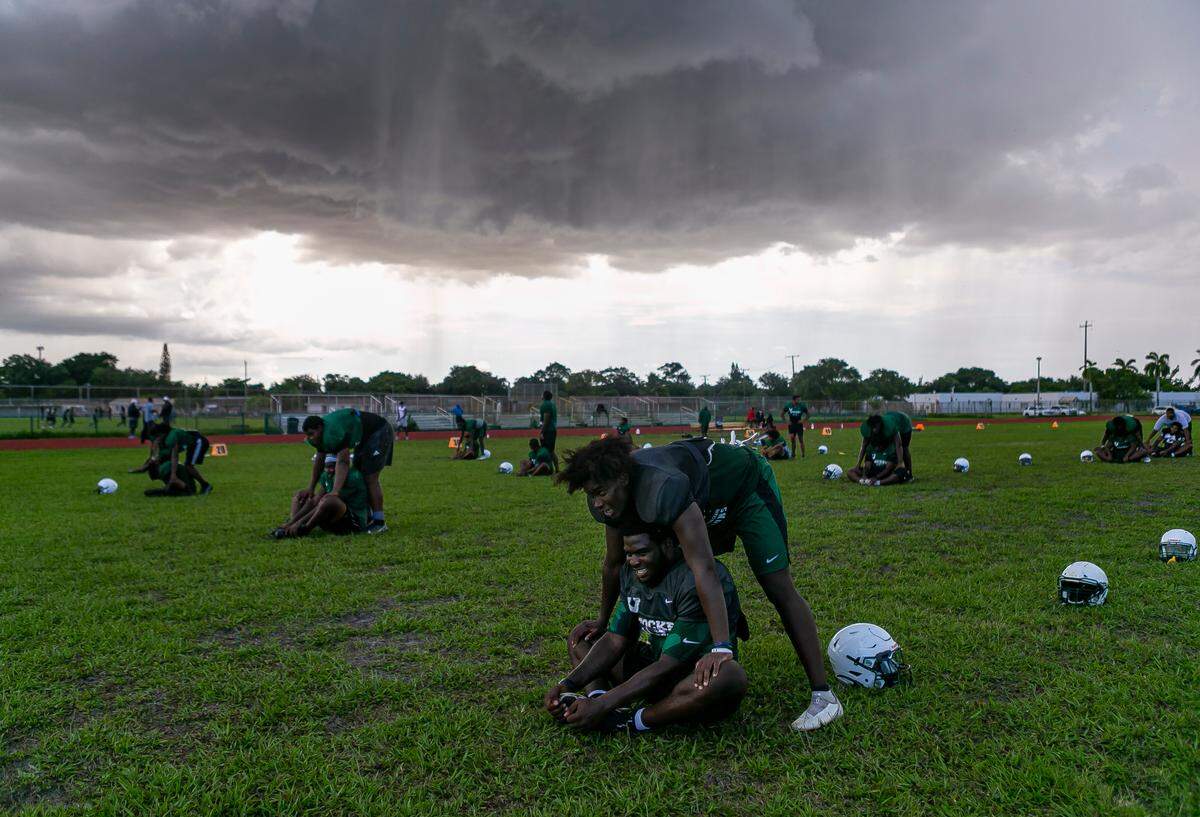
On the Monday before Miami Central embarked for California to open the 2021 season with a nationally ranked showdown against St. John Bosco, Roland Smith could afford to stand on the side of the practice field at Miami Central Senior High School, survey what he has helped build and spend a little time reminiscing.
He has, after all, taken plenty of influence from Jimmy Johnson, whom he played for with the Miami Hurricanes and who taught Smith the value of putting together a good staff and letting assistant coaches coach. He learned from — and built on — everything Telly Lockette established last decade in the earliest days of Miami Central’s dynasty, which has now yielded seven state championships since 2010. Above anyone else, he points to Willie Goldsmith.
If there’s any singular person who deserves credit for what inner-city Miami high school football has become in the past 25 years, it’s Goldsmith.
“He showed us,” Smith said, “that you can win a state championship in the inner city.”
In 1995, Goldsmith led Northwestern to its first Florida High School Athletic Association state championship and Smith, who was the junior varsity coach at the time, watched football in Florida change forever. In the 25 years since, Miami and Miami Gardens inner-city schools have combined to win 26 state championships, and the Rockets matched the Bulls for Miami-Dade County’s all-time lead by winning their seventh last season.
Smith has been at the helm for the last five, but his fingerprints — and the fingerprints of Northwestern of the 1990s — are all over the entirety of Miami-Dade County’s most dominant current dynasty. Lockette, who led Central to its first two state titles in 2010 and 2012, was Smith’s offensive coordinator when the coach won his first state title with the Bulls in 2006 and played for Goldsmith at Northwestern just before the Bulls broke through in 1995.
Now Smith has one of the Rockets’ most talented rosters ever and a chance to make history. If Central can complete a three-peat this season, the Rockets would become Miami-Dade County’s all-time leader in FHSAA titles, and Smith would match St. Thomas Aquinas legend George Smith for the most championships ever by a South Florida coach.
“Coach Smith,” star linebacker Wesley Bissainthe said, “is one of the greats.”
Rise of inner-city football
Goldsmith came to Northwestern in 1989 with a bold promise.
“I told the interview committee I would win a state championship,” the retired coach recalled.
Until then, the Bulls were, as Smith recalled, more concerned with just winning their district. They had only even been to the FHSAA postseason twice, losing in the district playoffs both times.
“We had some of the best, most talented teams,” said Smith, who graduated from Northwestern in 1986, “but our goal was to win a district championship. Our goal was never to try to win a state championship. We went to the playoffs and we knew that you could win a state championship. I don’t think we believed in that.”
Even now, Goldsmith thinks his bold promise is part of why he got hired and a bold promise took bold action.
There was never a question about the Bulls’ talent. Northwestern won the 1964 state championship in the segregation-era Florida Interscholastic Athletic Association and had already sent nearly a dozen alumni to the NFL by the time Goldsmith arrived. Smith and Lockette both point to the “discipline” Goldsmith brought to the program as transformational.
On the first day he met with players, Goldsmith laid down some new ground rules: Shirts always had to be tucked in, hair needed to be cut short, players were to sit in the front row in class and everyone must show up to meetings 30 minutes early.
“Those kids looked at me like I was crazy,” Goldsmith said.
Crazy eventually worked. In 1990, Northwestern won its first district title. In 1994, the Bulls went to the state semifinals for the first time.
The 1995 championship is a distinct turning point. Northwestern was the city’s first historically Black school to win an FHSAA championship and it started a 25-year run of dominance for inner-city schools.
The Bulls and Rockets have each won seven. Booker T. Washington has won six. Carol City, which won back-to-back titles in 1996 and 1997, has four and Norland has two.
Before 1995, the so-called “inner-city” schools had combined for just two FHSAA titles and one was Edison in 1970, before the demographics of Little Haiti had fully shifted and made the school predominantly Black.
“All that stuff started from Willie Goldsmith,” said Lockette, who graduated from Northwestern in 1994 and is now the Marshall Thundering Herd’s running backs coach. “It all starts from there.”
Even now, most inner-city coaches can trace their tree back to Smith and, going further, Goldsmith.
Booker T. Washington coach Gerald Cox worked for Smith at Central. Northwestern coach Max Edwards was an assistant for Smith at both Northwestern and Central. Carol City coach Dorrean James played for Smith at Northwestern. Even Edison coach Luther Campbell has ties back to Smith — he got his start as a linebackers coach at Central under Lockette, who had previously been Smith’s offensive coordinator at Northwestern.
“We went over there with the goal of building something,” Campbell said, “not just being the doormat to Miami Northwestern or anybody else.”
Smith’s legend in the making
Smith was an unheralded backbone to the Bulls’ first state title team — he helped the JV team put together three straight undefeated seasons before getting promoted to the varsity staff in 1997 — and it happened, essentially, by happenstance.
Smith played for Johnson and Dennis Erickson at Miami, and won a pair of national championships, then he briefly played for Don Shula when the Miami Dolphins picked him in the eighth round of the 1991 NFL Draft. He never played in an NFL game, though — an ankle injury cut short his rookie year — so, in 1994, he went into teaching and the only way Northwestern could guarantee him a job was if he agreed to join Goldsmith’s staff.
It meant in a seven-year stretch, Smith either played or worked for Johnson, Erickson, Shula and Goldsmith, then he won another state championship as an assistant coach for four-time state champion Billy Rolle with the Bulls in 1998. He had a mountain of influences to pull from when he succeeded Rolle as Northwestern’s coach in 2001.
Twenty years later, those influences are still obvious at Central, which began its season at No. 15 in MaxPreps’ national rankings.
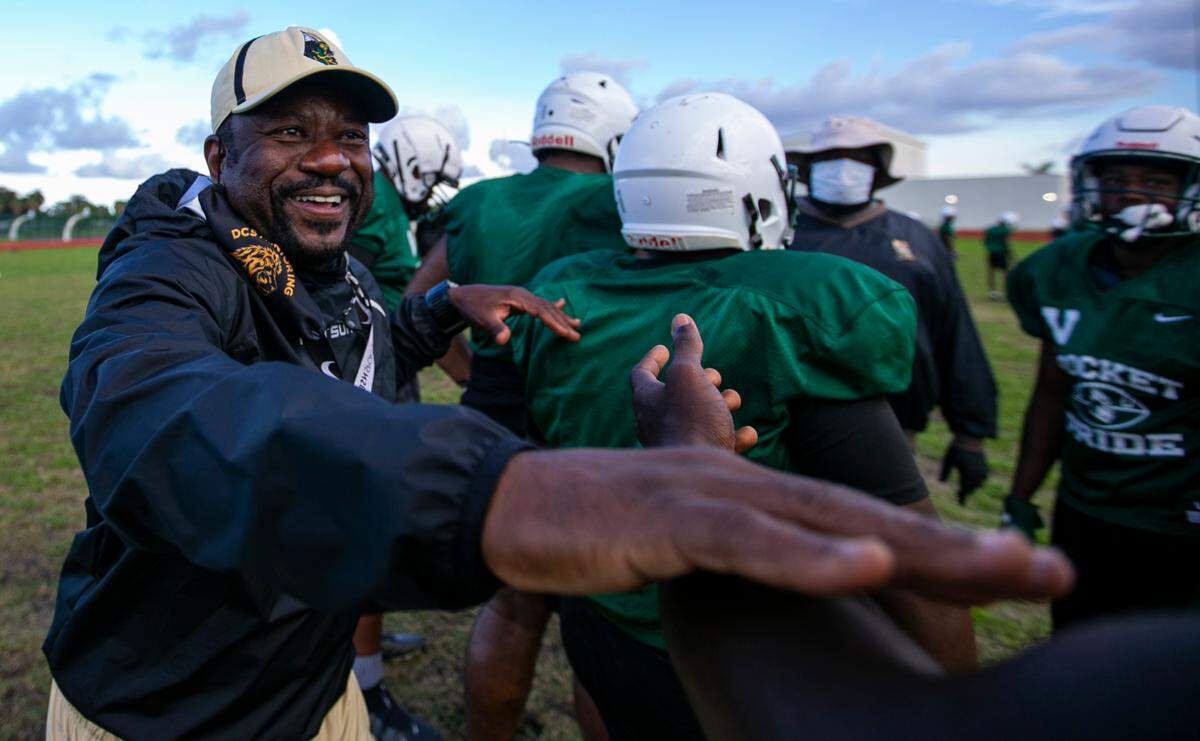
A practice almost seems as if it could go on without Smith, and often he’s simply standing back and observing his well-oiled machine — there’s Johnson, who taught him, “In order to keep good coaches, you’ve got to let your coaches coach.”
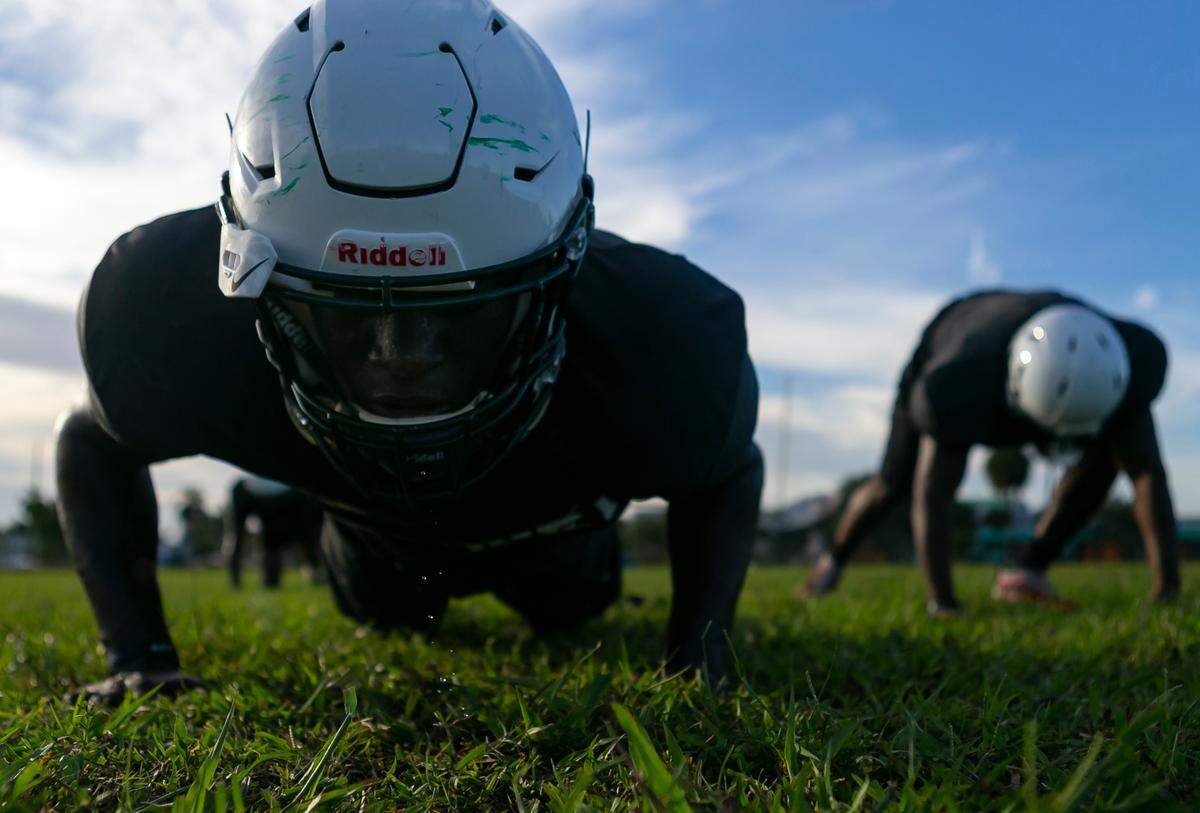
Every practice begins with a disciplinary period, when athletes who show up late or commit any other violations of team policy are forced to run laps, or do some other sort of strenuous activity while the rest of practice goes on around them — there’s Goldsmith.
The defense he runs is still almost always one of the best in the country — there’s Rolle, who was the Bulls’ defensive coordinator before he took over as coach. The offense he runs, led by junior quarterback Keyone Jenkins, is also prolific — there’s Lockette, who brought the spread to Northwestern, and established Central’s reputation as “Running Back High” by helping develop Devonta Freeman and Dalvin Cook into stars.
For those early days of the Rockets’ dynasty, Smith was entirely out of coaching. A scandal at the end of the 2006 season — star running back Antwain Easterling arrested for lewd and lascivious battery, and the Bulls letting him play in the state championship anyway — marred Northwestern’s championship and led to Smith’s dismissal before the start of the 2007 season. He and his assistant coaches were eventually cleared of any wrongdoing.
For six years, Smith taught at a middle school and spent his spare time watching his son play in Pop Warner Little Scholars. He also went to every Central game as a fan once Lockette took over in 2008 and served as an informal adviser to his friend. Hardly a day would go by without someone telling Smith he needed to go back to coaching.
Since Smith returned to the sidelines in 2013, Central has put together an unprecedented run of success with five more state titles in seven years. As his peers have flocked to the college ranks, Smith has stayed in West Little River, where more than 80 percent of students are economically disadvantaged and the Rockets practice on a field with crooked goal posts
“Once I felt what it felt like and what it brought to the community — the pride, the joy when you win a state championship — my goal year in and year out is to try to win one every year,” Smith said, “because we’re the ones keeping our school spirit up, the community up.”
This story was originally published August 20, 2021 at 9:04 AM with the headline "Northwestern’s 1995 title forever changed Miami football. It still fuels Central’s dynasty."