What South Florida football coaches are saying about SCOTUS’ ruling about postgame prayer
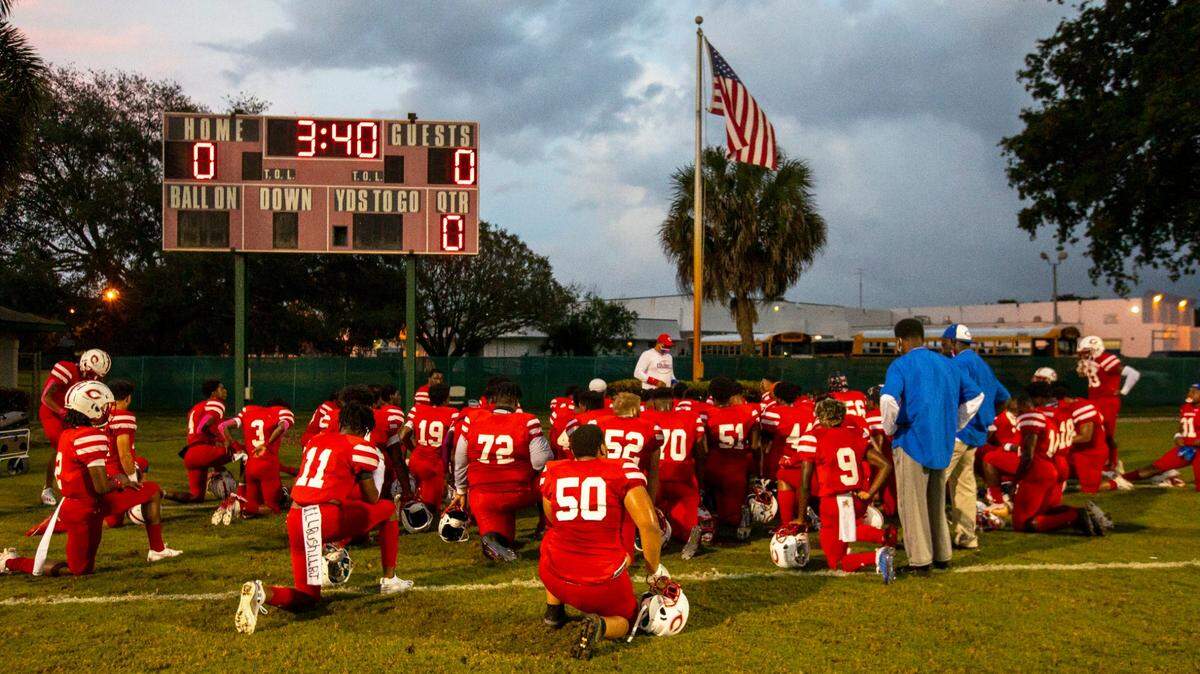
The scene is a common one, playing out after high school football games across South Florida, the entire state and most of the country: The final whistle blows, teams shake hands and then each trudge toward one end zone or the other for a postgame huddle, often concluding with some sort of prayer.
On Monday, the Supreme Court of the United States decided this is OK. In Kennedy v. Bremerton School District, the Supreme Court sided with Joseph Kennedy, a former assistant coach at Bremerton in Washington, in his argument claiming the school district was violating his religious freedom by telling him he couldn’t pray so publicly after games.
The majority opinion found Bremerton violated both the Free Speech and Free Exercise clauses of the First Amendment. The dissenting opinion cited precedence recognizing “school officials leading prayer is constitutionally impermissible” after the Bremerton school board expressed concerns players would feel implicitly coerced into joining in prayer because an authority figure was leading it.
Across the Miami metropolitan area, it will largely keep a status quo, as a large contingent of teams were doing something similar already. Although the vast majority of coaches contacted either declined to comment or did not respond, those who did were uniformly pleased the Court’s ruling, while also insisting any form of prayer will always be strictly voluntary.
“I grew up on it,” said Homestead coach Philip Simpson, who played and previously coached at Southridge. “Every game, we got in a big circle and we sang the alma mater. Somebody in the middle did a prayer and then we did the alma mater every game at the damn 50.”
“If you don’t want to pray, you’re more than welcome to not be involved in the prayer. If players decide they want to have a prayer, that’s on them,” said Luther Campbell, who’s better known as Uncle Luke and has coached Miami’s Edison since 2018.
“I believe that prayer’s a positive thing,” Western coach Adam Ratkevich said, “but at the same time I would never impose my views on anybody else.”
Both Simpson and Ratkevich said their teams’ procedures will be unchanged by the ruling, while Campbell said his Red Raiders avoided prayer in the past, but, “We’re going to pray now.”
For Simpson’s Broncos, a pregame chapel has also been part of the routine ever since he took over as coach in 2019. On a typical game day in Homestead, Simpson said he holds a chapel session 15 minutes before the pregame meal, usually finding some Biblical story he can relate to the Broncos’ upcoming game. These sessions, he reiterated, are always strictly voluntary and he had about 10-12 players last year who “never showed up.”
“I never ever, ever said anything to them,” Simpson said.
Part of why Simpson likes the ruling, he said, is because he believes school is the place for children to be exposed to all different worldviews. He contrasted the Kennedy decision with the so-called “Stop WOKE Act,” which the Florida legislature passed in February and Simpson criticized because of the way he believes it will restrict discussion of race in classrooms.
“The way we continue to constrict the mindsets is just a little mind-blowing,” Simpson said.
In Davie, Ratkevich said he has always stayed away from his Wildcats in prayer himself, in part because of the diverse demographics in the region. Broward County, for example, has one of the largest Jewish populations in the state and the western parts of the county -- like the area where Western in located -- contain more than 60 percent of the county’s Jewish population, according to a 2016 study by the Jewish Federation of Broward County.
“It’s very multicultural and whatnot in South Florida, and you’re going to have kids on your team that are Jewish, you’re going to have kids on your team that are atheist,” Ratkevich said. “That’s something you need to be cognizant of.”
Still, Ratkevich has always been OK with players leading postgame prayers after he has huddled the team together.
It’s still the way envisions handling things, even after the Court’s ruling.
“I personally don’t ever lead a prayer with my kids,” Ratkevich said, “but we will allow a player-driven prayer for those who are so inclined.”