
Barry University’s Avi Kigel: from harrowing army service to championship coach
When Israel native Avi Kigel was 18, he started his mandatory three-year service in his country’s army.
Kigel’s first task was patrolling the highly contentious Gaza Strip, and what he witnessed was harrowing.
“I saw death,” Kigel said. “I had people shoot at me. My perspective on life changed.”
After his service, Kigel left Israel for a tennis scholarship at Norfolk State. That began a journey that has led Kigel – now 53 – to becoming a nine-time national championship women’s tennis coach at Barry University. That’s a record number of championships for any women’s tennis coach in NCAA Division II history.
Barry associate head coach Nanda Alves, a Brazilian native and former pro tennis player who competed in the main draw of the 2005 Australian Open, has known Kigel since he hired her in 2018.
According to Alves, there are several reasons for Kigel’s success.
“Avi knows tennis. He has experience as a player, and he can see the game,” Alves said. “He’s also very calm. He connects with players. He keeps them in the moment (so that they don’t) lose control.
“He’s also a good recruiter.”
Given Kigel’s success, it’s no surprise that in the summer of 2024, he was promoted to director of tennis at Barry, giving him full control of the men’s and women’s programs.
Dr. George Samuel, this program’s former coach who hired Kigel at Barry years ago and is now retired, said he wishes Avi well with his added duties.
“It’s tough running two programs and trying to be No. 1 in the nation in both,” said Samuel, 71. “But coaching comes natural to Avi.”
Kigel said he’s excited.
“I’m always looking for a new challenge,” Kigel said. “When I have nine championships, I want 10.
“But I don’t want my players to feel pressure. After my experience in the army, I never had any fear playing or coaching tennis. I want to win, but tennis is not life and death.”
In 2025, Kigel’s first season running both programs, Barry’s women won their ninth national title while the men reached the NCAA quarterfinals.
“My job,” Kigel said, “is to keep the level of Barry tennis at the top every year.”
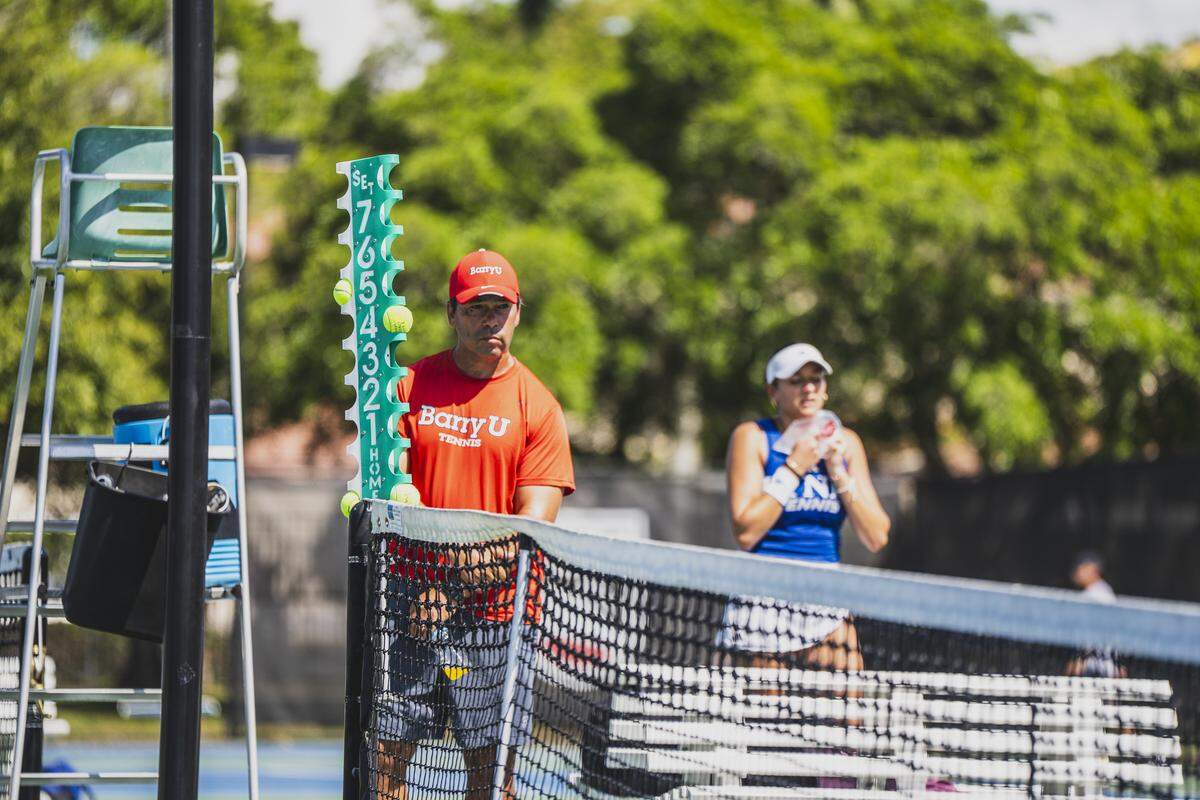
How Kigel got to the top of Division II tennis is an incredible story.
The son of an engineer (his father, Josef) and a teacher (his mother, Bella), Kigel was a top-10 player among Israel’s juniors. But, during his first year in Israel’s army, Kigel didn’t pick up a racquet even once.
“In the army, you lose your freedom,” Kigel said. “You have to ask for permission for everything, even to go to the bathroom. It humbles you.
“But I was proud to serve in the army. It’s part of being Israeli. I did my part.”
In his final two years in the army, Kigel was able to train for tennis, although he was not allowed to compete in tournaments.
After his obligation ended, he sought out a tennis scholarship in the U.S., and he landed at Norfolk State at age 22.
Kigel said he chose Norfolk State because the coach was the nicest, and that type of kindness is something he strives to achieve when he recruits players.
In four years at Norfolk State, Kigel earned a Bachelor’s degree in Health and Fitness. On the court, Kigel had many successes, including a win over Barry’s No. 1 seed.
Following graduation, Kigel moved to New York City to work as a personal tennis coach and trainer. Two years later, he found out that the aforementioned Samuel was looking for a graduate assistant tennis coach at Barry.
During an interview, Kigel reminded Samuel that he had defeated Barry’s No. 1 singles player while at Norfolk State.
Samuel hired Kigel and put him in charge, unofficially, of the women’s team.
“It was frightening,” Kigel said. “I didn’t have much coaching experience at that time.”
“The message was, ‘Here are your eight players. Figure out how to run a team practice.’”
As a graduate assistant, Kigel earned his Master’s degree in Exercise Science. Kigel was then hired at Davidson College – NBA star Stephen Curry’s alma mater – as an assistant women’s tennis coach.
“They offered to sponsor me for my Green Card,” Kigel said of Davidson.
Four years later, Kigel got the call to return to Barry -- this time officially as the Bucs’ head coach for women’s tennis.
During his first practice in preparation for that initial season, Kigel told his athletic director that he wanted to get rid of his entire roster.
“I was told I couldn’t do that,” Kigel said. “I wanted to change the culture. We had some lazy kids who played well only when they felt like it.”
Despite those issues, Kigel’s first team (2009) went 17-8 and made it to the NCAA regional finals.
By 2010, most of the players Kigel had inherited had left through graduation or transfers as Barry went 24-4 and won the South Regional.
Then, in 2011 – just his third season as a head coach – Kigel led Barry to its first-ever national championship in women’s tennis. Every player on that team was recruited by Kigel.
The Bucs have not slowed down since.
Kigel, in 17 seasons as Barry’s head coach, has led the Bucs to a record of 407-30.
Now that Kigel is in charge of women’s as well as men’s tennis, Barry’s assistant coaches are even more important.
Kigel has three associate head coaches – Fred Bonal with the men; and the aforementioned Alves as well as Yeffrens Lopez with the women. The men’s team also has assistant coaches Alejandro Palacios and Vincent Versier and volunteer assistants Kern Pedersen and Gabriele Felline.
Alves said that adding men’s tennis to Kigel’s proverbial plate is a way to keep him feeling challenged.
“Avi could be coaching at a big Division I program, but he really loves Barry,” Alves said.
Alves and all those other coaches are great, but the biggest parts of Kigel’s team are his wife, Naama, who is also from Israel; and their son, 10-year-old Ori, who is a budding tennis standout.
Kigel said he has had offers to leave Barry and coach in Division I. But, due to how comfortable his family is in Aventura, Kigel hasn’t even considered leaving Barry over the past eight years.
“Our community is maybe 80 percent Jewish,” Kigel said. “It feels like a small Israel. We celebrate the Jewish holidays as a community, and there are some great Jewish schools.”
Another advantage of staying at Barry is that Kigel has the flexibility in his schedule to train his son.
Clearly, tennis is the family business, and – for Kigel at least -- there’s little difference coaching men or women.
“I look at all of them as individuals,” Kigel said. “They’re all different, and, as coaches, we have to figure out how to motivate them.
“It’s all about getting to know them, and, when they have tough moments off the court, hopefully they talk to us about it, and we can help them.”
Kigel, who still practices with his players and believes he can beat them all – whether that’s true or not – is all about developing the full person.
“My goal is to open as many doors for our players as possible,” Kigel said. “That’s true whether that’s in pro tennis, in coaching or in an internship.
“That stuff comes first. The championships are a bonus.”
Fortunately for Barry, there have been a lot of bonuses.