
Florida basketball enters defining regular season stretch as it hosts Kentucky
No. 14 Florida, for all its problems, is now ranked fourth in Torvik and seventh in KenPom, the two primary college basketball rating sites.
That’s what happens when you’re 8-2 in a conference that both of those rating systems think is the best in the country, despite only housing four ranked teams. The Gators, among the SEC squads in the AP Poll, are the top dog at No. 14, and they’ll host No. 25 Kentucky (17-7, 8-3 in the SEC) this weekend.
The route to this point, though, hasn’t been without bumps. While Florida (17-6, 8-2 in the SEC) currently looks the part of a top 10 team (and rates that way, too), what Kentucky — and each of the other three ranked opponents Florida’s lost to — can do is shoot from deep. The Gators, three months into this season, still can’t.
“Three-point shots not flying,” Florida forward Alex Condon said. He’s shot a hot 6 for 44 from three (13.6%) this year. “But I don’t worry about it. Affect the rest of what you do well.”
And that’s why Florida’s winning. The Gators are the first team in the last decade to place in the top three in the country in both offensive and defensive rebounding. In its last ranked game against No. 22 Alabama, it scored 72 points in the paint. In turn, the Gators now project as a top-three seed in most bracketologists’ latest work, and those aforementioned metrics suggest they may be trending toward a No. 2.
If this — the winning without an ability to space the court — seems relatively unprecedented, that’s because it is.
In the last 10 NCAA Tournaments, no team that’s earned a No. 1, 2 or 3 seed has entered the tournament shooting worse than 30% from three, a line only about one quarter of college basketball teams don’t eclipse each year. Florida’s hitting at a 28.8% rate, which is the worst among the top 130 teams in Torvik and sandwiched between notable college basketball powers Mississippi Valley State and Maryland Eastern Shore. MVSU is the worst team in the country (1-23), for whatever it’s worth.
When the year began, Florida could brush this issue off. Teams improve, and non-conference struggles aren’t abnormal, especially for past reigning national champions. But four weeks away from Selection Sunday, times have changed, and the vibe is evolving, too.
“I couldn’t get to my rhythm too much,” Florida forward Thomas Haugh said after shooting 5 of 12 from the field against Texas A&M on Saturday. “It’s been a learning experience for all of us. Because of our expectation early in the year, anytime something negative happens, whether it’s lost or somebody doesn’t play well, or doesn’t shoot well … that’s going to be the focal point.”
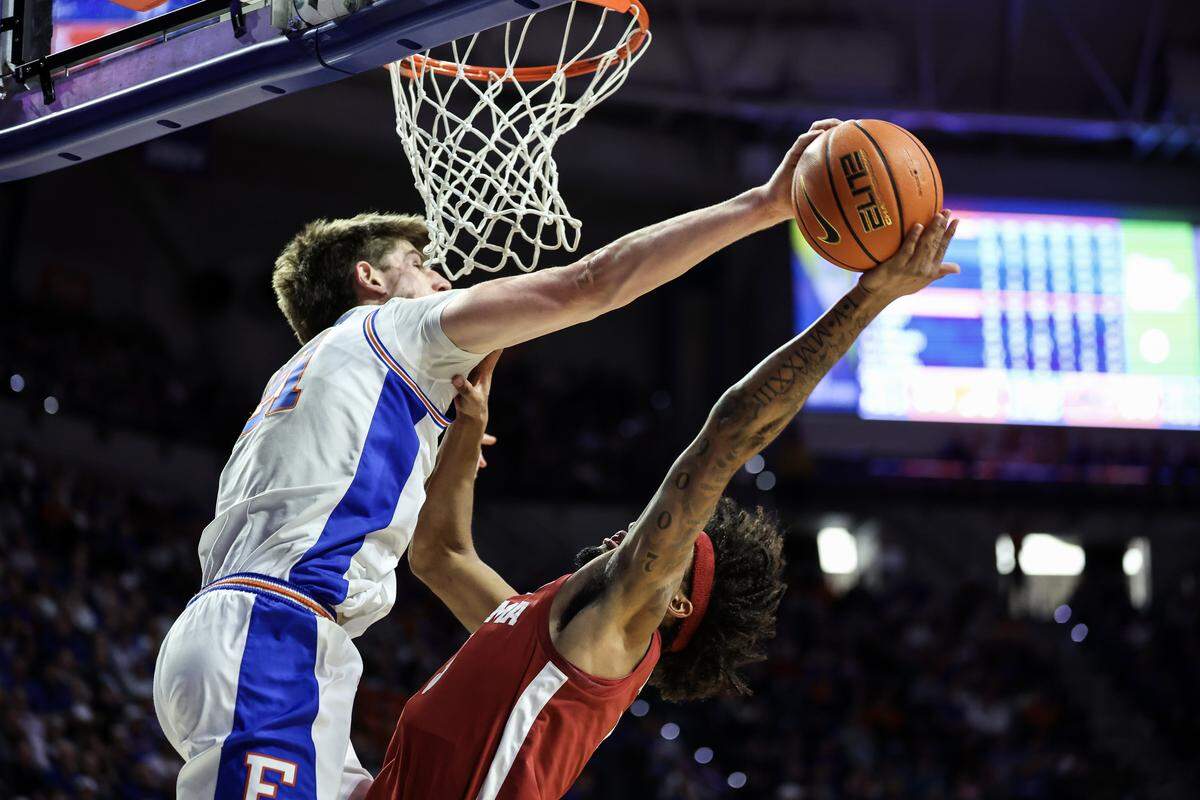
Beyond the abnormality of this persisting struggle, there’s reason to worry about the viability of Florida’s current offensive structure in a tournament setting. Playing multiple games in a span of days, the odds of catching an opponent on a good night improve. The instances in which top seeds can’t match a foe’s shot-making? Well, that’s how Cinderellas are born. For that reason, the lowest three-point percentage among the last decade’s national champions was North Carolina’s 35.5% in 2017. The average is 37.5%. And only nine of the 120 top three seeds since 2015 have even shot below 33% from three. Only one of those reached the Final Four (2016 North Carolina). A quartet lost during the first weekend, including top-seeded Purdue in the first round three years ago.
The few that entered the tournament shooting so poorly and still survived to the Elite Eight provide a blueprint for how this Florida outfit remains promising. Those like Zion Williamson’s Duke and Brice Johnson’s North Carolina leaned into dominant frontcourts. They established residency at the free throw line, taking over 20 attempts a game while hitting at least 70%. Florida averages 25 a night at a 70.2% clip, so consider that box checked.
“There’s different ways to score the basketball, and getting to the foul lines the most efficient way, even when you’re not shooting it incredibly well, it’s really efficient,” Florida coach Todd Golden said. The most pertinent example is Haugh. “It’d be a bad decision to let him do that.”
But if the Gators hope for an NCAA Tournament run similar to last year’s, shooting will be necessary. Currently, certain statements are still present too frequently.
“We got some good looks,” Golden said after the Alabama game. “We didn’t make some open threes.”