
University of Florida unveils facial authentication for ticketing
“It’s a fraud!” Florida sophomore Dylan Neves, 19, exclaimed from a line outside Ben Hill Griffin Stadium on Saturday night. “They’re taking our information!”
Austin Hicks, 32, shook his head, with his wife, Amber, and 3-year-old son Eli in tow. Moments later, the trio was through the gate as Neves waited in UF’s regular admission line. The difference?
Hicks and Co. signed up for the University of Florida’s newly implemented facial authentication ticketing system, the first of its kind in collegiate athletics. Neves had not. And those were the juxtaposing opinions throughout a trial run of an evening as Florida faced Long Island University to open the 2025 season.
Six of Florida’s 18 gates were fitted with an “Express Entry Line.” To enter through that section, fans submit a photo before the game, and it’s transferred to tablets at the specific gates. Each device is fitted with Wicket facial authentication technology and when the fan arrives, it scans his or her face and matches it to the saved template. From there, the fan and his or her party can enter with only one person’s face being scanned, if all of the tickets are in one account.
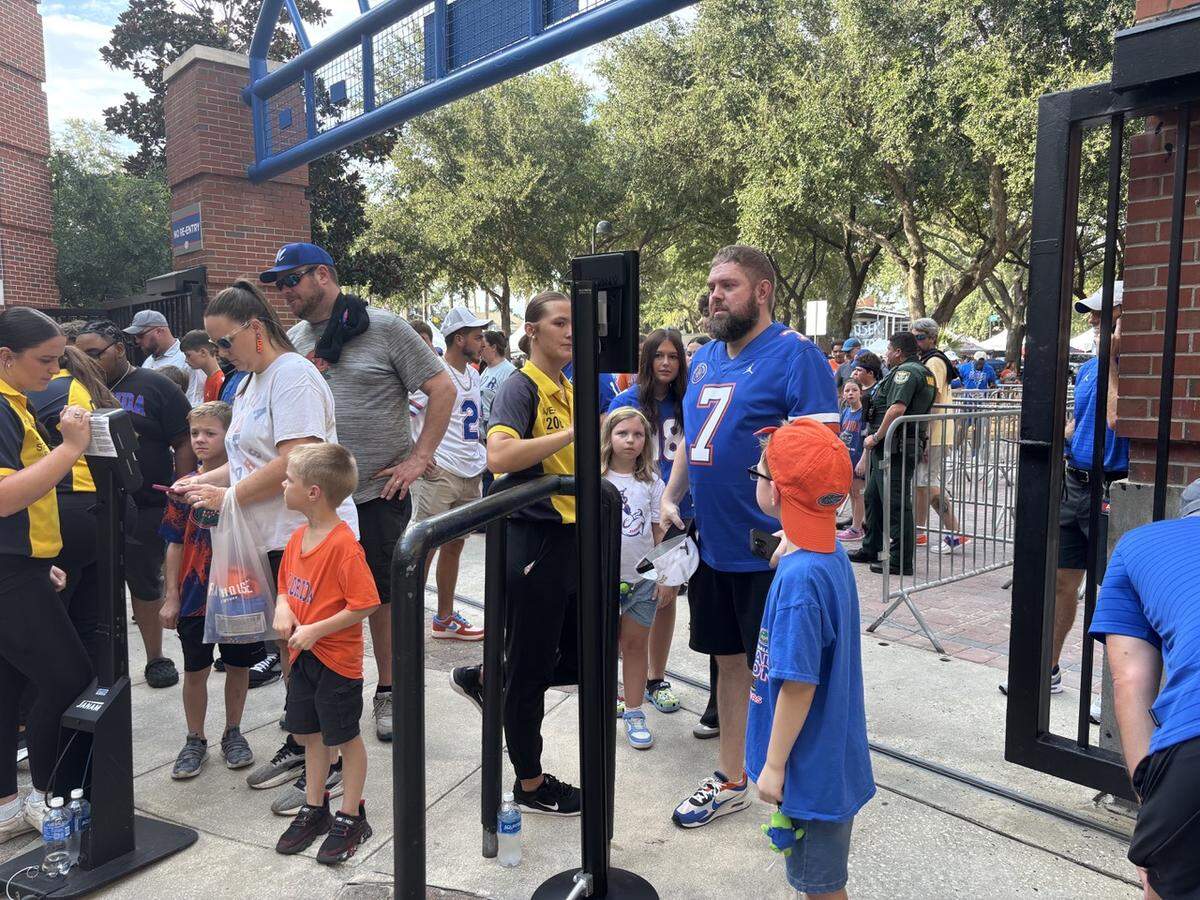
“The intention is to get fans through the doors and into the stadium as quickly as possible, and this system does that,” Wicket COO Jeff Boehm said. “It’s rapid. It’s seamless. … We’ve actually found older people like it more because of its ease.”
Of the 89,451 in attendance for Saturday’s 55-0 victory, roughly 6,000 (6.7%) signed up to use Express Entry, which they had to opt into. Express lines moved rapidly, emptying entirely within 10 minutes of gates opening and flowing smoothly for the rest of the evening.
“With a child, this just made sense,” Hicks said as his wife bounced his son on her hip. “I trust the technology, and uploading everything really was intuitive. I’ll do it again at any event I attend, and I’ve done it before at an NFL game.”
While the technology is a new addition to the UF gameday experience, it has had a presence at the professional level since 2020. With the COVID-19 pandemic in full effect, the Cleveland Browns were looking for a way to help fans enter games with more distance and brevity. The pair started working together soon thereafter. Five years later, the company is now partnered with multiple NFL and MLB teams. It will extend into two other colleges this fall, and expects to arrive at other major university athletic departments in the near future, possibly including Miami.
Of UF students polled in lines, 80% said they were in favor of Florida’s new entry option. One concern, though, was making sure fans learn about the facial authentication choice.
“I didn’t hear about it, but I definitely would’ve used it had I,” Florida freshman Ivy McNair, 18, said. “I’m watching all these people file in, and I kinda wish I was over there. It’s so much quicker.”
The expectation is for the option to remain for Florida’s six other home games this year, but there’s still more may be on the way. While a University of Florida Athletic Association spokesperson said the current plan isn’t to require entry through facial authentication at any point in the future, Boehm thinks this will be similar to the transition from paper tickets to the current virtual tickets UF requires. After a period where fans could choose either option, many venues stopped accepting paper tickets after they reached a certain clip of virtual users.
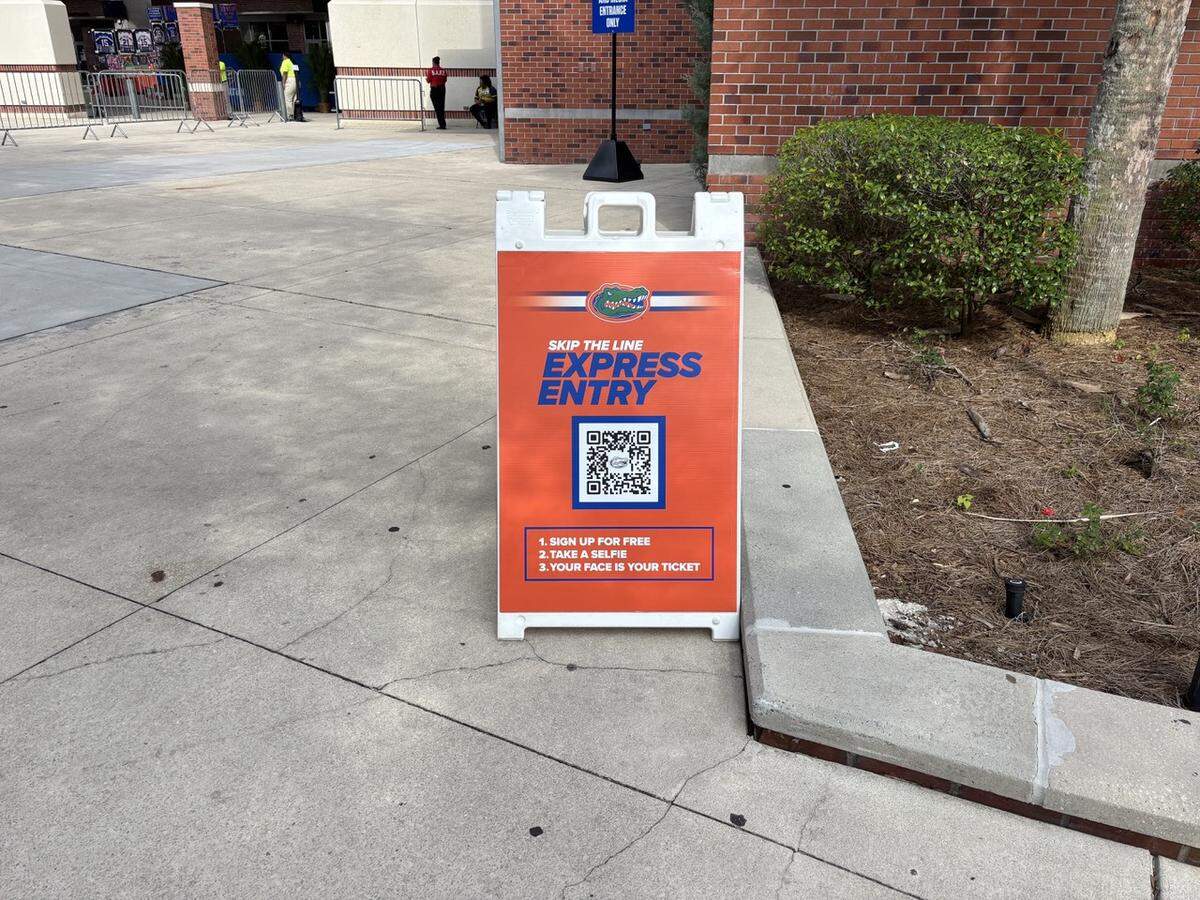
But there might be a difference.
Madison Square Garden utilizes facial recognition to ban attorneys and firms that are amid lawsuits against the company. While that might not be directly applicable to the University of Florida or any other school looking into the option, the technology provides an easy means of sorting out those a governing figure doesn’t want in attendance, which is where Neves jumps back into the frame.
“I think it’s invasive for them to have that information and be able to hold onto it,” he said. “The concept of using AI or something like this to determine who I am, and potentially help identify me in the future, isn’t something I want anything to do with.”
A UAA spokesperson explained that the Express Entry option won’t be used to enforce bans. Boehm provided the same sentiment, explaining that Wicket refers to its technology as “facial authentication” rather than “facial recognition,” because it isn’t used to scan crowds and find unwanted attendees. But there is no difference in mechanics between “authentication” and “recognition”.
Another concern is where the image and data one uploads goes, which Boehm emphasized was strictly protected and unable to be pulled from any of the tablets, due to being a “numerical representation,” saved as code, rather than a file. That doesn’t mean one’s information disappears after each game.
“The photos and the templates are stored in secure cloud storage. Keeping them allows fans to enroll once and continue to use their face for future games. Fans can opt out at any time (at which point all fan data is deleted),” Boehm said. “Essentially, it is up to the University of Florida to define how long those photos and templates are stored. Most pro teams we work with keep them in perpetuity.”
Of 38 fans polled that used Wicket, only eight said they knew Florida stored the photo they uploaded.
So, in an evening that felt like it featured a time machine, UF balanced opinions in its technological rollout, even while Express Entry lines flowed.
This story was originally published August 31, 2025 at 7:00 AM.