No mask requirement, full crowd at Orange Bowl: Organizers explain why they’re OK with it
On the same day the Georgia Bulldogs arrived in South Florida to get ready to play the Michigan Wolverines in the Orange Bowl, the Miami Hurricanes pulled out of their postseason game and they weren’t alone.
Orange Bowl week began with a wave of altered bowl games across the college football landscape. On Sunday alone, the Military Bowl and Fenway Bowl had to be canceled because of rising COVID-19 cases among players, and the Sun Bowl started searching for a replacement for Miami, which was dealing with its own miniature COVID outbreak.
On the eve of the College Football Playoff, five bowl games had been canceled for virus-related reasons and the Sun Bowl has had to replace the Hurricanes as the highly contagious omicron variant has led to record case numbers across the country. The Orange Bowl, fortunately, has not been one of them, although organizers know they won’t be in the clear until everyone is actually at Hard Rock Stadium in Miami Gardens on Friday.
“We’ve still got a day and a half to go,” Orange Bowl CEO Eric Poms said. “We are cautiously optimistic, but we’re taking it minute by minute.”
Poms and other members of the Orange Bowl committee hoped this 2021 Orange Bowl, the third major college football postseason game they’re hosting in 2021, would be a return to normalcy. Instead, it has been a return to unfortunate familiarity.
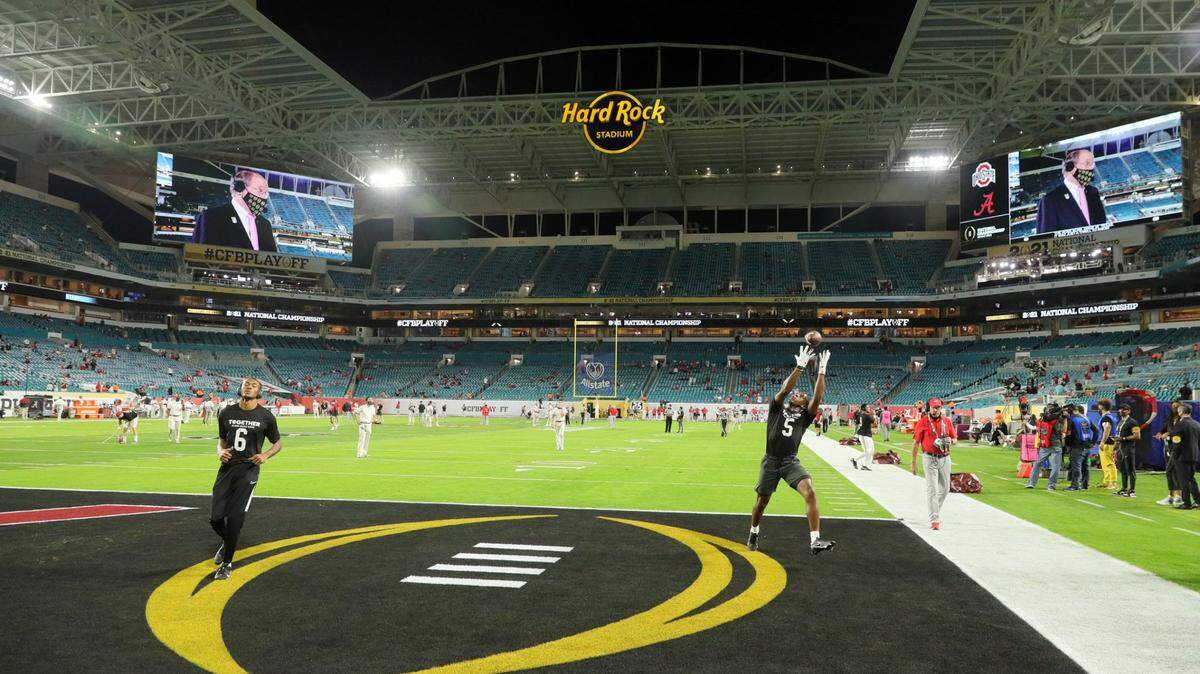
In January, the Orange Bowl hosted the 2021 Orange Bowl and the 2021 College Football Playoff National Championship at a time when case counts were far lower, but vaccinations weren’t widely available. It’s why organizers now feel comfortable packing Hard Rock Stadium, even with cases soaring.
How COVID’s affecting Orange Bowl
In the seven days leading up to the 2021 National Championship, Florida reported an average of 15,939 new cases per day. In the past seven days, the state has added an average of 36,781 new cases per day, although Florida in August did begin reporting by case date, rather than when the date was actually logged, meaning some of these new cases stretch back into early December or even November, but leave out more recent numbers.
Either way, the current case counts are as high as — and maybe even higher than — they were during the height of the delta wave in August and come after the season was mostly played during months when the state was mostly reporting fewer than 5,000 new cases every day.
Still, this Orange Bowl will look much more like a typical Miami Dolphins or Hurricanes game from this season, rather than one of those January postseason games.
In January, the Orange Bowl limited attendance to 20 percent of normal capacity, required masks and banned tailgating at the National Championship. On Friday, fans will party across the parking lots in Miami Gardens, masks will be merely recommended rather than required and Hard Rock Stadium will be full of Michigan and Georgia fans.
Orange Bowl president Jack Sieler said the committee has spent the past few weeks discussing potential changes to COVID policies — “We’d be putting our head in the sand if we’re not,” he said — but ultimately felt comfortable sticking with the policies Hard Rock had in place throughout the fall.
“The leadership there, going back to last year, has been very vigilant about creating a safe, healthy, comfortable environment for patrons,” Poms said.
Poms and Sieler pointed to the widespread availability of vaccinations — a massive difference from January — as the reason they felt comfortable conducting the game at full capacity and without any sort of mask, testing or vaccination mandate.
In the seven days leading up to the 2021 championship, an average of 140 people were dying of the coronavirus every day in Florida. Even with case counts far higher now than they were in January, the seven-day average for COVID deaths is down to 18.
“Last season was a little different. The vaccines weren’t available. You didn’t have the high level of vaccinations, so now this year we’re not looking at the same risk,” Sieler said. “You’re looking at certainly a very troublesome virus, but it doesn’t have the potential adverse downside that it had last year when we went into the bowl games.”
Players shoulder Orange Bowl responsibility
Those most affected by COVID regulations are now the teams themselves, especially given the CFP’s harsh edict: If a team “determines that it is unable to compete,” then it will have to forfeit rather than postpone.
The teams, of course, want to make sure this doesn’t happen and so does the Orange Bowl, which missed out on a year of massive ticket revenue when it had to limit capacity for its two January games.
All the events in the lead-up to the game, save for a coaches luncheon Thursday at Jungle Island, have taken place outside. All interviews have happened remotely via Zoom. The Playoff is requiring those with field access during semifinal games to either be fully vaccinated or test negative within 72 hours of kickoff.
“We’re excited to be in Miami and everything, but, as we all know, it’s a hot spot for COVID,” Bulldogs defensive tackle Jordan Davis said. “We just have to make sure that we protect ourselves and wear our masks and just enjoy the moment.”
This year, bowl season has been a reminder of how little central authority the NCAA has. The NCAA, nominally the governing body of college football, doesn’t actually run any of the bowl games or even the CFP, meaning every game, every team and every conference can set its own procedures. It means every school is still following its conference’s testing guidelines — which differ from league to league — and local regulations, plus whatever rules the team itself sets.
The Wolverines, for example, had a team outing Dec. 22 to get booster shots. Michigan and Georgia have tightened up team protocols to make sure they prevent any sort of outbreak, which could prevent them from playing.
Throughout the entirety of the pandemic, college football has been a microcosm for the country, with every jurisdiction setting its own guidelines and personal responsibility as the emphasis. At the end of its second pandemic season, college football still is avoiding any sort of uniform guidelines and asking every entity to figure out the best way to navigate this omicron wave. With the virus more widespread but also seemingly less deadly than it was a year ago, the Orange Bowl committee insists it is comfortable holding an outdoor game at full capacity.
“Not that we weren’t prepared for the potential of what was to come, but going through the fall you were very hopeful that it would be a consistent pattern and that we would have a more comfortable week,” Poms said. “But given what we went through last year ... during a time where there weren’t vaccinations, we were very well versed in how to approach this.”
This story was originally published December 30, 2021 at 5:11 PM.