
How to fix playoff to avoid UM being short-changed. And Canes personnel news
A six-pack of Hurricanes notes on a Thursday:
▪ Conference commissioners have spent hours in recent days listening intently to the Big 10’s proposal to double the playoff field from to 24 next year, as opposed to implementing the Southeastern Conference’s suggestion to expand the field to 16.
Do you know how their time would be better spent in the months ahead? By implementing serious objective tiebreaker procedures that would remove the appearance of conflict of interest and the pretzel-twisting logic exhibited by the College Football Playoff committee in attempting to justify why Miami cannot yet be compared with a Notre Dame team that it beat and why a Utah team that was blown out at home is ranked ahead of Miami, and why “good losses” are suddenly a thing.
There’s a reason the NFL and NBA use head-to-head to break two-team ties; it’s the most equitable way to do it.
The mystery is why the CFP won’t do the same. The athletic directors on the committee don’t have the time to review tape of every team’s games, nor are they particularly qualified to do it.
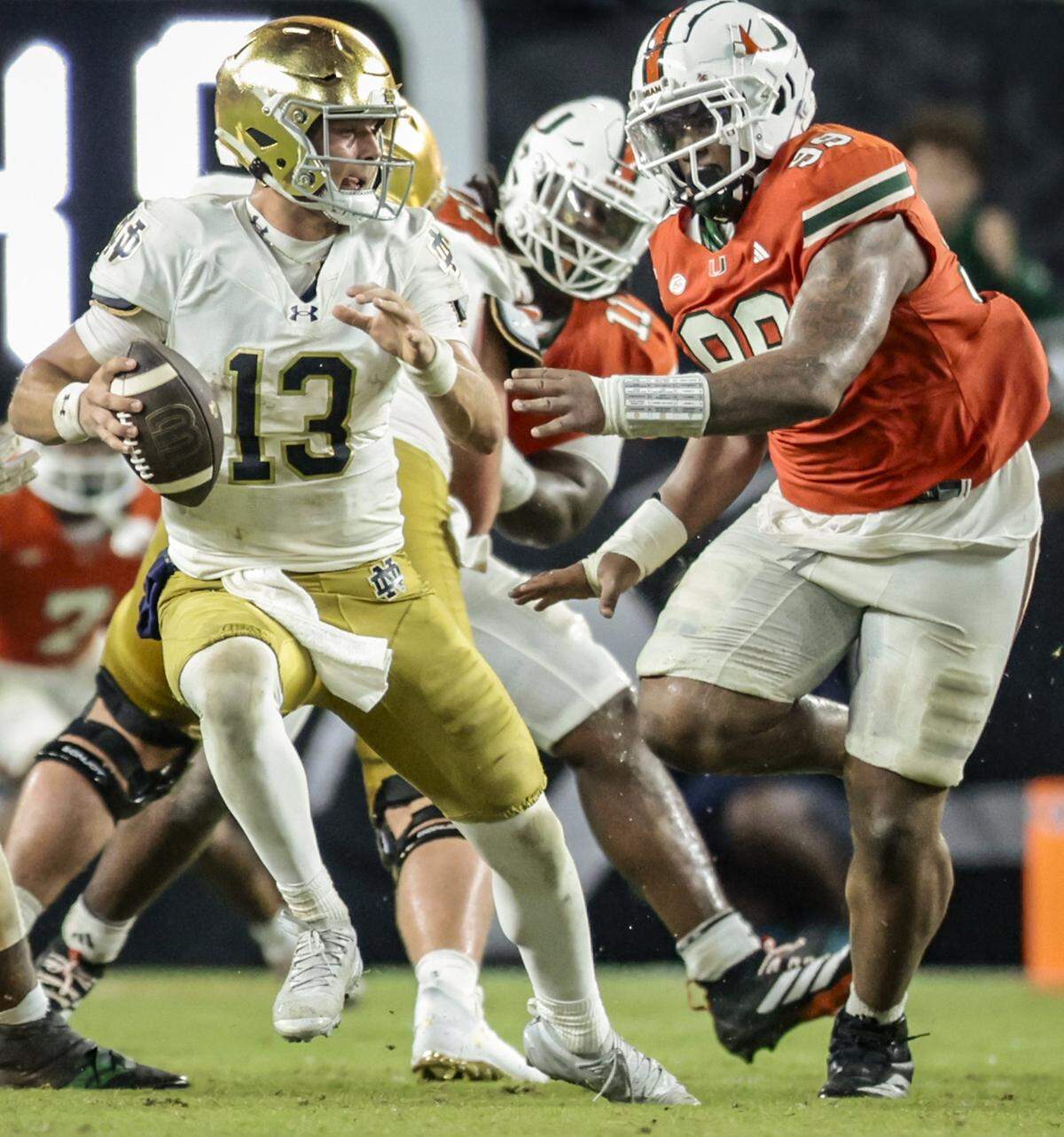
So why not implement basic rules that would eliminate some of the subjective decisions that are avoidable?
Keep in mind that there rarely will be only two teams that finish with two losses. (At the moment, there are 10 Power 4 teams have two losses.) So automatically giving Miami the nod over Notre Dame and the eight other teams with two losses wouldn’t be equitable.
But if all the Power 4 teams with two losses played each other, then the record among those teams in head-to-head matchups should be the tiebreaker.
And if the Power 4 teams with two losses didn’t play each other, why not rank those teams in order of the records against teams with two losses, one loss or no loss, and allow that to determine at large bids.
Shouldn’t the teams with the best records against the best teams — something that can be determined with no subjectivity required — be rewarded?
That proposal would not always assure that a two-loss team that won a head-to-head matchup with another two-loss team would get the nod, but it makes it far more likely. (UM would beat out Notre Dame using this formula.)
If there are still ties, use record in games played against a minimum of three common opponents to break the tie.
If that doesn’t break the tie, use the NFL’s “strength of schedule” model — the average win-loss percentage of the teams on your schedule, with a formula designed to credit teams for non-conference wins against Top 25 teams.
There is always going to be some subjective element to all of this. But the goal should be to find a fair formula to minimize those subjective elements, not only to treat every school without bias but also to avoid any perception of conflict of interest.
That perception now exists in several ways, including the addition of Utah athletic director Mark Harlan to the committee last week. Yes, Harlan and other ADs recuse themselves for voting for their own school.
But there’s still an appearance of conflict, because Arizona State remaining in the rankings (at 25) gave Utah a 1-0 record against teams in the CFP top 25, which is among the reasons No. 12 Utah is ranked one spot ahead of Miami.
So why not do everything possible to avoid the appearance of conflict by instituting hard-and-fast tiebreakers that break ties among all Power 4 teams with one loss or two losses?
▪ As colleague Jordan McPherson noted here, a Georgia Tech win against visiting Pittsburgh on Saturday night would eliminate UM’s slim chances to make the ACC title game. Even if Pittsburgh wins, Miami still needs one SMU loss (against Louisville or California) and likely one Duke loss (to UNC or Wake Forest), beyond winning out against Virginia Tech and Pittsburgh.
Miami’s chances of making the playoffs as an at-large team are higher, but not much higher. Because room in the field must be made for the ACC champion and the highest-ranking Group of 5 champion, UM likely needs to supplant three teams ahead of it in the standings, which would be accomplished by winning out and a Utah loss (it will be heavily favored against Kansas and Kansas State) and a BYU loss (at Cincinnati and home to UCF) and potentially a third loss by Oklahoma (home to Missouri or LSU) or an Alabama upset loss to Auburn or a shocking Notre Dame loss to Syracuse or Stanford.
There’s also the chance that if Utah and BYU lose, the committee could move UM ahead of Notre Dame because the CFP says it will heavily weigh UM’s win against Notre Dame only if they are within three spots of each other, or both ranked between 9 and 12. (They’re separated by four now, with Notre Dame 9th and Miami 13th).
A case could be made to root against Oregon against USC on Saturday, because that would give the Ducks two losses. But a case also could be made to root for Oregon, because that would eliminate the chances of the No. 15 Trojans jumping the Canes and also would tarnish Notre Dame’s biggest win (against USC).
▪ Even beyond the outrage of ignoring UM’s win against Notre Dame, the fact the committee suddenly is prioritizing quality losses seems arbitrary, because that isn’t mentioned among criteria that the committee is supposed to consider.
Here’s how it reads in the Selection Committee Protocol document:
“The committee will select the teams using a process that distinguishes among otherwise comparable teams by considering: Strength of schedule, Head-to-head competition Comparative outcomes of common opponents [without incenting margin of victory], and, other relevant factors such as unavailability of key players and coaches that may have affected a team’s performance during the season or likely will affect its postseason performance.”
Though strength of schedule factors in quality of opponents, nowhere does it say that “quality losses” should be factored in.
In explaining why UM is four spots behind Notre Dame, CFP selection committee chair Hunter Yurachek has said “we really compare the losses of those two teams.” (Notre Dame lost to ranked UM and Texas A&M, while UM lost to now-unranked Louisville and SMU.)
How is that suddenly a thing when there is nothing in the bylaws to support that?
▪ Among the most pleasant surprises of this UM season: how effective transfers Jakobe Thomas and Keionte Scott have been in coverage. Scott, whose season-ending leg injury was very damaging, went from having a 145 passer rating against at Auburn last season to producing a 66.7 passer rating against with Miami.
Thomas has four interceptions and a 61.5 rating in his coverage area, with 17 completions in 30 targets for 213 yards — after posting a 116.7 passer rating against in limited coverage work at Tennessee last season.
Credit both players — and also credit defensive backs coach Zac Etheridge and coordinator Corey Hetherman.
Thomas, who has three interceptions over the past two games, “brings a level of physicality that’s really, really hard to find,” Mario Cristobal said on his coach’s show.
▪ Freshman safety Bryce Fitzgerald played 36 snaps in Scott’s absence against North Carolina State and permitted two of four passes in his coverage area to be caught for 23 yards.
“People don’t realize how hard it is to miss winter and spring,” Cristobal said of Fitzgerald, UM’s only scholarship freshman who enrolled after spring football. “We threw a lot on his plate — multiple positions, special teams. He’s not phased.”
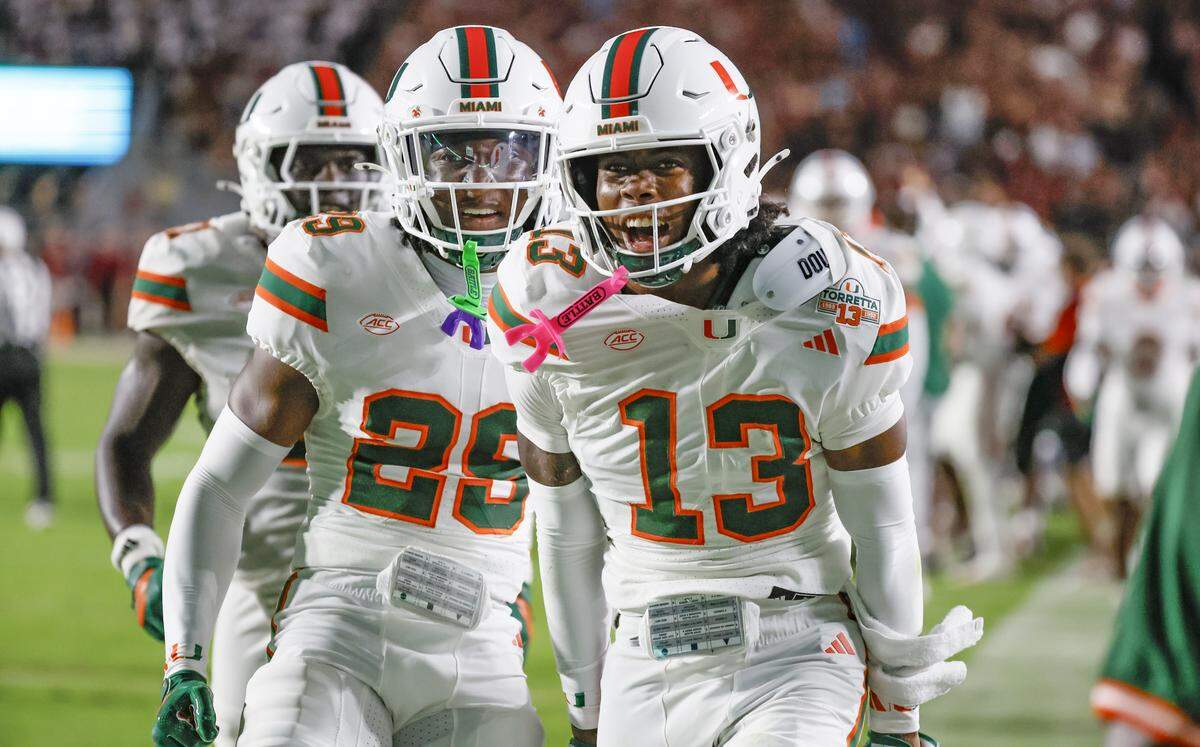
For the season, Fitzgerald has a strong 70.5 passer rating in his coverage area.
With OJ Frederique out, cornerback snaps are being split fairly evenly among Damari Brown (30 last week), Xavier Lucas (27) and Ethan O’Connor (27).
The passer ratings against all three this season — 60.8 against Brown, 63.7 against Lucas and 94 against O’Connor.
▪ Quick stuff: Cristobal, on his coach’s show, explained the better offensive play the past two weeks this way: “We finally relieved ourselves of anxiety by acknowledging we are our own worst enemy” and deciding to “attend to those things” that have been hurtful. That, he said, has included “calling the right plays,” blocking more effectively and playing the right players…
Cristobal said the team made the decision recently to “put together the best November in the history of the program.”...
ESPN assigned Bob Wischusen and Louis Riddick to Saturday’s noon game at Virginia Tech.
This story was originally published November 20, 2025 at 2:54 PM.
