Rhett Lashlee’s arrival in Coral Gables effectively meant a blank slate for the Miami Hurricanes’ offense. The offensive coordinator encouraged open competition at nearly every spot at the outset of spring practice. Miami shifted players around on the offensive line and let a group of mostly unproven wide receivers compete to be the Hurricanes’ top targets. Lashlee even insists there’s a quarterback competition despite D’Eriq King’s arrival as a high-profile transfer in January.
The assistant coach could only learn so much from the four spring practices Miami held before the COVID-19 pandemic chased students and forced the NCAA to halt all athletic activities. Whenever the NCAA outlines a timeline for the return of college football, Lashlee will have an important set of decisions to make under unusual circumstances.
“There’s no question it’s going to be different than — quote — ‘normal,’” said Lashlee, who is also the quarterbacks coach. “We’ve got competitions going on everywhere, and we’re going to have to make decisions quicker probably than normal in terms of the amount of practices or data we have to go into that decision because depending on how much time they give us you’ve got to get ready, but I look at it like this: We’re football coaches. It’s our job to get done whatever they put in front of us and if they want us to play on Sept. 3 in the Walmart parking lot, then we’ve got to find a way to get that done.”
For now, the NCAA remains in a holding pattern. Coaches are meeting virtually with conference commissioners and conference commissioners are all meeting virtually with each other to try to figure out what a return plan will look like. For now, there is no concrete plan. The season could move to early 2021 or be delayed until later in the fall, but the NCAA also hasn’t officially postponed anything from the currently planned August start date.
Lashlee is in the unenviable position of trying to entirely overhaul the Hurricanes’ offense remotely. He arrived as the offensive coordinator in January, promising to implement an up-tempo, spread attack. He got a few months to teach in the meeting room and then four practices — two in full pads — to teach at Greentree Practice Fields before the coronavirus shut down spring practice.
Those four practices, though, were more than most teams got. Only a handful of teams kicked off their spring practices before the virus started to run rampant, and those few practices are an advantage Lashlee and his staff, which also includes new offensive line coach Garin Justice and new wide receivers coach Rob Likens, can lean on.
“That was really good for us to learn a little bit about our kids. Did we learn all the info we needed? No, but we at least have something to go off of other than just our initial thoughts, and so it gives us a better educated guess,” Lashlee said. “It was good for our kids to learn us at least enough to know how we coach, and how our demeanor is and the expectation. Everything from the way we want to practice and how we want the offense to go, they at least understand that.”
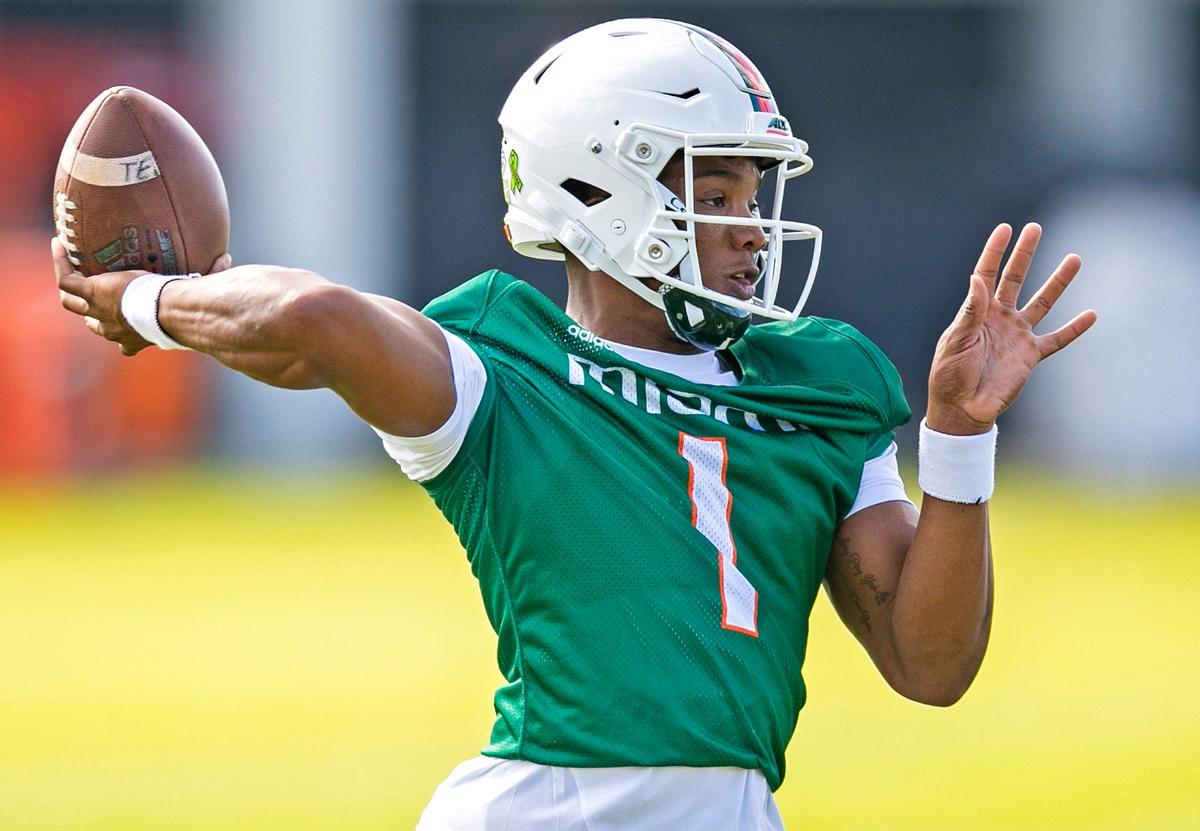
Miami Hurricanes quarterback D’Eriq King (1) sets up to pass during a March 2 practice. King impressed everyone during the Hurricanes’ first week of spring practices. Al Diaz adiaz@miamiherald.com
D’Eriq King’s challenge
Now the toughest challenge coaches face is the near-total inability to monitor their players. Miami begins every day with remote video conferencing meetings , either to have players meet with coach Manny Diaz, their coordinator or their position coach. The Hurricanes follow those meetings up by video chatting as a group with strength and conditioning coach David Feeley, who suggests a workout for the day with demonstrations of how to complete them. Once those are done, Miami releases its players to go about the rest of their days on their own.
This time of year — between the end of spring practice and the end of the spring semester — would usually see the Carol Soffer Indoor Practice Facility brimming with players coming in to work out on their own. A first-year quarterback such as King, who joined the Hurricanes in January after a standout four-year career with the Houston Cougars, would round up his new group of receivers to build even more chemistry with the unfamiliar lot. Coaches, although unable to mandate anything like this or take part in any official capacity, would be able to watch it all from their offices overlooking the indoor practice fields.
In non-ideal circumstances, Lashlee said it’s good to have a veteran like King, who knows what sort of commitment it takes to be successful in the sport. The assistant coach is happy with how his quarterback — and everyone on offense — is handling it.
“This whole distancing physically makes it a lot harder to maybe develop those relationships with a personal level, but I know he’s stayed in contact with the guys, both in the quarterback room and at other skill spots,” Lashlee said. “For all of our players, we can’t work them out, we can’t make them do anything, so a lot of this is on them to be self-motivated self starters. Fortunately, a lot of our guys, I think, have done a lot on their own to try to stay in shape and stay ready. That’s what we preached to them is at some point this thing is going to break to the point they’re going to let us get back to work and get ready for a season at some point. We don’t know when that’ll be and we’ve got to be ready.”