
This is how UM star got mentally tough and ignored all distractions to win a national title
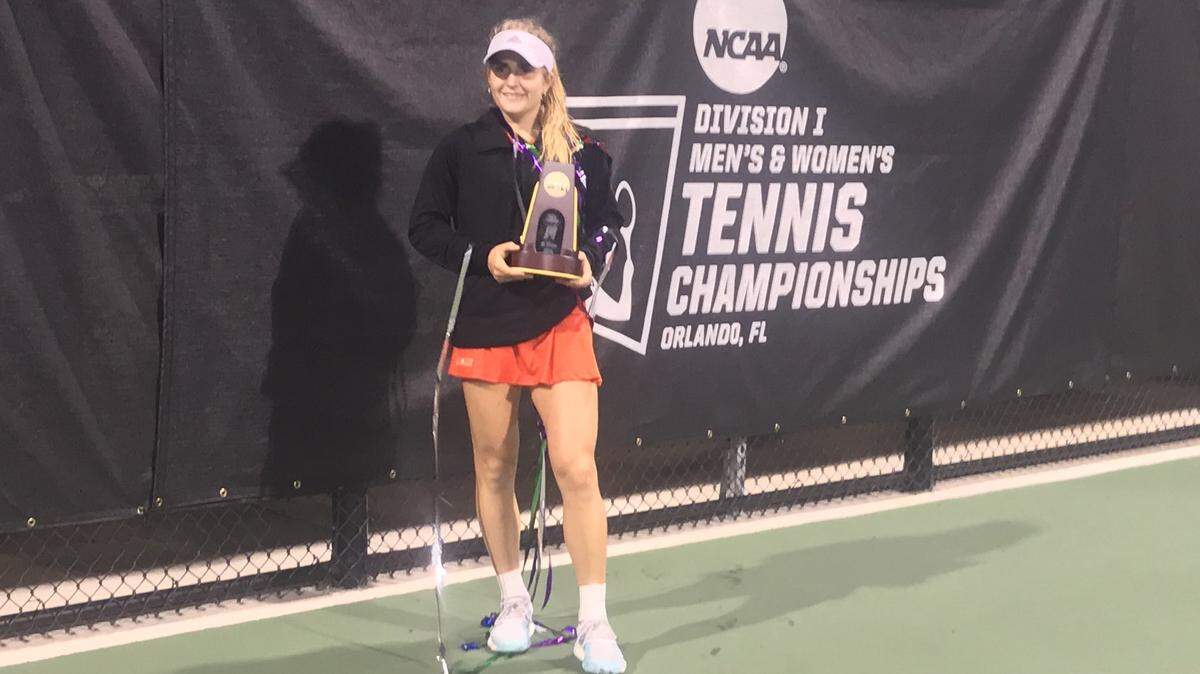
Georgia had a Bulldog … but Miami had a pit bull.
That’s one way to describe how it is that Miami Hurricanes junior Estela Perez-Somarriba — whose best on-court attribute is her dogged determination — won the 2019 women’s tennis national singles title this past Saturday night in Orlando.
Perez-Somarriba was able to keep her focus despite her opponent, Georgia’s Katarina Jokic, crying in frustration several times during the match. In addition, there were loud cheers from a nearby court where a championship doubles match was being played, but Perez Somarriba was able to block out that noise as well.
“I was just trying to think about me and the ball,” Perez-Somarriba said after her 6-7 (1-7), 6-2, 6-3 win. “No one else.”
After dropping the first set to the second-seeded Jokic, Perez-Somarriba won 12 of the final 17 games, proving that her No. 1 seed going into the tournament was legit.
“With what was on the line, this was the best college tennis match I’ve ever seen,” said Paige Yaroshuk-Tews, who has been the head coach of the Hurricanes for 18 years. “The physicality on both sides, for nearly three hours (2:53), was impressive.”
Perez-Somarriba won six matches in six days to become just the second women’s tennis player in Canes history to win a national title, joining Audra Cohen (2007).
As it turns out, Jokic, a 5-7 sophomore from Bosnia, and Perez-Somarriba, a 5-5 junior from Madrid, Spain, have a rivalry that goes back for more than a decade. They played once when they were about eight years old in Europe, but Jokic doesn’t recall the match, which Perez-Somarriba perceived as a slight.
They met again in November of 2017 in Georgia, and Jokic prevailed 7-5, 7-5. That loss also did not sit well with Perez-Somarriba, who led the nation in wins this season (43-5).
“I watched [Jokic] a lot this week,” Yaroshuk-Tews said of her scouting work. “And every time she and ‘Stela’ crossed paths, they did not acknowledge each other. You could feel that Katarina wanted to play Stela, and Stela wanted to play Katarina.”
They each got the matchup they desired, but not until Perez-Somarriba survived a scare to reach the quarterfinals, losing the first set before beating No. 77 Paola Diaz-Delgado of VCU, 4-6, 6-0, 7-6 (7-3).
Jokic, who made a deep run in doubles and in the team competition, seemed to run out of energy against Perez-Somarriba. That’s understandable — it was Jokic’s 15th match in nine days.
Early on, though, Jokic — whose strength is her crushing backhand — seemed to be anticipating every Perez-Somarriba shot.
Miami assistant coach and former star player Laura Vallverdu, one of just three Canes to make the NCAA final along with Perez-Somarriba and Cohen, didn’t like that first set.
“I told Paige, ‘This is not working. We have to confuse [Jokic],” Vallverdu said. “[Jokic] was controlling the court.”
Miami changed its strategy in the second set, and Perez-Somarriba started hitting some more looping shots, changing speeds and the eye angle for Jokic. Perez-Somarriba also hit more balls down the middle, taking the angles away from Jokic.
The plan worked, and Perez-Somarriba improved her career NCAA Tournament record to 12-2, breaking the program record for postseason wins. She also went 31-1 over her final 32 matches this year, losing just six sets during that span.
Perez-Somarriba is in phenomenal shape, and the tougher the opponent, the better she plays. She went 19-2 against top-50 foes, 10-1 against top-25 players and 5-0 vs. top 10.
Yaroshuk-Tews said she wasn’t nervous for Perez-Somarriba during the title match — just excited.
“My mentality is, ‘I’m going to war with her’,” the coach said. “I’m doing the mental work, and she’s doing the mental and physical work.”
That philosophy hasn’t always worked. Perez-Somarriba made a stunning march to the Final Four as a freshman but was upset in the Sweet-16 round as a sophomore.
“Last year, she choked,” Yaroshuk-Tews said. “There’s no denying she got tight. She had performance anxiety.
“Stela is a perfectionist — in tennis, in school, with her nutrition, everything. But she faced a girl she had played before and knew her weaknesses, and she panicked. I remember flying home from that tournament thinking, ‘We have to figure this out.’”
Yaroshuk-Tews spent the past 12 months working on her star’s mental toughness, making her a pit bull on the court.
“I would tell her, ‘Stela, this is how I would beat you,’” the coach said. “That made her angry.
“We would play games in practice where she was only allowed to hit slices. Sometimes she didn’t understand why. Sometimes she didn’t like me. Laura played ‘good cop.’ I was ‘bad cop.’”
Sufficiently toughened, Perez-Somarriba arrived on the court on Saturday believing that the only way she was leaving Orlando was with the first-place trophy.
“I’m happy all the work I put in paid off,” said Perez-Somarriba, who is majoring in Economics and intends to return for her senior season before graduating in May of 2020.
Perez-Somarriba is now in Spain, vacationing with her family, but she plans to return in one month. She said she will rest for a few days before reaching for her tennis rackets.
“I love tennis,” she said. “I don’t think I can be away for more than one week.”
This story was originally published May 28, 2019 at 12:08 PM.