
Here are four stories worth watching for at the 2026 Life Time Miami Marathon
.jpeg "Sandy Duplicki (left) will be guiding blind runner Kimberley Dobbs in the 2026 Life Time Miami Marathon.")
When 18,500 people line up in front of Kaseya Center to participate in the Life Time Miami Marathon and Half-Marathon on Jan. 25, each will arrive with a story.
A story of triumph over an illness. A story of loss. A story of love. Or, simply, a desire to stay fit, take on a personal challenge and cross the finish line.
Here are four stories worth watching for that morning.
A Team Effort
Sandy Duplicki will be running the half-marathon tethered wrist-to-wrist to Kimberley Dobbs, who is blind.
Two years ago, Duplicki, an avid runner from the Philadelphia suburb of Lansdale, became Dobbs’ guide after replying to a message on a local Facebook runners’ group.
“Kim reached out and said, `I’d like somebody to take me on hikes. I’m a blind woman. I want to try hiking. Would anybody be interested?’,” Duplicki recalled.
Thirty-five years prior, Duplicki volunteered to help at a Special Olympics event, and her assignment was to guide a blind runner for one lap on a track. The experience stuck with her, so she offered to accompany Dobbs on hikes along the Green Ribbon Trail, a natural dirt trail that follows the Wissahickon Creek.
Before long, Dobbs, a 42-year-old therapist who had competed in paralympic cycling, decided to take up running. Duplicki, a 54-year-old who works at a mortgage company, was inspired to help her reach her goal.
“I’m not into running for myself anymore; I like the fitness, the feeling you get afterwards that you’ve accomplished something, but I wasn’t setting giant challenges for myself anymore, so this was the perfect time to help someone else reach their goals,” she said. “It’s been very rewarding.”
Last summer, they did the Philadelphia Women’s Triathlon together, and since then they have been training for the Miami Half-Marathon, which will be the longest distance Dobbs has ever run.
Dobbs, who went blind as a teenager, chose to race in Miami because of the warm weather and because she has a friend who is competing in the para-cycling division.
Duplicki and Dobbs link their wrists with a hoodie drawstring (they find that works better than a shoelace) with about a foot of distance between them. Duplicki gives directions as they go, alerting Dobbs when to turn right and left, if there is a speed bump, pothole, manhole cover, or any other obstacles on the racecourse.
“I will say, for example, `Speed bump coming in 3-2-1, and then she knows exactly when to expect it,’’’ Duplicki explained. “If there are pine cones on the road, I let her know. Most of the time we are just talking about other things, and then I’ll loudly interrupt and give her an instruction.”
The Miami Marathon allows blind runners to have two guides, one on each side, so Duplicki’s eldest daughter, Ellie, will also be alongside Dobbs next Sunday. Her job will be primarily to warn other runners not to bump into them.
A Heart Worth Saving
Migdalia Rodriguez thought she might die when she went into surgery for a heart transplant on Jan. 13, 2025. More than a year later, the 41-year-old from Miramar will be walking in the Miami Half-Marathon, with a plan to attempt to sprint the final stretch to the finish line.
“In April of 2024 I was told I had end-stage heart failure,” she said. “I went from thinking I was going to travel the world to finding out I had months to live. My world collapsed. I used to be super athletic, so this was devastating news.”
She was told the only option was a heart transplant. She went through the surgery at the Cleveland Clinic in Weston and immediately afterward, she envisioned herself walking and running again. She made that her personal goal.
“All I wanted to do was get up and move, my body was like, `This can’t be it.’ My soul was like `This isn’t it. This is not the end of my story’,” Rodriguez said. “I had to find a purpose.”
Buoyed by the support of close friends, she got stronger little by little. She started with a walker, then a few steps on her own at a time. Now, she feels she is ready to walk the half-marathon.
.jpeg "image1 (2).jpeg")
“Heart failure couldn’t take my spirit away; I am going to meet that goal, even it if means I have to walk and not run, but I am going to make that finish line,” she said. “For me, this is spiritually and emotionally symbolic. I am going to show the world that no matter what tragedy brings me down, I am going to fight back.”
Rodriguez is writing a book about her journey, which she plans to self-publish in February. It is titled “A Heart Worth Saving.” In the book she will explain how much it meant for her that somebody’s donated heart saved her life.
“Think about what this heart has done for me,” she said. “Through the power of organ donation, you are able to save other lives when your life is gone. We can save and impact other lives beyond our time, beyond the finish line.”
Motherly Love
Alexandra Losardo watches her 2-year-old son Jay battle Cerebral Palsy every day, sees him struggle through hours of intensive physical therapy when he would rather be home playing with trucks.
“He has to work 10 times harder than a normal 2-year-old does, so I thought, if he can do it, I can certainly push myself, as well,” she said. “I’ve always been a bit of a runner, but I’m not a long-distance runner by any means, so I want to do this to raise money for research in honor of my son.”
Inspired by her son’s fighting spirit, Losardo, who moved to Coral Gables from San Francisco in 2021 with her husband and their two children, will be running her first full marathon to raise money for the Cerebral Palsy Alliance Research Foundation.
The plan is for her family to be waiting for her at the finish line.
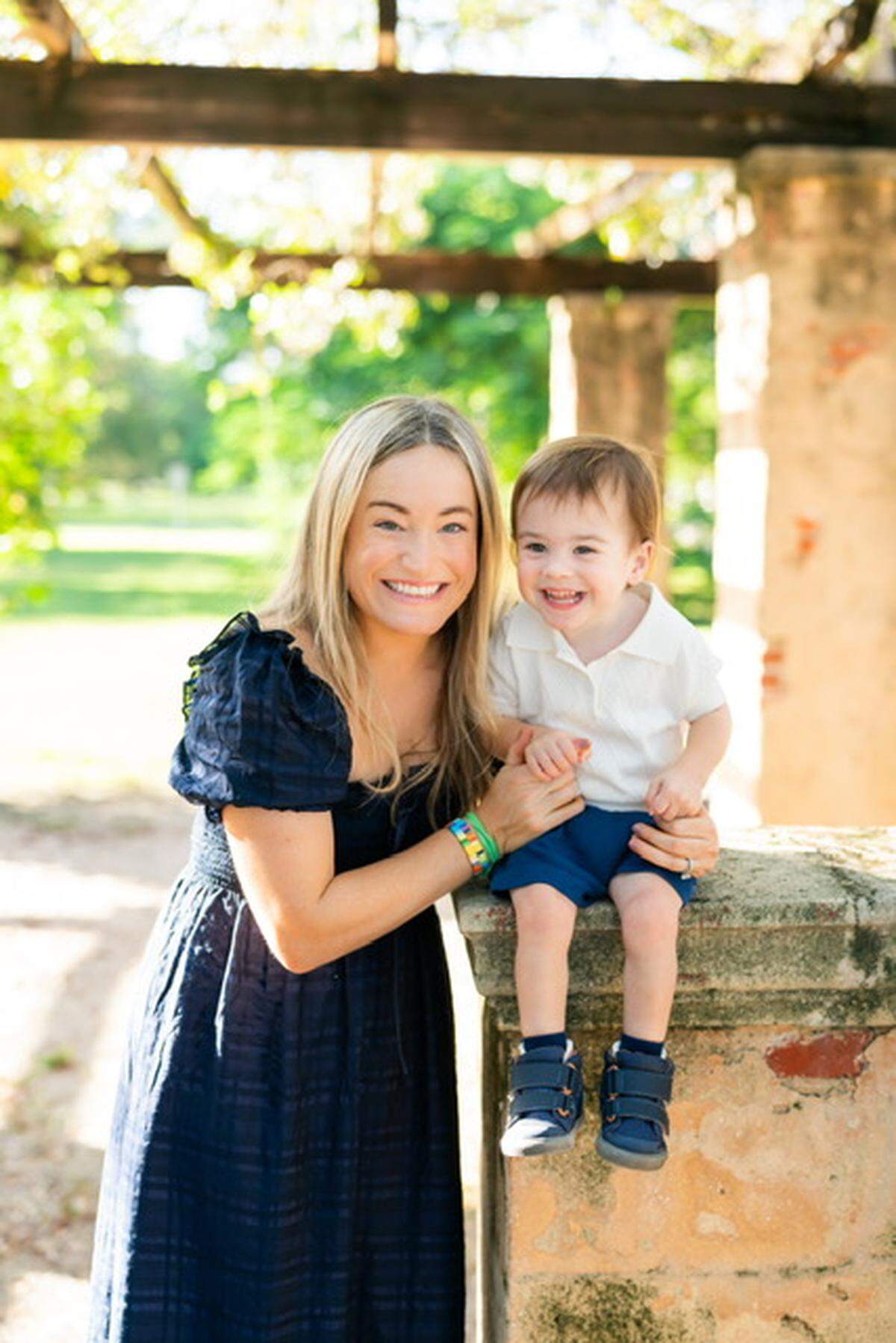
Losardo was a nurse for 12 years but gave up her job to take care of her son and their 10-month-old daughter, Gigi.
“Running has always been my stress reliever, my therapy,” she said. “Now, it means even more to be doing it with this purpose.”
Love at the Start Line
Elvis Manzanillo remembers the exact moment he fell in love with Kat Pena. It was at the start line of the 2022 Miami Marathon. The D.J., hyping up the crowd, did a roll call of countries asking people to cheer if they were from that country.
When he shouted “Dominican Republic!” Manzanillo, an occupational therapist living in Broward County, screamed. So did Pena, a health care worker who was visiting Boston. They made eye contact.
And thus began a marathon love story.
They took a photo together. He asked for her phone number and invited her to brunch after the race. She accepted.
“We’ve been together ever since,” Manzanillo said. “She’s my life partner. She wound up moving to South Florida and we formed a life together and created a running community in Broward County that has impacted hundreds of lives.”
.jpeg "image2 (3).jpeg")
Last year, 85 runners from their club, The Broward Running Society, participated in the Miami Marathon. This year, 64 signed up. The ones who aren’t running will be cheering their friends on at Mile 11 at the corner of Northeast 16th Street and 2nd Avenue They will throw confetti and blast noisemakers.
“We have formed a great running community, given people something healthy to do two to three times a week,” he said. “It’s better than going to a bar into the wee hours of the night. And to think, all of this started because we made eye contact at the start line of the Miami Marathon.”
This story was originally published January 16, 2026 at 6:09 PM.