
UF’s Lee looks to buck trend of mid-major transfers struggling at big programs
In college basketball transfers from mid-majors are usually going to be a work in progress, especially when faced with the immediate challenge of contributing to a contender. That doesn’t stop the top teams from recruiting mid-major stars, but the pan-out rate isn’t optimal.
In recent years, obscured names only the sport’s crazies will recognize, like Malachi Smith, Tyson Walker and Nicolas Timberlake, have ventured to beasts like Gonzaga, Kansas and Michigan State, having led their previous conferences in scoring on ballooned usage rates. While some had time to develop, none matched the expectations that followed them to their high-major stop. In turn, the top-ranked team they joined underperformed.
No. 22 Florida (8-4) is a good team. Yet the Gators’ 28.2% clip from three-point range foils any aspirations of being a great team. And the poster child is Xaivian Lee, an transfer from Princeton, who’s shooting a team worst among rotation players at 35.2%. The transition from Ivy League to SEC has taken longer than expected, or Florida anticipated, which rested its repeat hopes on the illusion of him achieving something almost no other mid-major transfer in his situation has done.
“Saying we’re going to do it and doing it are two different things,” Lee said candidly about his struggles in late November. “Every game is like this is the game and then — whatever.”
While past players can only be so much of a predictive measuring stick, f how mid-major transfers to top teams have performed in other instances can serve some value for fans hoping to see Lee improve.
In this test, we limited the data sources to the preseason top-five teams of each of the past 10 years, to best replicate the nature of Florida’s circumstances entering this year at No. 3. Those 50 teams have relied on 23 mid-major transfers as rotation players. Comparing the first 15 games of each transfer’s season to however many games thereafter, which typically placed the breaking point in the second week of conference play, 13 of the 23 increased or maintained how much they were scoring.
More than 50% of mid-major transfers watched their shooting percentage decrease through the season. Lee can’t afford that, as he delicately outlined a week ago when saying he needs to “make some [expletive] shots.”
What shouldn’t come as much of a surprise is that rarely does any player such as Lee improve offensively from the mid-major to high-major levels. In the last decade, 87% of mid-major transfers decreased their scoring after transferring, and 56.5% did so by seven points or more.
Outliers persist, such as Miami’s Tru Washington, who transferred from New Mexico to UM this year and still improved from 10 to 13 points. More often than not, though, these players struggle to find their footing in a faster environment. That doesn’t mean they can’t ultimately prove integral to a postseason run. Think, Jordan Miller, a couple of years ago. But he even struggled in his first season at UM after transferring from George Mason.
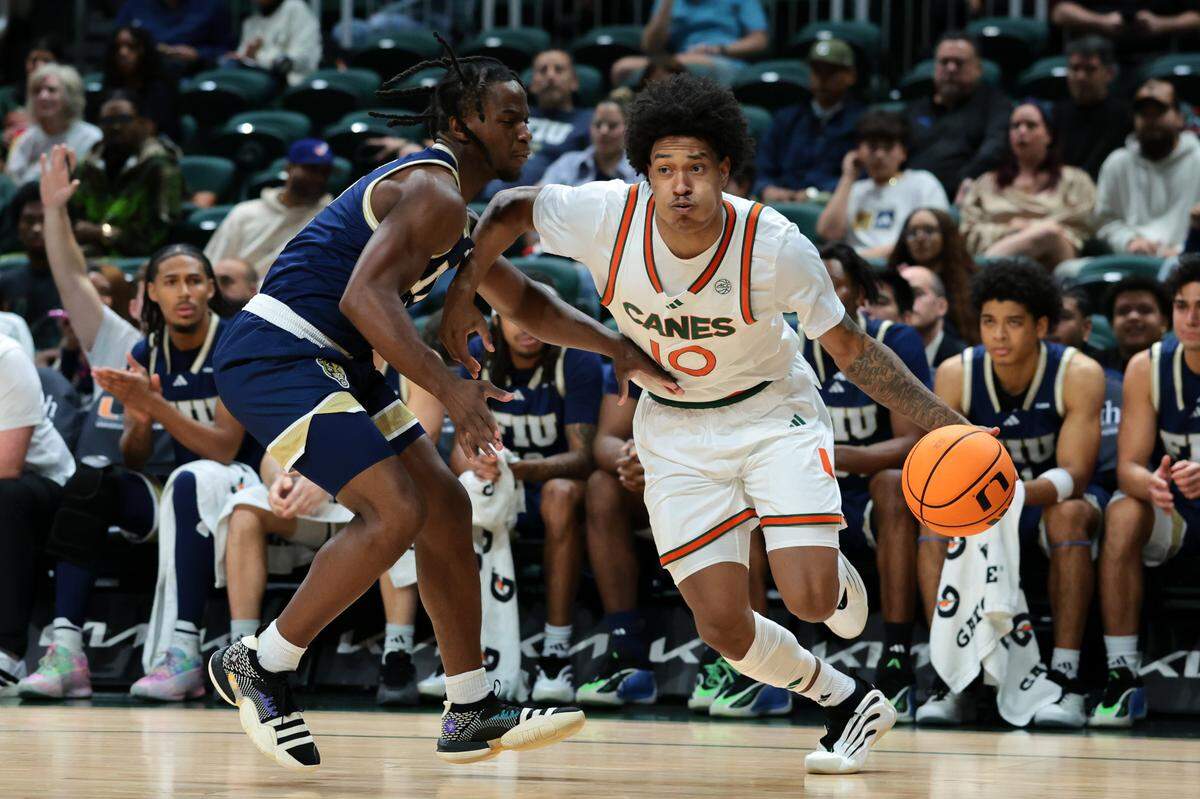
“He was with us for two years, and we only got to the Elite Eight and the Final Four,” Miami coach Jim Larrañaga said. “I’d say that was a pretty big impact.”
Of last season’s first- and second-team All-Americans, 60% were once mid-major transfers. So the framework for success is clearly established. Even then, what Lee has done during his past six games would be an outlier. Despite starting the season averaging just 7.2 points, he has now leaped to 17.3 points since, with at least 14-point increases in his field-goal and three-point percentages. His competition during that stretch, while weaker in Florida’s last three games, includes No. 4 Duke and No. 5 UConn.
“The obvious one for me is Xaivian playing really well, starting to shoot the ball well and starting to score for us,” Florida coach Todd Golden said. “That’s given us a big lift.”
The Gators turn to SEC play in a week. But if his current level maintains, or he even conserves a semblance of the efficient Ivy Leaguer-turned-SEC star he has been lately, Florida’s preseason dreams might still be realistic.