
‘Bad housing policy’: Miami approves parking rules that could worsen home affordability
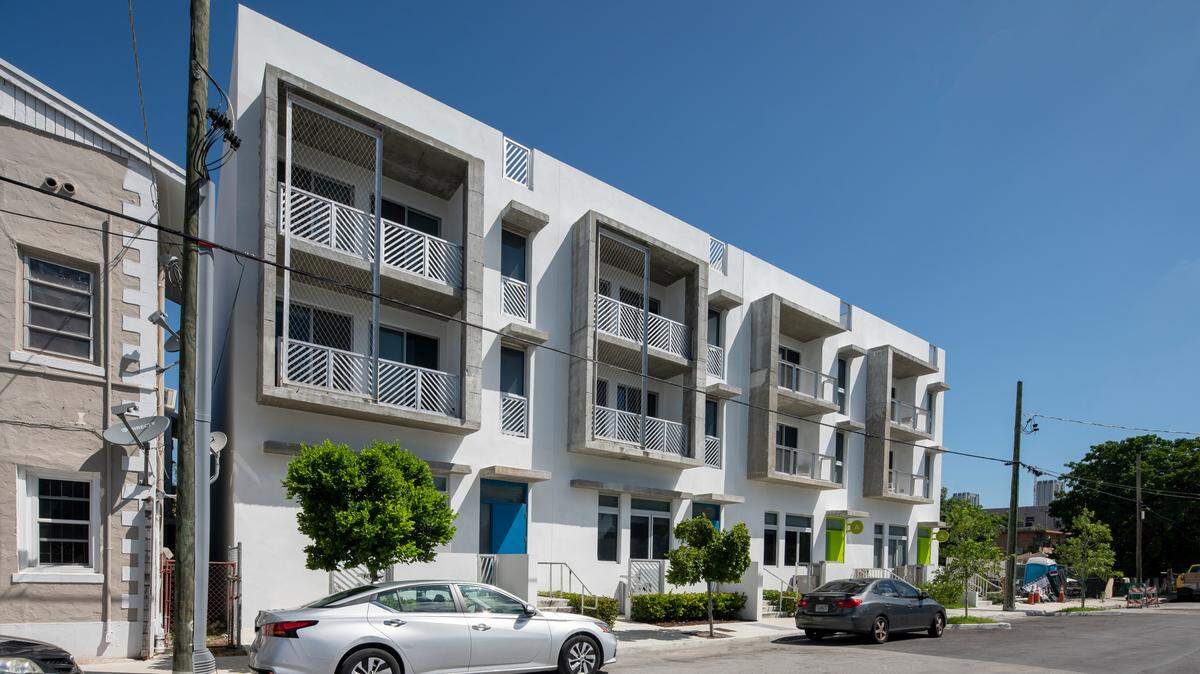
A controversial measure that significantly curtails parking-reduction ordinances credited with spurring construction of affordable and lower-cost housing across Miami easily won approval from city commissioners on Thursday — but not before they agreed to exempt a broad swath of neighborhoods from its effect amid an outcry from housing advocates, builders and developers.
The 4-1 vote still erects what critics say is a significant hurdle to developers looking to reduce required parking in real estate development projects close to public transit stations and corridors. Those parking reductions, most of them in place since the start of the city’s Miami 21 zoning code in 2009, have until now been routinely approved by planning officials.
The new rule requires that all applications for parking reductions go through a full series of public hearings, culminating in a city commission vote. Critics say that politicizes and prolongs the approval process by months or even years, increasing costs and likely discouraging many developers — especially developers who have been building small apartment houses in Little Havana and other urban neighborhoods — from pursuing projects that wouldn’t be feasible without parking waivers.
Amid an unprecedented housing crunch that recently prompted Miami commissioners to declare a public emergency, advocates say that ability to reduce costly parking — or in the case of small buildings, to forgo parking entirely — has led to construction of dozens of small- and large-scale urban residential developments in downtown Miami and neighborhoods like Little Havana. By saving on parking, developers can offer more units at lower rents and prices, they say.
The change was driven by concerns from two commissioners, Joe Carollo and Manolo Reyes, who dismissed critics’ concerns. The commissioners said they were motivated by parking shortages in neighborhoods in their districts, which include Little Havana and Flagami. They didn’t link the shortage to any specific projects, while city administrators presented no justification or analysis for the abrupt change.
City planners have pointedly declined to discuss it, noting it’s not their proposal. The city planning board voted 9-2 against an earlier, more draconian version of the park requirement change, with one member calling it “garbage.”
Just before voting, commissioners threw things into some confusion when they began proposing to carve out specific neighborhoods in their districts from the new requirement, including historically black Overtown and West Coconut Grove, as well as the Omni Community Redevelopment District that encompasses the area around the Arsht Center for the Performing Arts.
They also exempted the areas covered by the Downtown Development Authority and an obscure zoning designation called the Urban Central Business District. According to descriptions on the city’s website, those encompass a vast stretch of downtown Miami running from Southwest 15th Road in Brickell north roughly to Edgewater, and from Biscayne Bay to Interstate 95.
All the proposed carve-outs passed.
That still left extensive areas of the city, including neighborhoods badly in need of affordable housing like Little Havana, portions of Liberty City and Allapattah, subject to the new rule — and considerable uncertainty over what rules apply where. Experts note that the available parking reductions already didn’t apply near neighborhoods zoned for single-family homes or duplexes, while, on the other hand, Wynwood has two special zoning districts that are not affected by Thursday’s vote and will still allow parking reductions by administrative waiver.
Commissioners brushed aside a request before the vote from City Attorney Victoria Mendez for time to draw up maps showing which set of rules apply where.
“It was even more uncertainty that was created. It’s not clear what the boundaries are,” said Steven Wernick, a Miami land-use attorney who opposed the change, after the vote. “It’s like an administrative nightmare.”
Carollo and Reyes dismissed claims the parking-reduction measures have helped ease the city’s housing crisis. They said reducing parking in new projects would worsen a shortage of street parking in neighborhoods in their districts, including Little Havana and Flagami.
“If this is going to make such a huge difference, I haven’t seen it,” Carollo said during Thursday’s hearing, claiming, again without offering evidence, that developers use parking reductions to boost profits, not to build affordable housing. “This is a tool so some developers can make more money. And we’re getting the pain. Come to our neighborhoods. People are fighting for spaces. It’s just not worth it.”
Reyes added: “I heard all the comments that this is going to curtail development, blah blah blah. Developers are going to develop.” At a hearing last month in which commissioners gave initial approval to the change, Reyes complained that people park in front of his private property.
Only Commissioner Ken Russell voted against the change at both hearings, saying it will hurt a policy that’s proven successful.
“By requiring hearings for everyone, It becomes a political decision instead of a policy decision,” Russell said.
Miami Mayor Francis Suarez, who championed parking reductions as a commissioner, did not respond Thursday to a request for comment relayed through a spokeswoman.
Critics say that, absent the ability to reduce parking, many developers will simply build more expensive homes, passing the cost of building garages onto renters and buyers. That’s especially true at a time when the price of concrete, due in part to supply issues, has tripled, said Truly Burton, vice president at the Builders Association of South Florida.
Neighborhood parking issues can be addressed through policies such as instituting a resident permit requirement, like Miami Beach does, she said.
“If there are issues, let’s sit down and talk about it and resolve those issues,” Burton said in an interview before the vote. “This really runs counter to their housing policy. If you want to have a city where only rich people can afford to live, they’re doing a great job. It doesn’t seem to make a lot of sense. It’s bad housing policy.”
Jon Paul Perez, president of developer Related Group, said the firm has used parking reductions to pass savings to renters and buyers in numerous residential towers in and around downtown Miami, Brickell and Wynwood — not to pad profits. The firm’s projects include luxury condominiums, middle-market apartments and income-restricted affordable housing projects. The cost of a single garage parking spot ranges from $30,000 to $40,000, adding millions of dollars to the cost of a project, Perez said in an interview.
He also noted that most major cities across the country are reducing parking minimums to lower housing costs and discourage driving, at a time when many city residents want to use cars less. And much of the parking developers have to build under what he said are excessive requirements sits unused, Perez said.
Making it harder to attain reductions, he said, “is not the wave of the future. In our minds, it’s like taking a step backwards at a time when we had made progress on this.”
The Miami 21 parking rules allow developers in close proximity to Metrorail or Metromover stations and “high-frequency” bus lines to apply to reduce minimum required parking — which is set at 1.5 spaces per residential unit, for instance — by 30%, 50%, or 100% in the case of buildings under 10,000 square feet.
The first version of the changes pushed by Carollo and Reyes would have entirely eliminated the 50% and 100% reductions, while requiring the 30% reductions to go to hearings. They agreed to reinstitute the first two after an onslaught of criticism.
Reyes then proposed the first carve-out in downtown Miami on Thursday, conceding the district has plenty of parking already. He also acknowledged critics’ concerns that requiring parking would discourage renovation or even prompt demolition of older apartment buildings erected without parking before World War II. Extensive renovations require bringing them up to current building code and adding parking, a physical impossibility in most cases.
This story was originally published April 29, 2022 at 6:00 AM.