
‘This year in Cuba.’ Holding on to a sliver of hope in Miami | Opinion
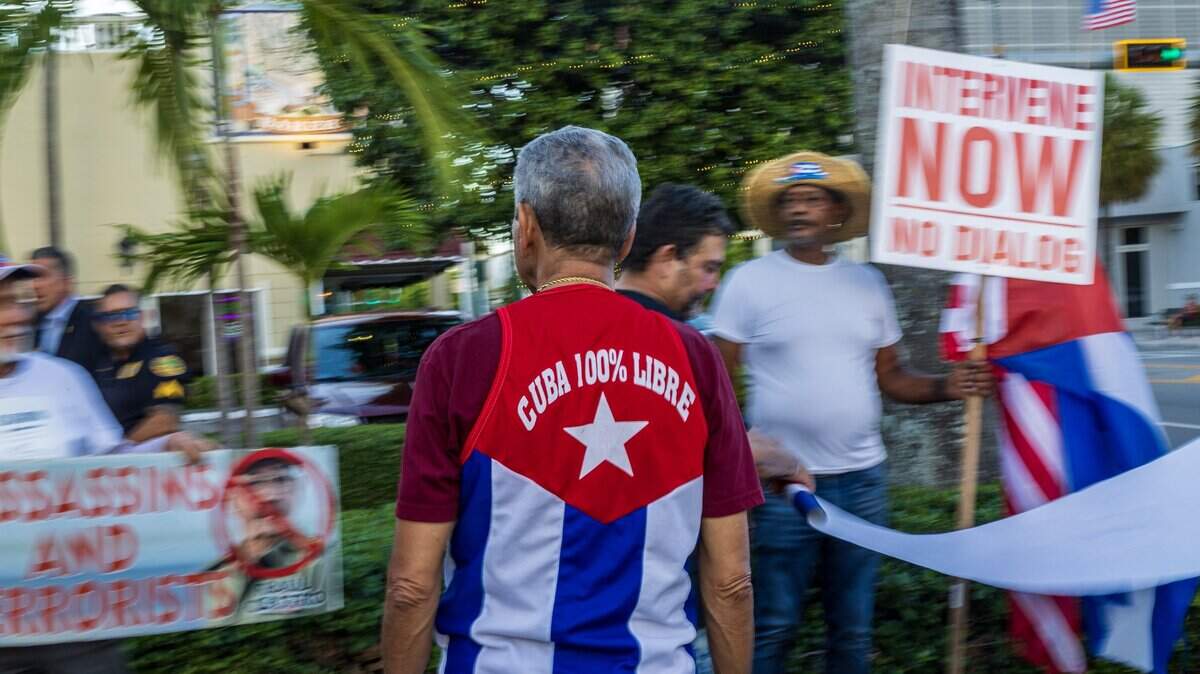
When I was growing up, every Christmas and New Year’s one family member or another would raise their glass to “next year in Cuba.” This was the holiday-party metronome of my childhood. Later, the poet, writer and academic, Gustavo Pérez Firmat, would write a Pulitzer Prize-nominated book taking the toast as its title.
The saying was proof that the Cuban exile community didn’t think they’d be in Miami for long — proof that the hope of return was more than just hope. It was a plan. That toast, however, began to fade over the years. The taller I grew, the less I heard it. The plan had changed.
It’s been decades since anyone uttered “next year in Cuba” in my house. That saying requires hope. Had hope died?
Perhaps because of my start as a visual artist, whenever I think of hope and Cuba, I think of the artist, Angel Delgado, who created a piece called La Esperanza es lo Último que se Está Perdiendo (Hope is the Last Thing We are Losing).
In 1990, Delgado created a performance in Havana, during which he walked into a state-sanctioned art exhibition, largely unnoticed at first. He set a circle of tiny green bones printed on paper on the ground, placed himself at the center of that circle, took out a copy of Granma, the official paper in Cuba — which holds only the singular, proselytizing voice of the regime — and proceeded to defecate on it.
A clear act of protest through art, the action came at a time, Delgado told me, when he felt repression closing in on his voice as an artist. Nineteen ninety was one year after the Berlin Wall fell, one year before the Soviet Union’s collapse. Cuba’s regime had a choice at this juncture. It chose to dig its claws in.
Delgado was imprisoned for six months for Hope. What would ensue on the island would soon be known as the “Special Period,” a period without Soviet subsidy, when the people of Cuba starved, lacking both food and freedom.
Not by coincidence, on this side of the diaspora in mid-90s Miami, I stopped hearing “next year in Cuba.”
On a recent phone call with Delgado, who now lives in Las Vegas, I ask him about Hope, both his piece and whether he sees any hope for Cuba.
“The system that the government has in place,” he said, “it’s impossible to do something through art and civic society. They always do the same, imprison the leaders … plant fear. The only thing that could change things, it would have to be an intervention, a very careful intervention. It’s not what I would ideally want, but…I just don’t see another way. A dictatorship doesn’t leave on its own.”
On May 20, when the U.S. government indicted Raul Castro for shooting down American civilian pilots (Brothers to the Rescue), I visited my 94-year-old grandmother. I didn’t know what she would say or if she’d even heard the news. News travels differently when you’re 94. When I’d gone to her after Fidel Castro’s death, this woman who had once hoped against hope, just shrugged her shoulders and told me it would all remain the same. The regime, she clarified, was still in power. Brutally entrenched.
This time, when I sat next to my grandmother and asked her if she’d heard the news about Raul’s indictment, she nodded, almost not looking at me.
“Y?” I asked.
There was a pause that felt eternal.
I could hear both of us breathing. And then, almost imperceptible, the beginning of a smile at the corners of her lips, the shadow of a grin. She turned to me with her permanently glassy eyes, the face I’ve looked into for comfort all my life. Now she searched my eyes. “Sera verdad?” she asked. “Could it be …?”
There it was again, that sliver of hope, exhausted and beaten, but present.
Hope doesn’t always look like what we think it will look like. It’s grittier, grayer than expected. It is, indeed, the last thing we are losing, and what, against all hope, we can’t afford to lose.
Vanessa Garcia is an author and screenwriter. She’s currently working on a book about her grandfather, who escaped three tyrannies: Franco, Hitler and Fidel Castro.