
A Holocaust survivor asked if her story will matter. Our AI choices may decide | Opinion
My phone rings, and a Holocaust survivor is on the line. She is 91. She wants to know if her story will still matter when she is gone.
I do not know how to answer that honestly, so I tell her what I know for certain: We are working on it.
Florida is home to approximately 7% of all Holocaust survivors in America, with South Florida holding one of the densest concentrations anywhere in the county; roughly 97% of the state’s survivor population lives in the tri-county area of Miami-Dade, Broward and Palm Beach.
Broward County alone is home to approximately 1,500 survivors. Miami-Dade has been the site of remarkable survivor advocacy: David Schaechter, a Holocaust survivor who co-founded the Holocaust Memorial Miami Beach in 1989 and served as president of the Holocaust Survivors Foundation USA, testified before the United States Senate Special Committee on Aging in April 2025 about the resurgence of antisemitism affecting elderly Jewish Americans, before his death that September at 96.
The memorial he helped build remains one of the most visited in the country, anchoring a community that includes one of the largest populations of elderly survivors in the nation.
Florida is also legally bound to take this seriously. In 1994, the state passed the Holocaust Education Bill, requiring every school district to incorporate Holocaust instruction, framed around understanding the ramifications of prejudice, nurturing democratic values and building tolerant citizens. That law was written when survivors were still plentiful in Florida classrooms.
Now they are fewer, and the tools entering those classrooms are more powerful and less accountable.
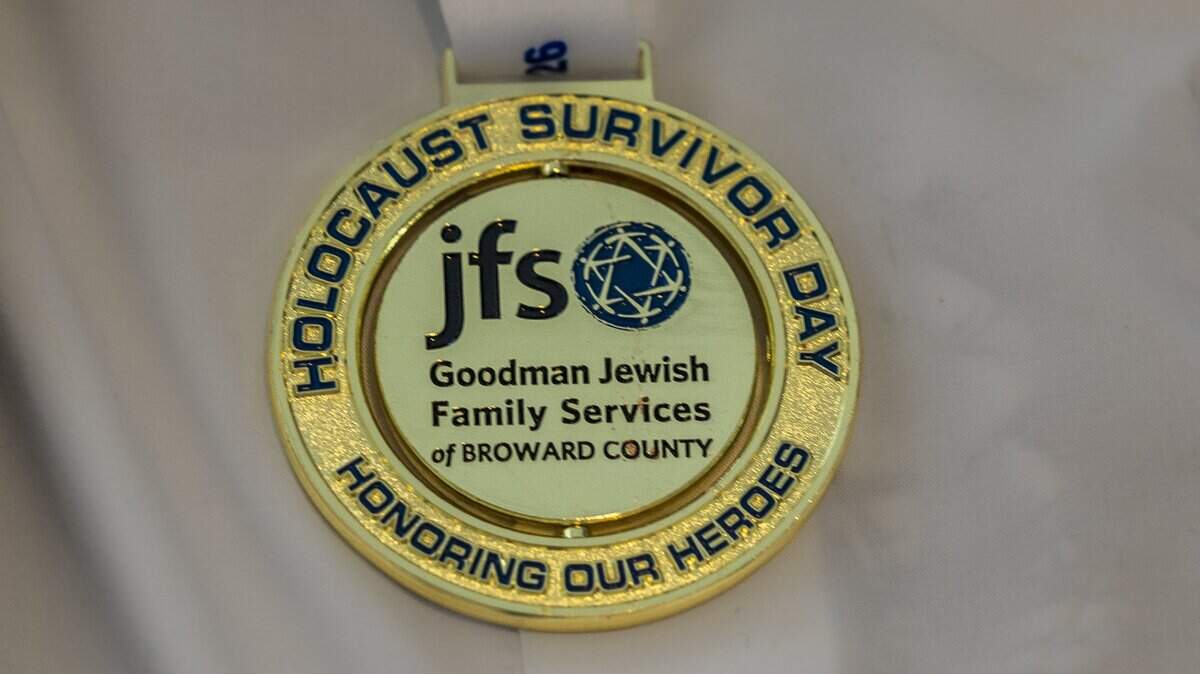
At a recent South Florida gathering on Holocaust Survivor Day, survivor Willy Lipschutz described the rising antisemitism he witnesses today: “I feel that I am about to die, and I am experiencing the same horrible situation I experienced as a baby. Antisemitism is growing. It’s growing. It’s growing.” These are not abstract fears. They come from people who have seen where indifference leads.
While leading The Blue Card, I have led the development of a hologram program featuring Sonia Warshawski, a Holocaust survivor whose testimony has been preserved and made interactive for students. When a student asks her a question, and she responds in her own words, the room goes quiet in a particular way. Something real is happening. But what makes it real is precisely what makes it different from so much of what is being built right now: the system does not generate. It retrieves. If Sonia never said something, the system does not say it for her. It pauses. It stops.
That silence is not a limitation. That is the whole point. We are not talking about getting a few facts wrong. We are talking about fabricating witnesses, building systems that speak in the voices of people who survived genocide and putting invented words in those voices because the technology can, because it sounds right. The road to that outcome is paved with good intentions and not enough caution.
Miami has the survivors to consult. It has the memorial, the institutions and the community infrastructure. What it needs from those building educational technology is the discipline to hold the line, to treat the gaps in survivor testimony not as problems to solve with prediction but as facts to honor with silence.
Survivors chose their words deliberately. That choosing is part of the testimony. A system that completes their sentences is not preserving memory. It is replacing it with something more convenient and less true.
The survivor on the phone wants to know if her story will matter. In Miami, where witnesses are still alive to be asked that question directly, what we build right now is the answer.
Masha Pearl is the executive director of The Blue Card, a nonprofit that supports Holocaust survivors in the U.S.