
At the national football championship, Cuban Americans saw their own journey | Opinion
On a cool January evening, as the lights of the national championship stadium burned bright against the winter sky, something more than a football game unfolded. For the Cuban American diaspora — scattered across Miami, New Jersey, Texas, California and countless towns in between — that night last month felt like a quiet miracle.
Out of more than 5,000 colleges and universities in the United States, what were the chances that the two programs that stood at the summit of college football would be guided there by sons of families who once crossed the Florida Straits with little more than hope in their pockets?
At one sideline stood Indiana University, led by Fernando Mendoza. His name rolled easily off the announcers’ tongues, but behind it lay a story that began decades earlier on a different shore. His grandparents, Fernando and Marta Mendoza, were part of the great wave of Cuban families forced to flee after the rise of the Castro dictatorship.
They arrived in Miami with the ache of exile in their hearts and the stubborn determination to begin again. They found work, built community and raised a son — also named Fernando — in the capital of Cuban exiles.
Fernando Mendoza, Sr., grew up in Miami and attended Christopher Columbus High School, where he played football on the same team as a young Mario Cristobal — two boys, both sons of Cuban exiles, unaware that their paths would one day converge again under the brightest lights in American sports.
Now that son, Fernando Mendoza, Jr., stood at the pinnacle of college football: The first Cuban American to win the Heisman Trophy. The quarterback who led his team through an undefeated season. The young man who, in a stretch that feels almost mythical, threw more touchdown passes in five games than he did incomplete ones. For the Mendoza family and for the countless Cuban Americans who see a piece of their own story in his, his success feels like a shared triumph.
But the Cuban American story on this field does not end there.
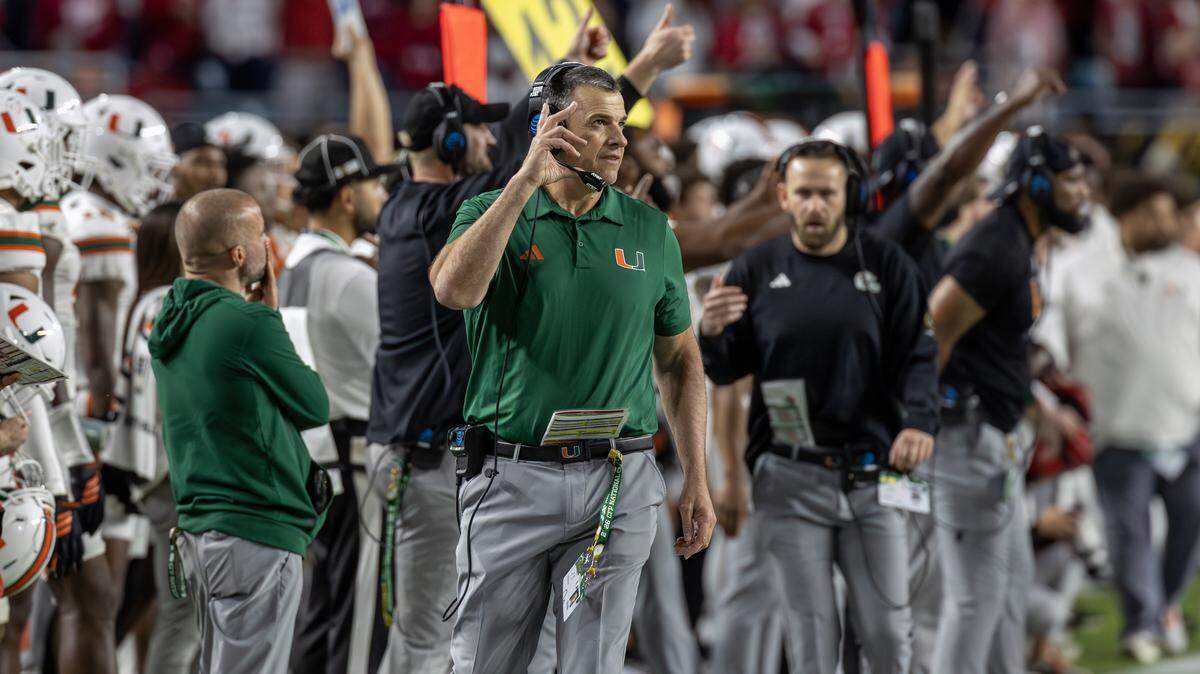
Across from Mendoza stood Mario Cristobal, a coach whose own life is woven from the same threads of exile and perseverance. Born to Cuban parents who fled the island in the 1960s — his father had been a political prisoner in Cuba — the Cristobals, like the Mendozas, started from scratch in a new country, carrying forward the belief that hard work and education could open doors once thought forever closed.
Cristobal found his own glory at the University of Miami, helping the Hurricanes win two national championships as a player. He would go on to make history as the first Hispanic head coach of a Division I-A program. After successful years at Oregon, he returned home to Miami in 2021, answering a call not just to a job, but to a legacy. Under his guidance, the Hurricanes have risen again, inching back toward the glory years that once defined them.
So this was more than a contest between Indiana and Miami. It was a celebration of journeys that began in Havana, in whispered goodbyes and hurried departures, in cramped apartments in Miami where families dreamed of futures their children might one day claim.
Some of us, as Miami residents, naturally cheered for the Hurricanes. Others found themselves smiling just as wide when Mendoza dropped back to pass, knowing what his success represented. But in truth, for many in the Cuban American community, the result almost felt secondary.
Either way, when the final whistle blew, a descendant of exiles stood in victory. And in that moment, under the glow of the championship lights, an entire diaspora saw its own long journey reflected back at it — proof that from loss can come legacy and from struggle, something worthy of a national stage.
Rene V. Murai is a Cuban American who resides in Miami and is a partner at the Avila Law Firm.