
Miami-Dade should not invest in Israel bonds | Opinion
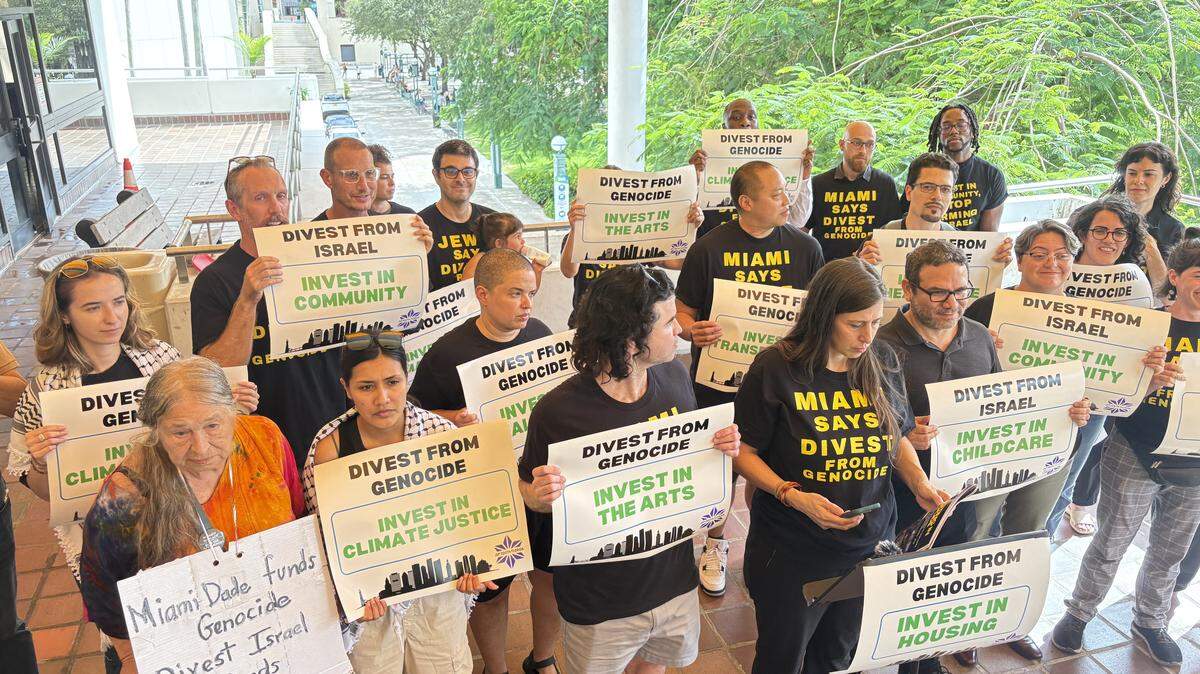
On Nov. 1, Miami-Dade County, specifically Clerk of the Court and Comptroller Juan Fernandez-Barquin, will quietly decide whether to reinvest $25 million of public money into Israel bonds when the position matures, meaning it comes to the end of its two-year term. There will be no ballot initiative, no town hall, no press release and no meaningful public input — yet this is taxpayer money being deployed into a foreign government’s debt (the only foreign government the county invests in) rather than reinvested back into the community that generated it.
A growing group of residents involved with the pro-Palestinian group Jewish Voice for Peace, under the banner Break the Bonds Miami, has been asking a simple but overdue question: Why are we sending millions abroad when the needs at home are visible on every block of this county?
And why, in particular, are we sending millions in public dollars to a foreign government facing accusations of war crimes, apartheid and genocide?
This group recently delivered a report to county leadership that includes the results of a survey conducted by volunteers, who polled more than 700 local residents on several questions related to the county’s bond purchasing practices.
The top line finding is staggering: 95% of respondents believe buying Israel bonds are not a responsible use of taxpayer funds.
But perhaps the most telling data point is what came before that: most people surveyed had no idea the county even maintains such a large investment ($151 million) in a risky foreign government debt instrument without public scrutiny or debate. That should concern anyone who cares about public trust.
We believe that public money should not be a tool of discretionary political expression — it is a public trust that must be used transparently, with clear justification, toward public benefit.
There is a widely repeated assumption that “bonds are bonds,” that a foreign debt instrument is just another tool for revenue generation. The past several years have demonstrated how incorrect that assumption is. Foreign government debt carries not only credit and interest-rate risk but also geopolitical and sanctions risk. Credit rating agencies consider when a foreign issuer becomes the subject of sanctions discussions, regime instability or military escalation.
When local government officials choose foreign debt over local investment vehicles, they are not neutral actors, and they sacrifice public benefit while investing in a country that has faced numerous credit downgrades and credible accusations of war crimes in the last two years.
The recently released Break the Bonds report offers a menu of alternative investment directions the county could pursue instead of reinvesting abroad.
They include categories of instruments that already exist within the “prudent investor” framework but simultaneously deliver tangible, local, observable benefits — for example, financing housing affordability and climate resilience, seeding local infrastructure and backing small business lending that keeps dollars circulating inside Miami-Dade. Those are meaningful forms of economic development, not charity. Residents do not expect public finance stewards to serve their individual political or business interests. They expect them to maximize public value.
The Break the Bonds Miami coalition is not only opposing a specific type of bond. It is also advocating for a standard: public-facing deliberation, plain-language disclosure and community participation before committing tens of millions for multi-year terms.
In an era of collapsing trust in public institutions, the fastest way to show fiscal seriousness is to show your work.
The county now has a decision with symbolic and material stakes. It can reflexively roll a maturing foreign debt position forward in silence, or it can pause, surface the decision to the public and realign public money with public benefit.
When residents ask their government not to export wealth and risk but to invest here, the burden of argument should not fall on them. The burden should fall on anyone who believes Miami-Dade’s money belongs anywhere else.
Rizwan Ali, a volunteer with Break the Bonds Miami, is co-founder of a real estate investment firm based in Miami.