
Are Florida’s flamingos returning? Hurricane Idalia revealed a comeback | Opinion
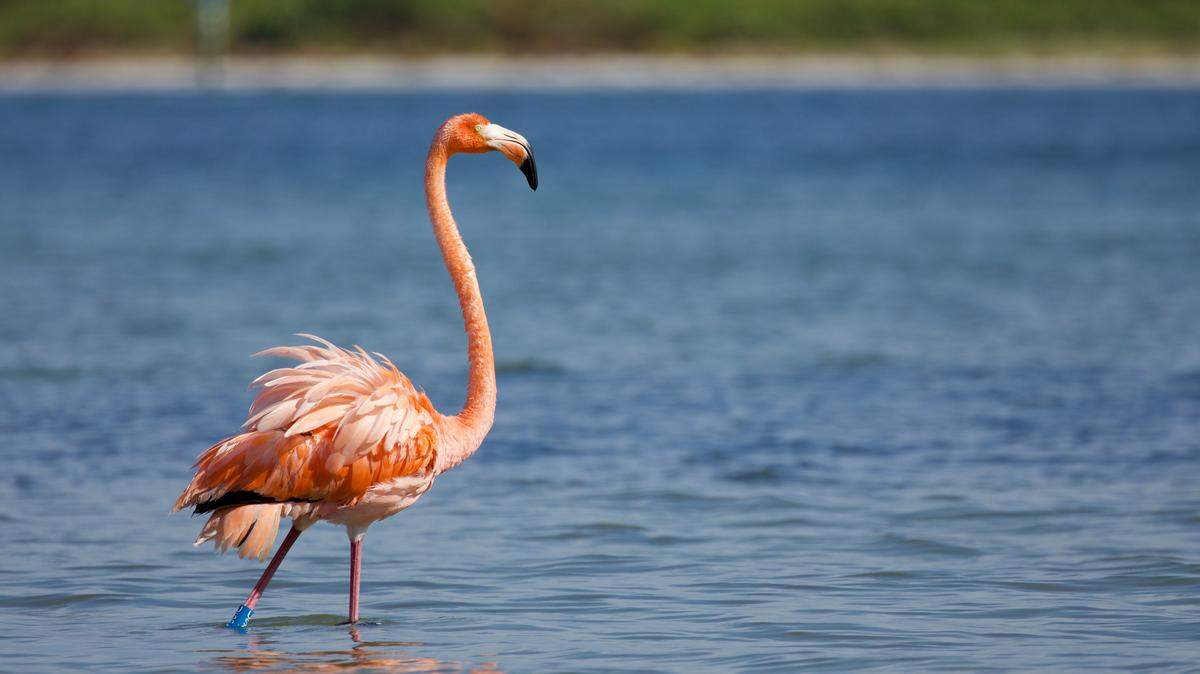
Hurricane Idalia blew a flock of 300-400 flamingos off course in August 2023, and unceremoniously deposited them across a wide swath of the eastern United States, including Florida’s gulf coast.
I’m an estuarine scientist, and I’ve spent 35 years with Audubon Florida studying the ecology of American flamingos and other wading birds in Florida Bay, Everglades National Park. So naturally, I was thrilled and intrigued by the sudden arrival of these flamingos.
One of the birds was rescued in the Tampa area after nearly drowning in the Gulf of Mexico. His rescuers named him Peaches.
A colleague and I were able to place a GPS tracking device and a bright blue band around his spindly leg. Unfortunately, a few days after Peaches was released, the tracking device failed. We lost track of him on a beach near Marco Island on Oct. 5, 2023.
Then, in June 2025, I received an email from colleagues at the Rio Lagartos Biosphere Reserve in Yucatan, Mexico, who had photographed Peaches, blue band still in place, nesting in the reserve.
Peaches’ story is the latest piece in the historical puzzle of flamingos in Florida. Though the native population disappeared more than 100 years ago, recent events lead me to believe that flamingos may be coming back to the Sunshine State, and that their return has been facilitated by the concerted effort to restore the Everglades and coastal ecosystems.
In his 1956 book “The Flamingos: Their Life History and Survival,” Florida Keys ornithologist Robert Porter Allen documented the demise of flamingos in the late 1800s. Like all wading birds in Florida, they fell victim to the women’s fashion trend of adorning hats with bird feathers.
The passage of the Migratory Bird Treaty Act in 1918 officially ended the feather trade. Given legal protection, most species managed to reestablish huge nesting populations in the Everglades by the 1930s to 1940s, presumably migrating from remote populations in Central America and the Caribbean.
Flamingos, however, did not.
Fast forward to today, and it appears that this slow comeback may finally have legs. Based on responses to a 2024 online survey of flamingo sightings, my colleagues at Audubon Florida and I concluded that at least 100 flamingos were left in the state after Idalia.
Then in July 2025, a flock of 125 individuals was photographed in Florida Bay. My colleagues and I believe that the flamingos that arrived with Idalia may be re-establishing a home in Florida.
The question is, why now?
To me, the answer is clear: Efforts to restore the Everglades and Florida’s coastal ecosystems are beginning to show progress.
When I arrived in the Keys in 1989, Florida Bay was undergoing an ecological collapse. A hundred years of draining, diking and rerouting the flows of the Everglades to create urban and agricultural lands had raised the salt content of the water, making it uninhabitable for many estuarine animals.
This kick-started Everglades restoration efforts, and in 2000, Congress passed the Comprehensive Everglades Restoration Plan with nearly unanimous bipartisan support.
Today, the bay’s health is vastly improved: Waterflow has gotten better, and the salinity is back to appropriate levels. In both 2018 and 2021, more than 100,000 pairs of wading birds nested in the Everglades. These numbers hadn’t been seen since the 1940s.
While the Everglades and Florida Bay are still a long way from full restoration, I believe the return of flamingos is evidence that these efforts are on the right track.
Jerome Lorenz, a Florida International University researcher, recently retired as the state research director for Audubon Florida after more than 35 years performing applied ecological studies in Florida Bay and the Everglades. His primary research focus has been on the effect of water management practices on Florida Bay. He earned a doctorate in marine biology from the University of Miami.
This article is republished from The Conversation under a Creative Commons license.

This story was originally published October 13, 2025 at 9:13 AM.