
Ron DeSantis has packed the Supreme Court. Florida needs a better system | Opinion
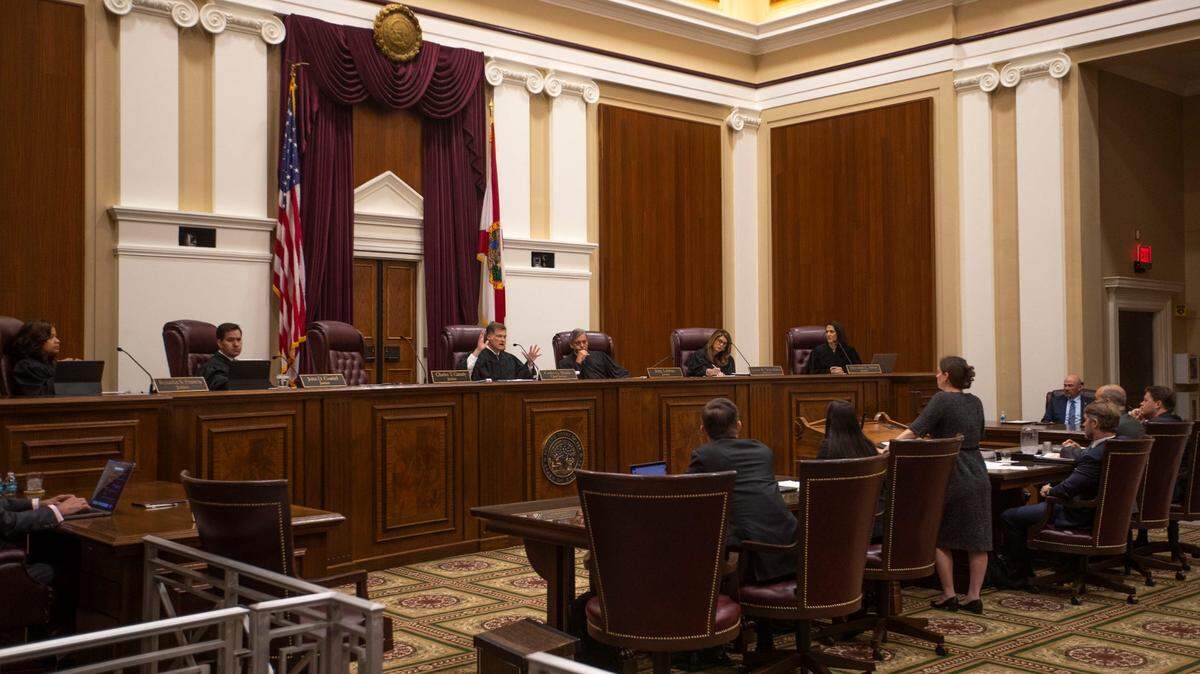
One of the more consequential decisions that faced Floridians this election year was also one of the least noticed. Near the bottom of a lengthy ballot, voters were asked to decide whether or not to retain two Florida Supreme Court justices recently appointed by Gov. Ron DeSantis.
To nobody’s surprise, both Renatha Francis and Meredith Sasso were retained – Francis with 63.1 % of the vote and Sasso with 62.3 %. The reason this wasn’t a surprise is that no Florida Supreme Justice has ever lost a retention vote since Florida adopted its current system in 1976 after a series of scandals prompted a move to so-called merit appointment and retention.
Even in the past, when there were grassroots efforts targeting certain justices, they prevailed. For instance, in 1984, the Florida Supreme Court knocked a controversial tax limitation amendment off the ballot. That amendment, championed by Miami anti-tax gadfly George Schulte and others, was the product of a petition initiative. The court unanimously ruled that it violated a rule requiring such amendments to deal with a single subject.
Two justices — Raymond Ehrlich and Leander Shaw — wrote concurring opinions supporting an even stricter application of the single subject rule. Despite the campaign targeting them, both were overwhelmingly retained.
Shaw was targeted again in 1990 after he wrote the majority opinion saying that the Florida Constitution’s privacy provision protected the right of pregnant women to secure an abortion under the terms of Roe v. Wade. Once again he survived.
Two years later conservative activists campaigned to oust Chief Justice Rosemary Barkett, whom they denounced as “too liberal.” She prevailed and kept her seat until 1994, when President Clinton appointed here to serve on the U.S. Court of Appeals, 11th Circuit, in Atlanta, a post she held for 19 years.
Such longevity is a feature of the federal courts’ lifetime appointments. Unless they’re impeached and convicted, federal judges may serve until they die or retire. Fortunately, there are checks and balances.
Indeed, as Americans are well aware, each president’s nominees for the U.S. Supreme Court and other federal judgeships are subjected to the advice and consent of the U.S. Senate, where recent committee hearings on the nominees’ qualifications have often featured a circus-like atmosphere exacerbated by partisan rancor.
So it’s with some trepidation that I ask whether the unfettered power Florida’s governors currently have to pack the state’s highest court with justices who take their cues from the governor’s office needs to be offset by, say, requiring nominees to pass muster with the state Senate.
Defenders of the current system may argue that the Florida Senate meets only 60 days a year, so such a change may require costly special sessions. They could even add that, given the Legislature’s recent record of deferring to DeSantis, Senate confirmation might be a mere formality — at least in the current political climate.
Some defenders of the status quo could also point out that governors must select their nominees from slates vetted by judicial nominating commissions. However, sensing that the Florida Bar had an outsized role on those commissions, a 2001 reform supported by then-Gov. Jeb Bush gave a larger role to governors.
As a result, DeSantis, now midway through his second term, has recently received the kinds of JNC nominees he wanted. Five of seven justices currently serving on the Florida Supreme Court were appointed by DeSantis, and the most recent ones — Francis and Sasso — have seemed eager to rubber-stamp DeSantis’ agenda.
Although Florida Supreme Court justices don’t receive lifetime appointments, they’re allowed to serve until they turn 75. Thus the mandatory retirements for DeSantis’s five appointees are, respectively, 2044, 2052, 2053, 2053, and 2058.
Therefore, unless these justices choose to retire, Florida will have them long after Ron DeSantis rides off into the sunset of his political career. Bottom line: Florida needs a better system, with real checks and balances on this awesome power.
Robert F. Sanchez, of Tallahassee, is a former member of the Miami Herald Editorial Board. He writes for the Herald’s conservative opinion newsletter, Right to the Point. It’s weekly, and it’s free. To subscribe, go to miamiherald.com/righttothepoint.