
State parks are not the place for golf courses or hotels. Floridians must speak up | Opinion
When the pandemic first hit in 2019, nature was my refuge, at times the only thing keeping me sane during the country’s long period of isolation. Despite being born and raised in South Florida, it was in this year that I fell in love with our state parks – they saved me in what was a dark time for many.
Now, it is my turn to save them.
Under the direction of Gov. Ron DeSantis’ office, the Florida Department of Environmental Protection (DEP) has recently announced major changes to state parks throughout Florida. Unfortunately, these changes aren’t for the better.
The Merriam-Webster Dictionary definition of “state park” is “an area of land that is owned and protected by a U.S. state because of its natural beauty or its importance in history.” Last I checked, adding golf courses, pickleball courts and resort-style hotels was not part of the directive. Under the guise of uplifting Florida’s “outdoor recreation economy,” the administration is set to bulldoze over protected landscapes and species. And they think they can get away with it.
DEP initially gave only about a week’s notice for public meetings throughout the state, which didn’t even appear to include a question-and-answer period, before rescheduling them to a later date. Maybe they hoped the announcement would fly under the radar for seven days, overshadowed by national news coverage of the Democratic National Convention. Regardless of the motivation, the initiative and the way it is being handled is an insult to the state’s democracy and to our environment.
Florida currently boasts more than 1,250 golf courses. Not surprisingly, this is the highest number of any of state in the U.S. These golf courses are most heavily concentrated in Palm Beach County, a stone’s throw away from Jonathan Dickinson State Park north of Jupiter, where DeSantis could build three brand new courses. I guess the 1,250 existing courses just weren’t enough.
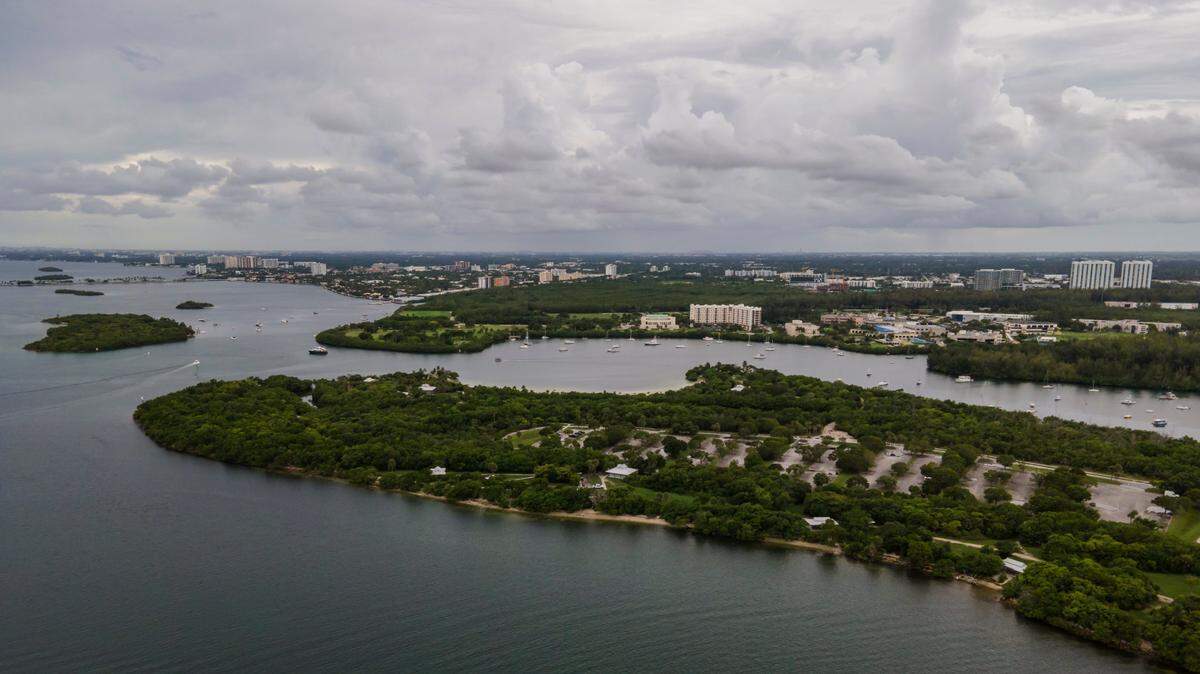
On Sunday, the DEP confirmed the organization behind the proposed gold courses at J.D. Park was withdrawing its proposal, but the agency did not mention any change of plans for other eight state parks, including Oleta River State Park in Miami-Dade.
Golf courses require extensive pesticides to keep their turf exquisite — dangerous chemicals that can and will run off into surface water and percolate into groundwater, poisoning the environment and local flora/fauna.
One such affected species is the Florida scrub jay, the state’s only endemic bird whose numbers have been in decline in recent years, pushed out as the human population has surged. You think our housing market has gotten bad, try being a scrub-jay family, which require between 22 to 24 acres of scrub habitat each — difficult real estate indeed in this day and age. Federally listed as threatened, only about 8,500 (between 7,700 and 9,300) birds remain in the state, and our state parks are perhaps the only thing keeping them from extinction.
One-thousand acres of Jonathan Dickinson State Park is equivalent to roughly 44 scrub-jay family habitats, each of which can be as large as 12 birds (eight adults and 1-4 juveniles). This was for just one of nine state parks — I don’t even want to do the calculations for the rest.
The good news is, in my opinion, DEP has dramatically underestimated local communities. News of this appalling initiative broke Wednesday morning, and by that afternoon I was driving past an impressive group of protestors gathered at the entrance to Johnathan Dickinson State Park, wielding signs denouncing the golf courses to come.
This initiative is a wake-up call, proof of the corruption evident in an agency mandated to protect our environment but seems intent on doing the exact opposite. A symptom of a larger disease, it is about time we as a community stood up to DEP. I know I will.
Karen Copeland is a resident of Hobe Sound. This opinion piece was distributed by The Invading Sea website (www.theinvadingsea.com), which posts news and commentary on climate change and other environmental issues affecting Florida.