‘Food Forests’ are reversing the learning gaps in math in Miami-Dade schools | Opinion
We are at a critical moment in U.S. education.
Student academic scores, particularly in math, are at their lowest in decades, according to recent results from the National Assessment of Educational Progress (NAEP).
Declines were expected because of pandemic-related challenges. However, the massive slide in scores cannot be ignored. Gaps in achievement for students living in poverty grew even wider. Our district’s new eligibility to provide 100% of students with federal food aid highlights the urgent need for action.
Last year, The Education Fund and Miami-Dade County Public Schools developed a solution to address these learning gaps, and the initial results are promising. Our approach has precedent. Our Food Forests for Schools program already has shown continuous and remarkable success in increasing student achievement in science.
We chose to leverage this program when TD Bank issued its annual TD Ready Challenge throughout North America, asking groups how they would ameliorate pandemic-related learning losses. Proposing a three-year effort to use our Food Forest methods to improve students’ math achievement, The Education Fund was chosen as the best TD Ready Challenge application in the United States and received the first and only 2022 $1 million TD Ready Challenge grant.
Our TD-funded pilot program is already bearing fruit. Our evaluation of results shows an impressive change: 78% of the students improved their math scores.
In addition to the math results, 71% of the students increased their science achievement and 58% of students increased their willingness to try healthier foods. Validated results encouraged Broward County Public Schools to adopt our program.
A first-in-the-nation effort, The Education Fund installs forests filled with superfoods on school grounds and teaches schools to use them as outdoor classrooms. Students and teachers gather under a leafy canopy daily. Our installations mimic natural forests, with fully grown trees, plus bushes, plants and ground cover. Students continuously munch on the leaves of longevity spinach, cranberry hibiscus, moringa and even acerola cherries plucked fresh from the tree. Circles of banana trees provide composting areas to teach soil science.
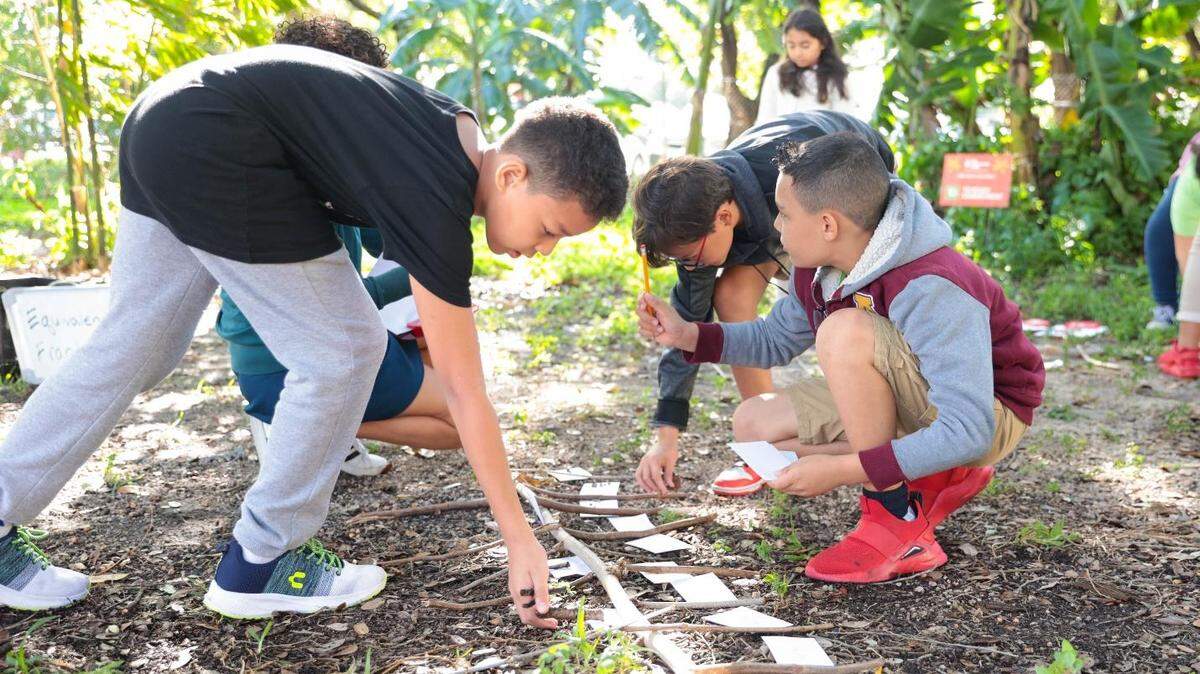
Students convene in the outdoor classroom to start their lesson — there is no such thing as sitting in the “back of the class.” Children walk along winding paths, examining leaves with magnifying glasses and rulers, filling measuring cups and using thermometers as they engage in hands-on lessons in science, nutrition and, now, math. In addition, students take home bags of healthy produce.
To build our pilot, The Education Fund partnered with Elon University associate professor Dr. Scott Morrison, whose research underscores the effectiveness of using outdoor classrooms to teach math. Morrison helped us create modules to teach existing Florida math standards in our Food Forests. This past year, our team collaborated with educators, teaching lessons while simultaneously guiding them on how to leverage the Food Forests for daily STEM lessons, especially math education.
For example, kindergartners arranged leaves in order of smallest to largest. Older students practiced equivalent fractions with branches from their forest. Students divided one side of a branch into fourths and the other into eighths. They used measuring tapes, clipboards and lesson sheets to determine and record distance, length and area. They graphed, wrote in journals and built model towers using materials from the forests.
These visual lessons brought concepts to life. And working in nature made students calmer, allowing them to grasp ideas and retain knowledge.
With the backing of the TD Bank grant, The Education Fund and Miami-Dade County Public Schools are demonstrating that by utilizing our Food Forests program to teach math skills and increasing its reach, students in the third-largest school district in the nation can reverse pandemic-era learning losses.
This innovative approach is not just providing immediate academic improvements, it’s also instilling lifelong lessons in healthy eating, environmental stewardship and supporting student resiliency.
Now more than ever, it’s crucial that parents, educators, citizens, business leaders and elected officials rally behind such innovative solutions. Help us bring the entire Food Forests program to more schools. Join us as we help students succeed.
Linda Lecht is president of The Education Fund, a nonprofit dedicated to developing innovative programs for public school students and educators in Miami-Dade County.