Affirmative-action ruling gives us a blank slate to plot a path forward to equality | Opinion
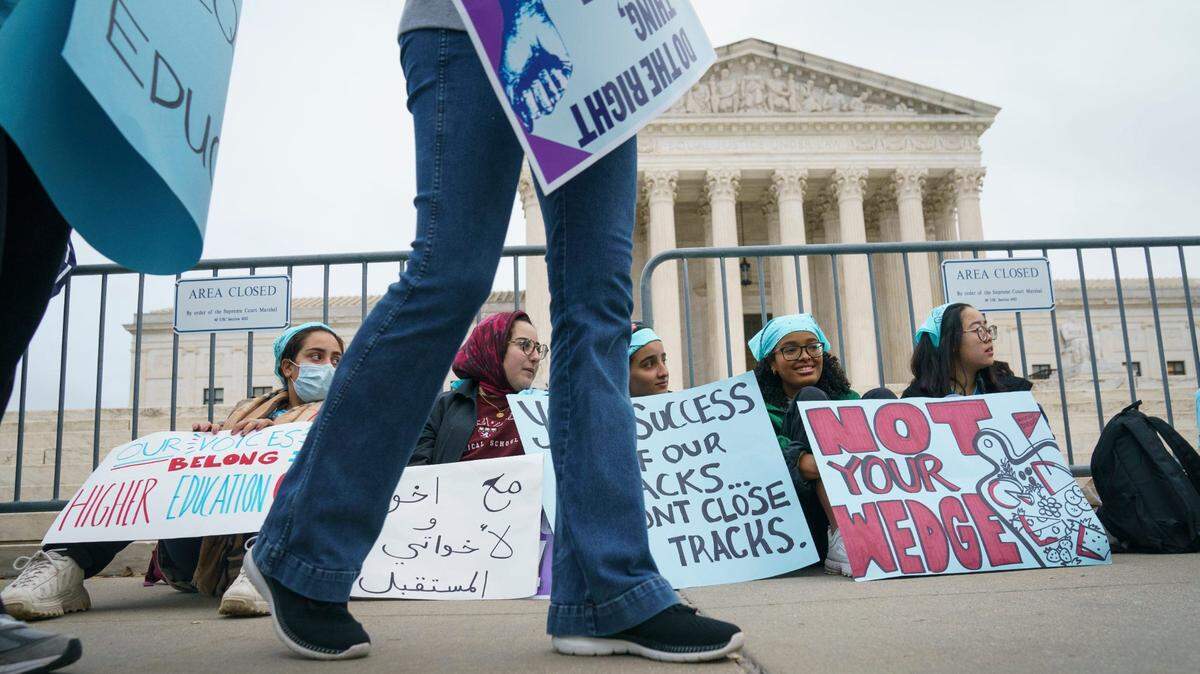
The recent rulings by the U.S. Supreme Court on affirmative action are microcosms of the state of politics, life and culture in America. As disappointing as the rulings were, they were in tune with the dialogue happening outside the courtroom.
Our back-and-forth on matters of equity and equality at dinner tables and online is akin to the deliberations within the chambers of the Supreme Court we saw last week — all based on our inability to address the ills of our past and offer legitimate, honest and meaningful racial reconciliation. This avoidance continues to be our country’s greatest challenge and plays out neatly in these court cases.
Many Americans are rightly outraged by the outcome. For more than 40 years, affirmative action allowed many of us, including me, to hope for a better future based on educational rigor and accessing opportunities that my ancestors could never have dreamed of.
The outrage is warranted. Yet, I don’t believe it is all doom and gloom. The Supreme Court’s assertion that racially based admissions violate the 14th Amendment’s equal protection clause is a fair assessment, but only in a perfect world, where the U.S. Constitution is racially blind. This assessment also requires that the people the Constitution seeks to govern abide fully by its blindness, without exception and with the utmost integrity. If the people are void of the same integrity, the outcome is skewed.
Affirmative action, for all of its good, was sometimes imperfect in practicality, because it didn’t go far enough; nor did it evolve to address modern racial issues. But, all the while, it challenged our perspectives socially.
Socially, affirmative action was one of the only policies that pierced white privilege and made people question whether Black and brown kids are taking their place. Whether their lives, or their kids’ lives, would be better if they had been born Black. The answer was always No. Chris Rock’s joke that nobody white would want to switch places with him is painfully funny because it’s true — even if some pretend that it’s not. The possibility that whiteness is no longer a pervasive advantage drives a certain kind of person insane. Affirmative action made them feel like, perhaps, the world did not revolve around their hopes, dreams and comforts, so it had to be questioned and destroyed.
The fact of the matter is that America prior to affirmative action was steeped in cronyism, racism, sexism and nepotism for its centuries of existence, one that didn’t benefit America overall no matter your racial allegiance. Those scales attempted to balance over the next 40 years based upon affirmative action, a law that bolstered equity, effort and skill. Affirmative action also benefited immigrants from all walks of life, either on a visa or fleeing communist regimes. It allowed those looking for a piece of the American Dream equity to attend elite universities.
Conversely, affirmative action was imperfect because it didn’t always pull the most disadvantaged out of poverty; rather it promoted legacy students or, often, Black and brown children already on the path to college. The fact that they were Black or brown and got into an Ivy League school allegedly based on affirmative action diminished their individual accomplishments. It was intellectually irresponsible and wholly inaccurate, a fact that one must address when contemplating the modern role of affirmative action.
With affirmative action now outlawed in its current form, colleges must hold true to their tenets of valuing diversity — unless you’re in Florida, where diversity is under attack — in ways outside of race itself. They can use socioeconomic thresholds that meet the standard of the 14th Amendment that can truly, if not better, address poverty, middle-class growth and proper education.
Colleges now have a blank slate to address the atrocities of Jim Crow-era legislation that barred many minorities from attending high-quality schools or receiving education on any level; redlining that caused a lower tax base, meaning less well-funded schools that, for decades, made it harder for students to compete in the college admissions process; racially biased entrance exams/standardized tests; and a host of other inequalities that blocked access to one of the best equalizers of wealth creation, education.
The blank slate seems like a hindrance in the wake of the court rulings, however, we can engineer a path forward that encompasses racial equality in all of its complexity. A path that, with the will, determination and foresight, can be better than anything we hoped affirmative action would provide.
A changing time requires us to learn from our immediate circumstances and require industries and organizations to be what their missions attest, a privilege not afforded our ancestors. It’s important to remember that no matter what others believe about our existence, as well as what we endure, it does not testify to our value in this new world. Rather, it sheds light on their insecurities, based on unmanifested fears.
Knowing this and remembering it in our core requires that we leverage these moments of uncertainty in a way that stand the test of time.
Rodney W. Jacobs is a professor of leadership, law and ethics at Florida International University.