DeSantis should take note: Florida doesn’t always get justice right the first time | Opinion
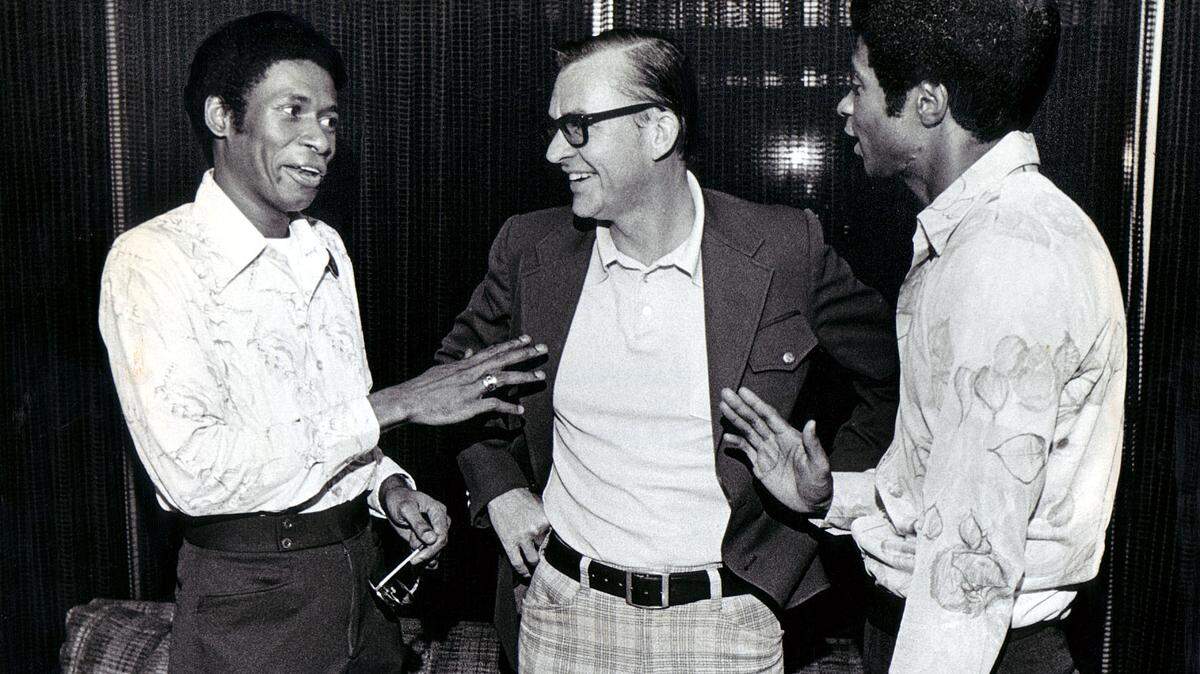
At a time when Gov. Ron DeSantis seemingly wants to speed up executions, an important new book offers a cautionary tale about one of Florida’s most notorious episodes involving capital punishment.
In “From Death Row to Freedom: The Struggle for Racial Justice in the Pitts-Lee Case,” Phillip Hubbart reports on the circumstances surrounding the 1963 murder conviction and ultimate exoneration of two Black men, Freddie Pitts and Wilbert Lee.
Hubbart, a Miamian whose long career included stints as a public defender and appeal court judge, for a decade was the lead attorney for a team of ACLU lawyers seeking — and finally getting — a new trial for the wrongly convicted pair, then ultimately a pardon.
The details of the case are mind-boggling. The two were brutally forced to confess to abducting and then killing two men they encountered at a gas station in the Florida Panhandle town of Port St. Joe. A key prosecution witness lied. Exculpatory evidence was ignored. During their original trial before an all-white jury, their court-appointed attorney did little to defend them.
This miscarriage of justice occurred amid an atmosphere of unbridled racism. Even when a new trial was held in nearby Marianna, the defense team was up against none-too-subtle racism as well as antisemitism because some of the Miami lawyers on the defense team were Jewish. Once again an all-white jury convicted the two.
In those days the ACLU routinely intervened in death-penalty cases, not necessarily in the hope of overturning a conviction but generally for the purpose of averting an execution. The organization still believes the death penalty meets the definition of “cruel and unusual punishment” and, thus, is forbidden by the U.S. Constitution.
The ACLU selected Hubbart, then a young attorney in the office of the Dade County Public Defender, represent Pitts and Lee. At that time the public defender was allowed to represent outside clients. Based on the case files he examined, Hubbart said he initially believed that the two were probably guilty of the crime.
Soon afterward, however, a fortuitous trail of evidence that stretched from Key West and Fort Lauderdale to Port St. Joe led to the real killer, a white career criminal named Curtis Adams.
Incredibly, when the original prosecutor and other law enforcement authorities in North Florida were shown the overwhelming evidence of Adams’ guilt and the innocence of Pitts and Lee, they brushed it aside. As a result, it would take 10 years before justice finally was done in this case, when Gov. Reubin Askew and the Florida Cabinet pardoned Pitts and Lee.
What kept the case alive all through the intervening years was Hubbart’s persistence and a valuable ally, Miami Herald reporter Gene Miller. Miller looked at the specifics of the case and set out to correct an injustice.
Miller not only wrote about the case, but he also persuaded the Herald to foot the bill to hire investigators and a noted polygraph expert to buttress the legal arguments that the convictions had been in error. Miller later discussed the case in his own book, “Invitation to a Lynching.”
In contrast to Miller’s reports on the incontrovertible facts of the case, the daily newspaper in Panama City shamed itself by pandering to the locals’ prejudices, repeatedly denouncing the Pitts-Lee legal team as a bunch of big-city outsiders.
Pitts, Lee, and Miller are gone, and Hubbart is now in his 80s. Lest anyone think that the Pitts-Lee case was an aberration, check out Gilbert King’s book “Murder in the Grove,” about a similar legal lynching in Lake County, Florida. Indeed, through the years numerous inmates languishing on Death Row were exonerated when evidence of their innocence belatedly surfaced.
As for DeSantis, after a trial that he did not attend, he was indignant that mentally addled Nikolas Cruz, duly convicted of killing 17 people at Marjory Stoneman Douglas High School on Valentine’s Day in 2018, was spared the death penalty when two members of the 12-member panel did not agree to it.
As a result, the governor persuaded the 2023 Legislature to eliminate the requirement that a jury must unanimously agree to impose the death penalty. He signed the bill on April 23, so now an 8-4 vote will be sufficient to impose the death penalty.
No doubt this will bolster DeSantis’ tough-on-crime reputation as he campaigns for the presidency. Many Americans are weary of what they perceive as crimes large and small routinely going unpunished when prosecutors fail to prosecute.
However, studies repeatedly have shown that the existence of the death penalty is not an effective deterrent that causes impulsive criminals to refrain from killing or from committing other violent crimes.
Never mind these studies, however. Our pro-life governor evidently thinks our criminal-justice system never makes mistakes and that, now, Florida’s Death Row needs an express lane.