
Would Ron DeSantis be a can-do president or a heavy-handed ‘caudillo’? | Opinion
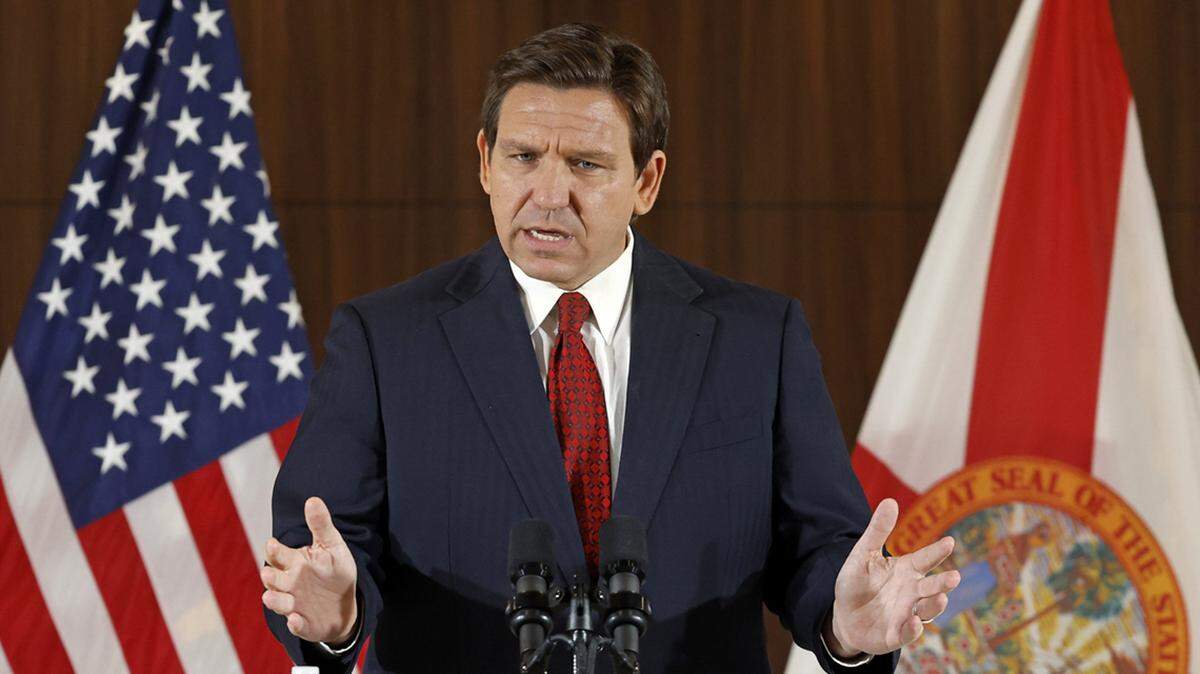
When less than half of Florida’s registered Democrats voted in the 2022 gubernatorial election, while almost two-thirds of the Republicans did, the inevitable result was a landslide re-election victory for Gov. Ron DeSantis.
Granted, he might have won anyway. Polls show that most Floridians approved of his leadership during his first term, when he was guiding the state through the pandemic and blasting the Biden administration’s immigration policies.
Now, however, as DeSantis prepares to announce that he’s running for president, there are troubling signs that voters who thought they’d be getting more of the same kind of leadership are instead getting an aspiring caudillo.
For one thing, DeSantis, not content with having the Florida National Guard available for emergencies, now wants to be commander-in-chief of a “State Guard.” As proposed, it would essentially be his own personal militia, a type of asset that empowered the quintessential caudillo, Spain’s Francisco Franco.
Even if this quasi-military force isn’t fully operational before DeSantis leaves office, this governor who won his first term in a squeaker over an unelectable Democrat arguably has more power than any other governor in Florida’s modern history. Moreover, he’s not reluctant to use it, even if it means superseding the will of voters who elect local public officials with whom DeSantis disagrees.
How is DeSantis more powerful than his predecessors? Let me count the ways. For one thing, he continues to display his disdain for constraints such Florida’s tradition of open government. For instance, he now wants his travel and its costs to taxpayers shrouded in secrecy, and his office has often been agonizingly slow to respond to public-records requests.
Worse, his contempt for the U.S. Constitution’s Bill of Rights — other than the Second Amendment — was newly evident in a fiery speech at Hillsdale College. There, he escalated his feud with Disney, a battle that began when the company exercised its First Amendment right to criticize a law DeSantis had championed.
DeSantis even has a degree of control over the other branches of the state government. In the Legislature, members of the GOP’s supermajority seem as reluctant to cross him as congressional Republicans are to criticize Donald Trump.
Then there’s the judicial branch. A pending appointment to fill a vacancy will mean that five of the Florida Supreme Court’s seven members will have been appointed by DeSantis.
Moreover, while a president’s nominees for the U.S. Supreme Court and other federal judgeships are subject to the advice and consent of the U.S. Senate, Florida’s governors face no such constraint. The state Senate has no say.
Result: Florida’s highest court and most of its district courts of appeal now have a conservative majority appointed by DeSantis, and they’re unlikely to overturn anything this governor does.
Oddly, some of DeSantis’ actions now seem at odds with the GOP’s positions. For instance, Republicans have advocated reforms in the way history is taught in public education. One commendable goal: paying more attention to foundational documents such as the U.S. Constitution.
Despite initial flaws, the U.S. Constitution — created by men who had rebelled against monarchy — is notable for its goal of preventing too much power from being granted to any single governmental entity.
Result: a sharing of power between the federal government and the states, and — within the federal and state governments — among independent legislative, executive and judicial branches, and with local governments.
When Florida’s post-Reconstruction constitution was adopted in 1885, its authors feared giving too much power to the governor, so they went even further in limiting the powers of that office. Until a new state Constitution was adopted in 1968, governors couldn’t seek re-election to a second consecutive term.
Past governors also had to deal with the fact that many of the limited powers of the executive branch had to be shared with an elected Cabinet whose members had no term limits.
When Gov. LeRoy Collins, the man whom many historians regard as Florida’s best governor, presided over a Cabinet meeting at the start of 1960, his final year in office, what did he see when he looked around the room? Three of the six Cabinet members had lots of experience, to say the least. The treasurer/insurance commissioner had been in office since 1941, the secretary of state since 1930 and the agriculture commissioner since 1923!
Most of this vestigial diffusion of power within the executive branch ended in 1998, when voters approved the Constitution Revision Commission’s proposals applying eight-year term limits to the Cabinet and shrinking it from six members to three.
These changes effectively expanded the governor’s clout. In addition, one of the Cabinet agencies abolished — the Department of State — includes the Division of Elections. In many states, the supervision of elections is under the control of an elected secretary of state. In Florida? It’s now under the governor.
So, as DeSantis goes far and wide to campaign for the White House and tout his book about freeing Florida, voters in other states might well ask, “Freeing Florida from what? Mask mandates and lockdowns? That’s yesterday’s news. We want to know what’s next. If you become president, would you bring your authoritarian tendencies from Tallahassee to Washington? Inquiring minds want to know.”

This story was originally published April 14, 2023 at 9:59 AM.