
End all government-sanctioned anti-Muslim policies, not just the travel ban | Opinion
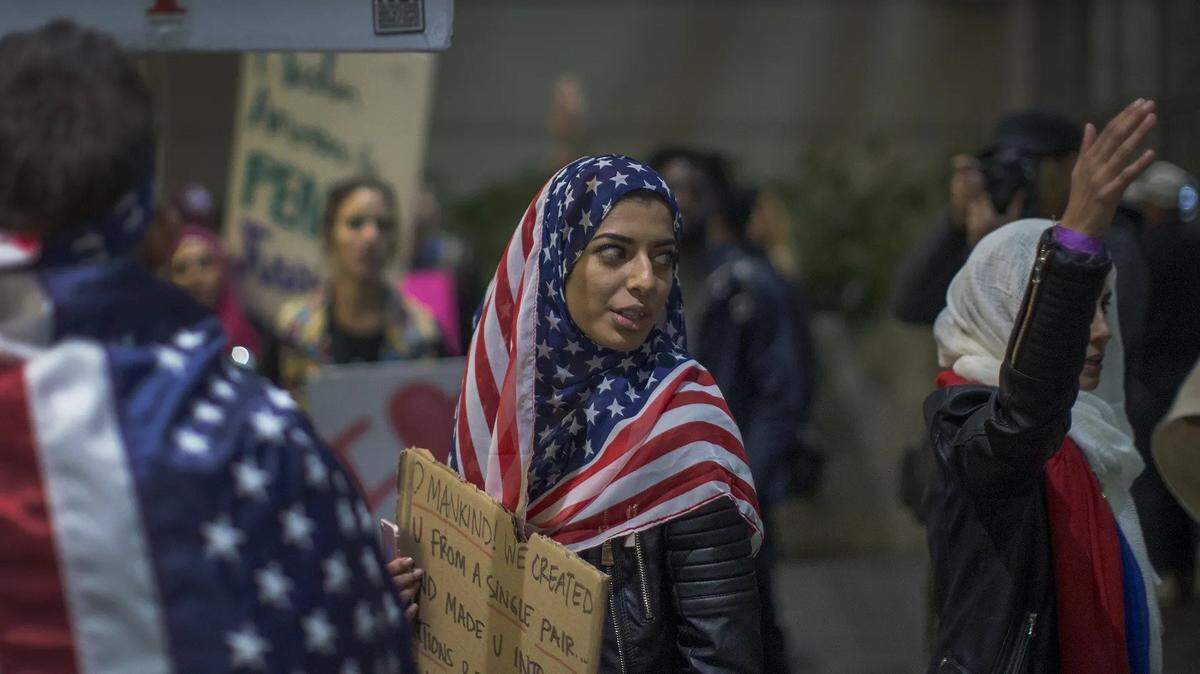
Twenty years after the attacks of 9/11, anti-Muslim racism is more deeply entrenched than ever in U.S. society.
In the 2016 presidential election, Donald Trump ran on a racist, anti-immigrant platform that was central to his victory. Then he passed the Muslim ban as sop to his supporters. But even before Trump, anti-Muslim racism already had become institutionalized here.
Take, for instance, the FBI’s longstanding program of sending agent-provocateurs into Muslim communities to entrap vulnerable populations — typically poor, Black and brown men, often with mental disabilities — to plan attacks. The logic is that all Muslims are “potential” terrorists, and that the FBI should nab them before they commit a crime.
This bizarre logic is reminiscent of Stephen Spielberg’s dystopian film “Minority Report,” based on Philip K. Dick’s 1956 novella. It involves a police “pre-crime” unit that arrests people who are believed to be predisposed to criminal activity. Muslims are being targeted based on the presumption of their potential for wrongdoing.
The New York City Police Department and others employ similar logic. With training from the CIA, the NYPD has spied on mosques, community centers, Muslim-owned businesses, religious bookstores, universities and other “hot spots” in New York, Connecticut and New Jersey. This program, which was officially shut down after the Associated Press reported on it, did not lead to a single terrorism conviction.
One study of the U.S. Department of Justice’s list of terrorism-related convictions from 2001 to 2010 found that 72% were cases of preemptive prosecution, in which the basis for conviction was the defendant’s perceived ideology and not his or her actual criminal activity. The thinking is: If you are sufficiently Muslim, you are sufficiently guilty.
Globally, the picture is no better. In 2012, The New York Times broke a story about “Terror Tuesdays,” President Obama’s practice of meeting with his advisers every Tuesday to determine the list of supposed “terrorists” to be assassinated. This list sometimes included U.S. citizens, such as the Yemeni-born cleric Anwar al-Awlaki, who was killed in a 2011 drone strike. His 16-year-old son was killed in a drone strike two weeks later.
No one has been held accountable for these extra-judicial killings because these brown and Muslim lives apparently do not matter.
The Times also revealed that, in an attempt to limit “civilian” casualty figures, the Obama administration simply reclassified them by designating all military age men in targeted areas as “combatants” unless proven innocent after their deaths.
The “Costs of War” project at Brown University estimated that, as of 2020, more than 800,000 people had been killed as the result of direct war violence in five mostly Muslim-majority countries where the United States conducted military operations.
We have paid a hefty price — financially, socially and psychologically — for the war on terror. The 20th anniversary of 9/11 should lead us to reflect on this cost in the same way that the murder of George Floyd in 2020 precipitated a discussion about police violence.
The Movement for Black Lives shed light on how anti-Black racism is not simply about hate speech and individual prejudice, but is rooted in the structures of U.S. society. Similarly, anti-Muslim racism is not simply religious intolerance or misunderstanding, but a structural form of racism.
It is not enough to end the Muslim travel ban. We must also halt all racist practices used by the security establishment — from entrapment and surveillance to preemptive prosecution. It is not enough to withdraw from Afghanistan. We must also end the global drone program and, instead, invest in infrastructure in all of the war-torn countries impacted by the United States.
Deepa Kumar is professor of media studies at Rutgers University. She is the author of “Islamophobia and the Politics of Empire.”
©2021 Tribune Content Agency