
Chief Justice Kogan took a contrarian view seeking to protect our right to die in peace | Opinion
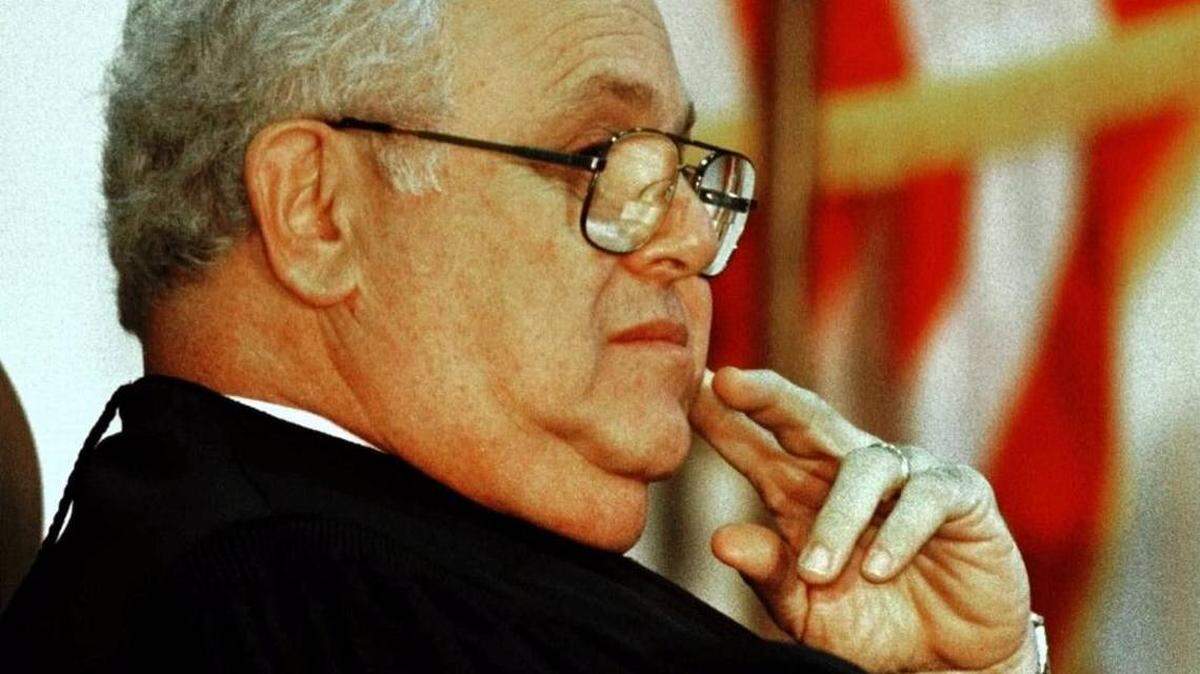
Gerald Kogan, who died March 4 at 87, was the epitome of a civic leader. He served his Miami-Dade community in various roles in the legal system, culminating in his appointment to state Supreme Court. There, his drive to open the mysterious processes of the judiciary to the public was part of a lifelong commitment to democracy that easily morphed into a passion for ethical government after he left the bench.
But he also should be remembered for one particular decision by the Supreme Court issued almost 25 years ago. His prescient dissent is an insight into his courage and commitment.The case was Krischer v. McIver, which, in 1997, it involved what was derisively called “assisted suicide,” now more accurately called “medical assistance in dying”.
Dr. Cecil McIver was a physician caring for Charles Hall. As the court told the story:
Mr. Hall is 35 years old and suffers from acquired immune deficiency syndrome (AIDS), which he contracted from a blood transfusion. The court found that Mr. Hall was mentally competent and that he was in obviously deteriorating health, clearly suffering and terminally ill. The court also found that it was Dr. McIver’s professional judgment that it was medically appropriate and ethical to provide Mr. Hall with the assistance he requests at some time in the future.”
Hall and McIver filed suit to enjoin the Palm Beach County state attorney from prosecuting the doctor. After a six-day trial, the court issued a declaratory judgment and injunctive decree addressing, “whether a competent adult, who is terminally ill, immediately dying and acting under no undue influence has a constitutional right to hasten his own death by seeking and obtaining from his physician a fatal dose of prescription drugs and then subsequently administering such drugs to himself.”
The court concluded that Florida law prohibiting assisted suicide violated the privacy clause of the Florida Constitution (as well as the due-process and equal-protection guarantees of the U.S. Constitution’s 14th Amendment) and enjoined the state attorney from enforcing the law against McIver should he assist Hall in ending his life. The state attorney appealed, and the case went to the Florida Supreme Court, with Gerald Kogan as chief justice.
Almost two decades earlier, in 1980, the people of Florida had overwhelmingly amended the state’s Constitution to add a specific right of privacy: “Every natural person has the right to be let alone and free from governmental intrusion into the person’s private life.”
The Florida Supreme Court then recognized a fundamental right to privacy extending “to all aspects of an individual’s private life …” And almost a decade before the McIver case, the Supreme Court ruled that the right to privacy applied to intimate areas of conduct such as women’s access to an abortion.
Given Florida’s specific guarantee of the right to privacy, it may be surprising that Kogan had to dissent when the Supreme Court overturned the trial court and allowed for McIver’s prosecution should he assist his patient — and that Kogan was the lone dissenter.
“To my mind, the right of privacy attaches with unusual force at the death bed,” he wrote. “This conclusion arises in part from the privacy our society traditionally has afforded the death bed, but also from the very core of the right of privacy — the right of self-determination even in the face of majoritarian disapproval. What possible interest does society have in saving life when there is nothing of life to save but a final convulsion of agony? The state has no business in this arena. Many people can and do disagree over these questions, but the fact remains that it is the dying person who must resolve them …”
And then he issued a challenge to his colleagues that soars and ties abstract law to the reality of daily life — “When his pain becomes unbearable, which one of us on this Court will be at his bedside telling him to be brave and bear it?”
Someday the passion of Kogan’s lone dissenting voice will be reflected in the policies of our country. Then, the constitutional right of privacy will not be just words on paper but a guarantee of freedom in areas of our lives where it matters most.
Howard Simon is the former executive director of the American Civil Liberties Union of Florida.
This story was originally published March 8, 2021 at 4:52 PM.