
In Florida, ex-felons’ right to vote could depend on a comma | Opinion
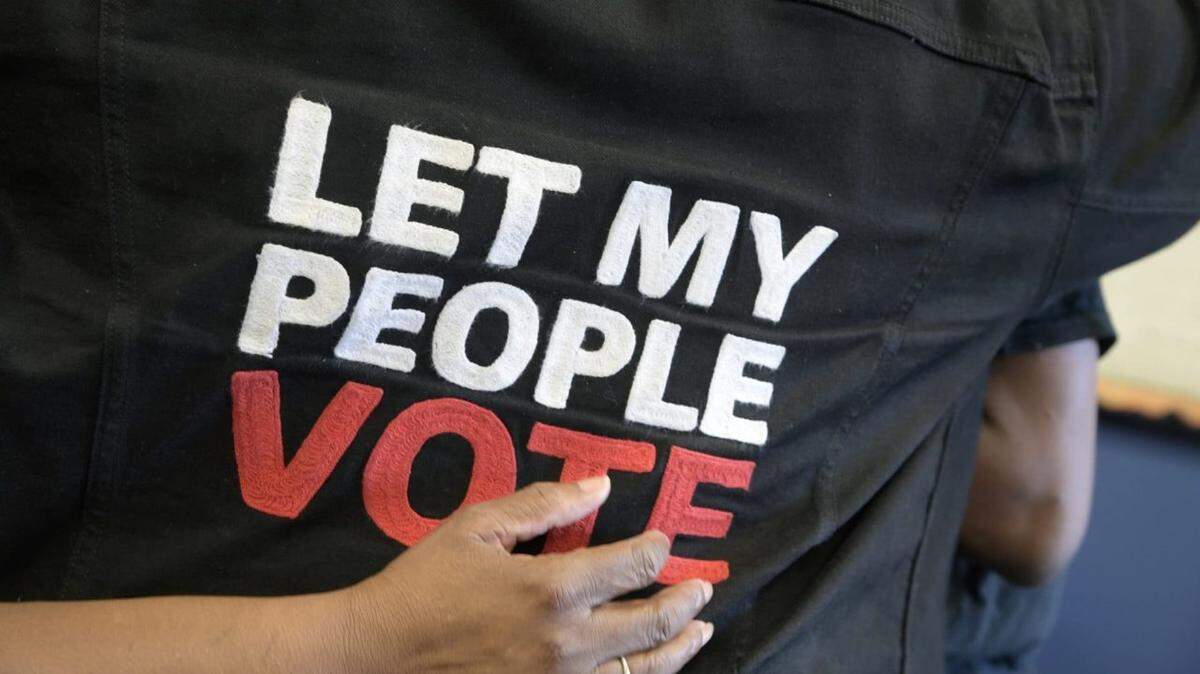
After all of the machinations and controversy surrounding Florida’s Amendment 4, which 5.1 million Floridians voted for last year, its meaning could hinge on, a comma.
This citizens’ initiative was launched purportedly to restore voting eligibility to almost 1.5 million people who had finished their prison sentences and to streamline the restoration of their right to vote. But implementing legislation is more restrictive.
Gov. Ron DeSantis asked the Florida Supreme Court for a nonbinding advisory opinion to facilitate implementation. Joe Jacquot, DeSantis’ general counsel, clarified DeSantis did so “not because of ambiguity in the text of Amendment 4 but for authority and an interpretation from this Court . . . of whether Amendment 4 requires legal financial obligations within a sentence to be completed before a felon regains voting rights.”
Jacquot emphasized “analysis of Amendment 4 should begin and end with its plain language” — the actual text voters approved.
The implementing legislation DeSantis signed this summer establishes — for the first time in Florida — that all such legal financial obligations, or LFOs, must be paid before restoration with some exceptions. But the legislation deviated from what voters approved when bill drafting in both chambers inserted an errant comma after “all terms of sentence . . .” That’s irrefutable even if inadvertent.
Here’s the plain language voters approved: “. . . Any disqualification from voting arising out of a felony conviction shall terminate and voting rights shall be restored upon completion of all terms of sentence including parole or probation. . .”
Here’s what the legislation says: “. . . Any disqualification from voting arising out of a felony conviction shall terminate and voting rights shall be restored upon completion of all terms of sentence, including parole or probation.”
This seemingly obscure observation could prove pivotal.
Without that comma, a grammarian might reasonably identify “including parole or probation” as specific terms modifying the scope of the more general “all terms of sentence,” in other words essential modifiers with which any terms that follow must be consistent. When the comma was added, these essential modifiers were reduced to a subordinate clause diminishing the weight of any such limiting language.
As a result, other terms of sentence beyond incarceration, if any, not necessarily consistent with these essential modifiers more readily could be included in the legislation, like fines, fees and also restitution.
Florida case law is replete with examples of the presence or absence of a comma affecting meaning and determining outcomes. I filed a brief with the court regarding these matters in anticipation of oral argument, which the Florida Association of Criminal Defense Lawyers joined.
Rules of syntax are elusive to many, so it’s not surprising this hasn’t generated much media attention.
Justice Robert Luck, one of three DeSantis Florida Supreme Court appointees and a former Third District Court of Appeal judge from Miami, noted these issues during oral argument. He asked Jacquot, “Isn’t the . . . best textual argument from the opposing side that when you have specific examples after a general term, the general term is to be read consistent with those specific examples?”
These issues might follow newly confirmed federal judge Luck to the U.S. Court of Appeals for the 11th Circuit (which hears appeals from federal district courts in Florida and surrounding states). The implications of first requiring payment of such legal financial obligations before restoration of voting eligibility are also being litigated in federal court in Tallahassee on U.S. constitutional grounds.
But what ultimately matters for purposes of Florida Supreme Court deliberations in this instance is the plain language of Amendment 4 — read at face value.
Simply put, the state Constitution prevails over legislation that may depart from it. So the potential importance of the Legislature’s misplaced comma — or more accurately the lack thereof in the plain language of Amendment 4 — shouldn’t be underestimated.
Neither should the significance of Miami-Dade State Attorney Katherine Fernandez Rundle and her team’s commitment to justice by attempting to work through restrictions imposed by the legislation in collaboration with other key stakeholders. The fact that research conducted by the investigative arm of the governor and Cabinet sitting as the Clemency Board indicates post-sentence civil rights restoration reduces recidivism, essentially promotes reentry and thereby reduces crime underscores the point.
As a practical matter, it follows that capacity to repay any such LFOs would increase if post-sentence restoration of voting eligibility under the new provision of our state Constitution is as easy and inclusive as possible without imposing a requirement that one must first repay them.
Let’s see what the Florida Supreme Court says.
This story was originally published December 4, 2019 at 10:57 AM.