
Getting rid of Palmetto toll lanes will make traffic congestion a lot worse | Opinion
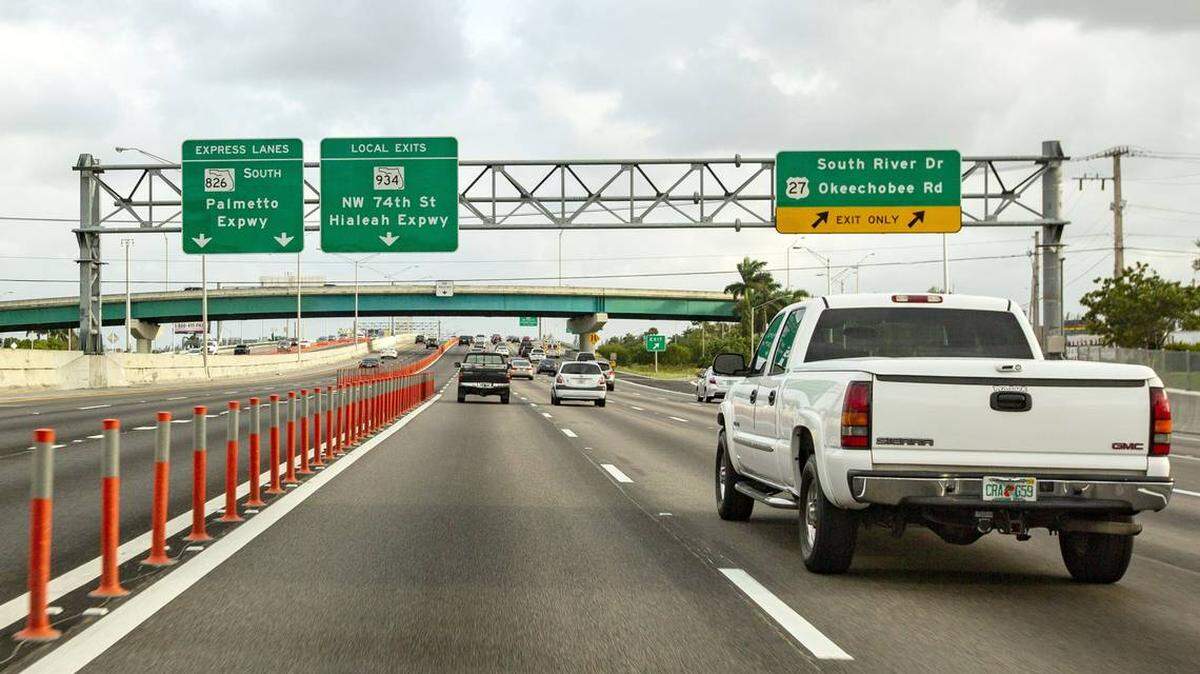
Two state legislators from Hialeah introduced bills in Tallahassee that would convert the new express lanes on the Palmetto Expressway to ordinary lanes and prohibit any tolling on the roadway. They contend that, since the express lanes opened in September, “Residents have experienced more congestion than ever and significant delays in their daily commutes.”
Those are serious charges, but there is no evidence to support them. In fact, actual traffic data on the Palmetto show significant improvement.
The Miami metro area is the fourth most-congested in the nation, according to the 2019 Urban Mobility Report from the Texas A&M Transportation Institute. Overall, commuters here waste 266 million hours a year stuck in traffic, at a total annual cost (wasted time and fuel) of $4.9 billion. That works out to $1,289 per commuter a year.
Priced express lanes, such as those that have operated on I-95 for 10 years, on I-75, I-595 and now on the Palmetto, are intended to reduce travel time and increase travel speed, by preventing those lanes from getting overcrowded during rush hours. And because vehicles in the express lanes would otherwise have been in the regular lanes, there should be less congestion in the regular lanes, too.
So let’s go to the numbers. Total volume on the Palmetto has increased by 25 percent since 2014, just five years ago. If no lanes had been added, the Palmetto might have ground to a halt by now. But data collected daily by Florida Department of Transportation show that peak-period travel times in the non-tolled lanes have decreased significantly compared with last year, before the express lanes opened.
For example, in the southbound morning peak, travel time in the regular lanes decreased from 18.99 minutes in September 2018 to 16.72 minutes today. And of course it’s even less in the express lanes, at 9.45 minutes.
Likewise, for the afternoon peak period, northbound travel time in the general lanes that was 19.66 minutes in September 2018 is now down to 12.18 minutes — and an even lower 6.98 minutes in the express lanes.
At the worst, most congested times of day on some segments of the Palmetto, the difference in travel speeds can be dramatic — such as an average of just 13 miles per hour in the general lanes vs. 53 mph in the express lanes (northbound, 6-7 p.m. between Northwest 36th Street and Northwest
74th Street).
These kinds of numbers are being seen across the nation. The new Palmetto express lanes are the 52nd such lanes to go into service. Every day, priced express lanes are giving hard-pressed commuters the option of bypassing rush-hour congestion in exchange for a toll. Atlanta, Dallas, Denver, Houston, Los Angeles, San Diego, San Francisco and Seattle commuters now have this option available on several freeways. And in every case the express lanes are delivering meaningful time savings and less-stressful commutes.
Because of the successful performance of these express lanes, all the above metro areas have made plans to build entire networks of express lanes, adding them to all their seriously congested freeways. In many cases, transit agencies are benefiting, too, because faster-flowing, uncongested express lanes enable far superior regional express bus service (as on I-95 today).
Florida DOT figures show that, after just three months in operation, the Palmetto express lanes are now attracting 40 percent of the total peak-period traffic. These drivers are choosing to pay for proven increases in speed and reduced travel time. If the bill to abolish the express lanes were enacted, the result would be more congestion on the Palmetto, not less.
In short, the Palmetto express lanes are working just as they were supposed to, delivering higher traffic volumes, higher speeds and quicker travel, while also improving conditions in the non-tolled lanes. Abolishing them would mean increased congestion, not less.
Robert Poole, who grew up in Hialeah, is director of transportation policy at the Reason Foundation.