
Don’t believe all the hype. Bipartisanship is alive and well in Congress | Opinion
For months now, cable news has been dominated by breathless reporting of President Trump’s misdeeds. The Capitol has been consumed in a kind of frenzied ballet, with reporters swarming its halls, tunnels and stairwells.
Each day, it appears that Congress is devolving further into partisan rancor. To many, American politics has never looked so bleak.
Yet, these were the same circumstances facing the nation 21 years ago this month, in November 1998, when the country and Congress were consumed by the potential impeachment of President Clinton. Though the years may have dimmed the memory of those proceedings for many, I was a member of the president’s cabinet at the time, and I can confirm that those days were similarly contentious.
However, even in that hyper-partisan atmosphere, Democrats and Republicans continued to come together to enact meaningful legislation for Americans’ benefit. During the investigation and subsequent impeachment proceedings, the House Democrats and Republicans worked together to pass hundreds of pieces of legislation.
Today is no different. Contrary to what some would have you believe, bipartisanship is still alive and well in Washington. Democrats and Republicans do not glare at each other when we pass in the halls. We do not refuse to work together. In fact, this couldn’t be further from the truth.
The Florida delegation in the House represents the full range of political thought in the United States. It contains some of President Trump’s fiercest critics, as well as many of his staunchest allies. Yet, we have come together to work on issues that matter to the people of our state and country.
Together, we’ve fought to protect the treasured natural environment from rising sea levels, pollution and other damaging effects of climate change. The Comprehensive Everglades Restoration Plan (CERP) was authorized in 2000, yet none of the projects it includes can be completed without substantial funding from the federal government. When the president’s proposed budget initially allocated only $63 million to Everglades projects, we came together as a delegation to request $200 million in funding. Thanks to our combined efforts, both the House and Senate appropriations bills include the full $200 million in funding for Everglades restoration.
This year, the House has passed a series of bills, including Florida Republican Rep. Francis Rooney’s Protecting and Securing Florida’s Coastline Act, to ban offshore drilling and keep Florida’s beaches clean. These bills will help restore coral reefs and marine habitats, facilitate our transition to renewable energy and ensure the state’s tourism-based economy and fishing interests are protected from oil spills. These aren’t Republican or Democratic priorities; they are Floridian and American priorities.
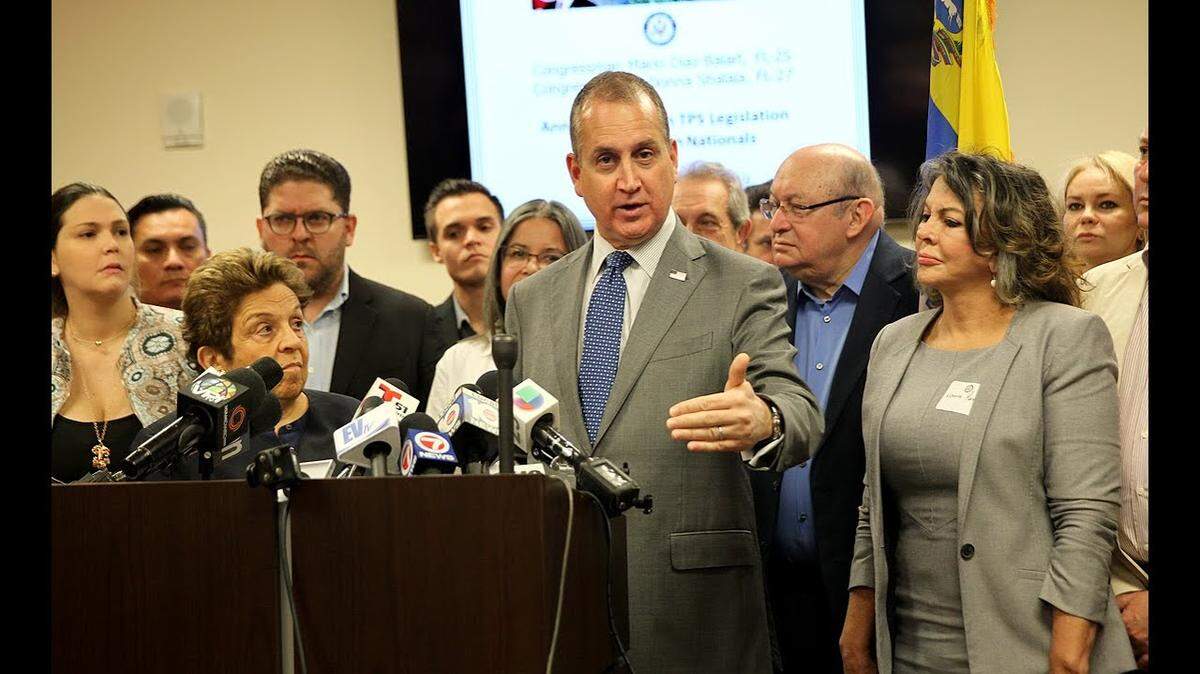
The Florida delegation’s other bipartisan efforts include addressing the humanitarian crises in Venezuela and Nicaragua and creating a path for Puerto Rican statehood. Republican Rep. Mario Díaz-Balart was instrumental in helping my Democratic colleagues and me pass the Venezuela TPS Act of 2019 in July, and he is the lead sponsor of the bipartisan Nicaragua TPS Act of 2019. More recently, Florida Democrats and Republicans joined Puerto Rico’s Rep. Jenniffer González-Colón to introduce the Puerto Rico Statehood Admission Act.
I’ve personally introduced bills to expand research on cannabis and to provide student borrowers with better information about their loans with Florida Republican Rep. Matt Gaetz. I’ve also worked with Sen. Marco Rubio to introduce the Protecting JOBs Act, a bill to prohibit states from revoking the professional licenses of borrowers who default on their student debt, in both the House and the Senate.
This spirit of bipartisanship extends well outside the state of Florida. One of my priorities in Congress is ending surprise medical billing through the Protecting People from Surprise Medical Bills Act. The legislation is a bipartisan effort between 46 Democratic and 57 Republican representatives.
So far this year, the House has passed more than 500 pieces of legislation. Over 100 of those bills were introduced by Republicans. The impeachment inquiry in the House has not reduced the rapid pace or the commitment to bipartisanship.
Good legislators don’t participate in “cancel culture.” No matter how much we may disagree with our colleagues’ ideology or politics, we recognize that we have a duty to work on behalf of the interests of the American people. I continue to support the impeachment inquiry, and I will also continue to work with any political opponent on any issues that will improve my constituents’ lives.
No matter how objectionable we may find each others’ positions to be, we weren’t elected to call people names. We were elected to get results for our community and our country.
Donna Shalala, former University of Miami president, represents Florida’s 27th congressional district in Miami.
This story was originally published December 2, 2019 at 5:52 PM.