
Netanyahu is a member of the “Flirting with Fascism” club. Its members are pushing hard for his reelection | Opinion
When Israel’s attorney general announced in late February that he would be indicting Benjamin Netanyahu on charges of bribery and breach of trust arising from three separate corruption investigations, it looked as if the long reign of the Israeli prime minister might finally be careening toward an end.
Some of us knew better than to write his political epitaph.
As a young journalist in 1996, I covered Netanyahu’s first run for prime minister, which took place just months after the assassination of warrior-turned-peacemaker Yitzhak Rabin. Netanyahu had attacked the Oslo peace accords signed by Rabin so mercilessly, and in the company of such extremists, that many Israelis blamed Bibi — as he is known in Israel — for adding to a climate of incitement and de-legitimization that opened the door to the assassination.
Afterward, Netanyahu found himself neck-in-neck with Shimon Peres, Rabin’s partner in making peace with the Palestinians. In a “Dewey Defeats Truman” moment, we went to sleep the night of the elections after filing our stories reporting that Peres has bested Netanyahu. We woke up in the morning to find that the tables had turned: Netanyahu had won. We scrambled to rewrite our stories, and Israelis either celebrated and succumbed to the reality that Netanyahu had succeeded in pulling the breaks on the peace train.
He has won every election he’s run in since, and if he wins again this Tuesday, it will be for a fifth term. It will represent yet another victory in his more than 30-year career of running for office. Then as now, Netanyahu has a talent in pulling forward in the last leg of the race.
What’s different now is that Netanyahu has friends in his corner, ones he couldn’t count on two or three decades ago. They’re a cadre of international leaders who, like him, don’t think a little thing like democracy ought to get in the way of running a country.
Netanyahu’s legal troubles remain, but waiting for his prosecution has turned out to be a little like waiting for the Mueller report. Just as the long-awaited investigation into the Trump campaign’s dealings with Russia was inconclusive and ultimately ended with President Trump taking several victory laps, the wheels of justice in Israel move slowly — and are similarly vulnerable to attacks on the judicial system’s purported partisan biases. The net effect is that voters in “the base” shrug, convinced these allegations don’t matter. And à la Trump, one gets the feeling that if Netanyahu were to shoot someone on say, Dizengoff Street in Tel Aviv, he still wouldn’t lose voters.
Team Trump has worked hard to ensure Netanyahu’s political survival. A little less than a year ago, Trump recognized Jerusalem as Israel’s capital and announced it would move the embassy there, jettisoning five decades of U.S. policy on the territories Israel captured in in 1967. Trump made a similar and potentially more significant declaration in March when he said that the United States was recognizing Israeli sovereignty on the Golan Heights, occupied by Israel in the same war and annexed in 1981.
Packaged together, these represent diplomatic achievements for Netanyahu that have been handed over on a silver platter by the Trump administration, which has still yet to unveil its much-touted Mideast peace plan after more than two years in office.
Timing counts. And after the Golan declaration, Netanyahu told reporters it all proves that any territory Israel seized in a defensive war was Israel’s to keep. We can read this for what it is: an unmasking of Netanyahu’s plans for the West Bank and an end to paying lip service to an elusive two-state solution.
But by far the biggest foreign gift to Netanyahu’s campaign has come from Vladimir Putin, who met with him in Moscow just days before the election. With the Russian president’s help, Netanyahu was able to escort home the remains of U.S.-born Yehuda Baumel, an Israeli serviceman killed in Lebanon 37 years ago. To bury a missing soldier in a national service on Jerusalem’s Mount Herzl right before the election is, by Israeli standards, practically a ticker-tape parade. It brings an unfinished chapter of war to an end, and Netanyahu gladly gets the credit.
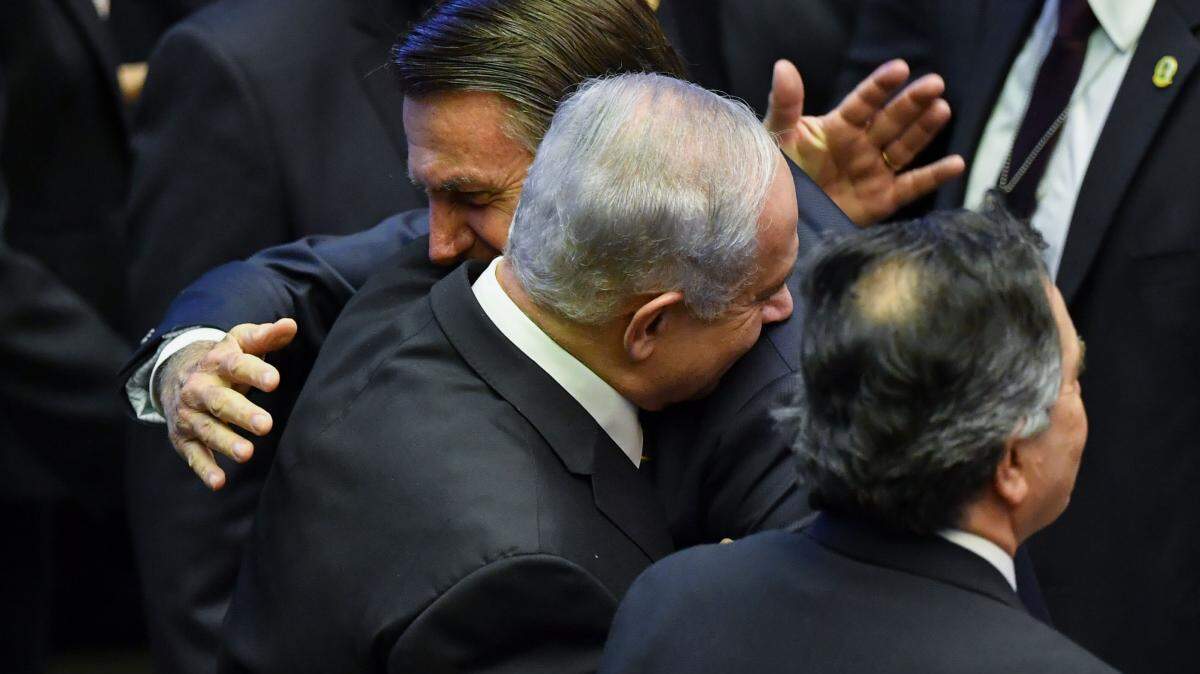
Netanyahu’s other good friends on the world stage include Brazil’s Yair Bolsonaro, who came for a four-day visit this week, and Hungarian Prime Minister Viktor Orbán. Together, they’re a kind of world-class “Flirting with Fascism” club, and it has become abundantly clear that they’re all campaigning for each other. Democracy, it seems, is so 2012.
It’s not that Netanyahu is a shoo-in, or even the most popular candidate. In fact, Benny Gantz, who like Rabin is a warrior turned statesman, is slated to garner the biggest bloc of seats in the 120-member Knesset, Israel’s parliament. But the number of parties with which he could form a coalition doesn’t add up to a governing majority, whereas the right-wing and ultra-Orthodox parties Netanyahu can team up with does.
This part can be hard for Americans to understand, because we’re not used to thinking of it still not being over when election day comes and goes. In Israel, that’s when things becomes as tricky as a game of Minecraft. Just as the rest of the world is left to wonder at our Electoral College, struggling to understand a system in which a candidate can lose the popular vote and still become president, this is the reality of Israel’s crazy-quilt democracy, in which 17 “viable” parties are running on Tuesday — not to speak of the smaller fringe ones.
If he is elected to a fifth term, Netanyahu has a few priorities. At the top of the list: an immunity law that would make it impossible to prosecute a sitting premier.
Ilene Prusher, who reported from Israel for 15 years, teaches journalism at Florida Atlantic University.