
Trump library may forever change how Miami’s Freedom Tower is perceived | Opinion
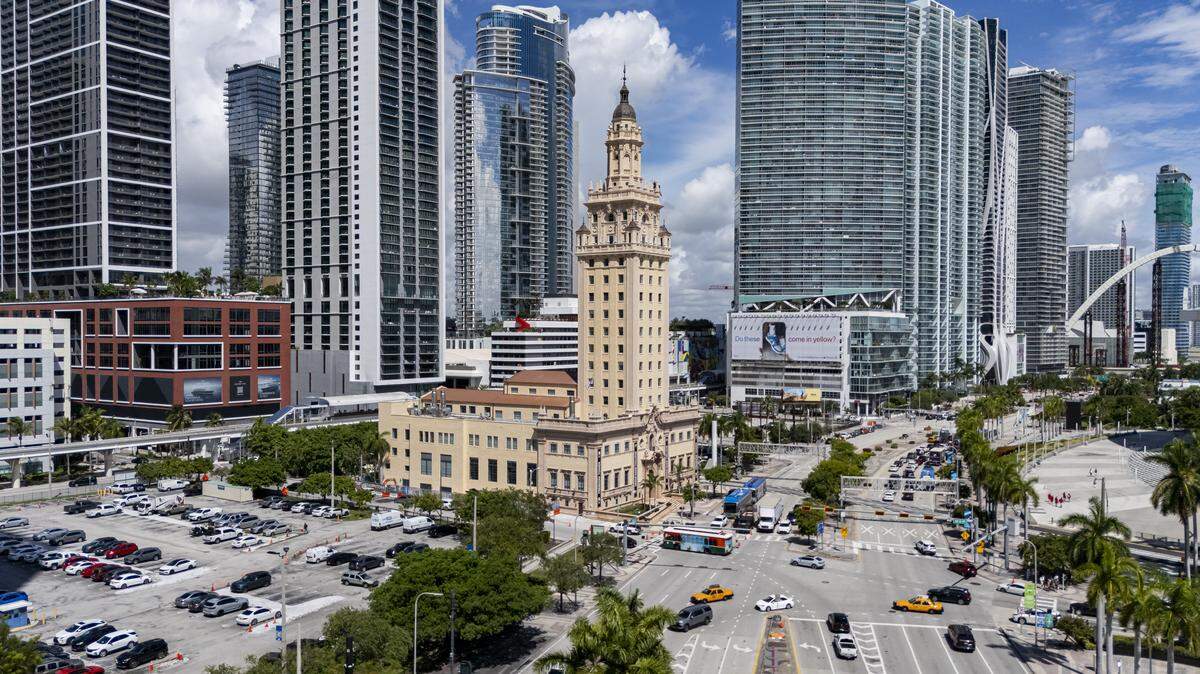
Towering over history
In my AP Seminar class at Don Soffer Aventura High School, students are tasked with researching and presenting any issue about which they feel most passionate. I focused on the preservation of historical monuments, especially those tied to painful or controversial history.
I concluded that historical structures must be protected because they preserve truth and warn society against repeating past mistakes. That conclusion is now extremely relevant to a debate in Miami.
The Freedom Tower served as the Cuban Assistance Center from 1962 to 1974, helping more than 400,000 Cuban refugees who fled communism to rebuild their lives. Designated a National Historic Landmark in 2008, it remains one of Miami’s strongest symbols of immigrant resilience.
For the Cuban community especially, it is the root of a population that reshaped the entire city. Despite this, in 2025, Florida approved transferring public land immediately next to the Freedom Tower to the Donald J. Trump Presidential Library Foundation.
According to recent lawsuits, the deal has become highly controversial. Critics argue that the transfer of valuable land to a sitting president for less than its true worth, in hopes of reported political benefits, may violate the U.S. Constitution’s Domestic Emoluments Clause. Supporters argue the placement honors the tower’s legacy of freedom.
The American Historical Association documented how monuments can reshape public memory depending on what surrounds them. The new structure, then, could forever change how the Freedom Tower is perceived.
What makes the project even harder to defend is how it is unfolding. Renderings show a gold-accented skyscraper featuring replicas of the Oval Office, a Boeing 747 in the lobby and a giant golden statue of the president, according to NPR. Trump himself told reporters the building will “most likely” function as a hotel rather than a traditional library, adding he does not “believe in building libraries or museums.”
The National Archives has not confirmed any formal partnership with the project. The building may never function as a true presidential library. Miami gave away deeply valuable public land, next to one of its most sacred landmarks, for what could amount to a luxury hotel.
Even if this was a true presidential library, its placement next to the Freedom Tower could be problematic. A library would at least carry some purpose. What is being proposed instead appears to be a commercial development, making what would have been an already dangerous decision into a far more damaging one.
The Freedom Tower’s story belongs to the families who arrived with nothing and built something extraordinary. It should not be attached to a commercial project that contradicts the values the landmark represents. Historical symbols are necessary and history should never be distorted.
Luca Vain,
Aventura
Safer streets
Smart Growth America appreciated the Herald’s coverage of Dangerous by Design in the June 29 story, “Do you feel unsafe walking in Miami? It takes millions to reduce pedestrian risk.” The article rightly focuses on the scale of the pedestrian safety crisis and also helps shift the conversation toward solutions that can save lives.
Miami deserves credit for securing federal funding and planning long-term street improvements, demonstrating city staff’s leadership and commitment. While those projects move through design and construction, people continue to walk and bike on these streets daily.
The city doesn’t have to wait to make progress. Miami has already used quick-build demonstration projects to test safer street designs. The city’s vision could be hastened by implementing temporary versions of the planned changes. Whether a new crosswalk or temporary bike lane, quick-builds improve the community’s day-to-day safety and signal that city staff and leadership care about pedestrians and bike riders. Winning grants might not capture much attention, but transforming someone’s morning commute for the better definitely will.
Miami should continue pursuing long-term improvements while expanding quick-build projects that can save lives today.
Heidi Simon,
Washington, D.C.
Mobility lawsuit
I urge Gov. Ron DeSantis and Florida Attorney General James Uthmeier to immediately withdraw our state’s participation in the Texas v. Kennedy federal lawsuit and stop supporting efforts that undermine Section 504 of the Rehabilitation Act.
I have a mobility disability and 504 is not abstract or theoretical; it directly shapes my ability to live, work and participate fully in my community. Thanks to 504, I can navigate the world independently, access public spaces and receive equitable healthcare. These are not privileges, they are basic civil rights. I’m also a social worker and teach leadership and advocacy skills to those with and without disabilities.
Weakening or dismantling Section 504 would make it harder for people with disabilities to assert their rights, access services and remain in their communities. Further, it risks pushing people with disabilities into institutional settings against their will, rolling back decades of hard-fought progress. By joining Texas v. Kennedy, Florida invalidates not only the updated regulations, but 504 itself.
If the court grants this request, I and many Floridians with disabilities would lose civil rights protection that our community has fought for generations to secure.
Shelly Baer,
Miami
FIU turns right
Much to the dismay of law professors and FIU’s former law school dean, the Miami Herald reported that Donald Trump associate Daniel Epstein will join FIU Law as interim dean. According to the report, Epstein will likely use his network to connect students with right-wing judiciary.
As a graduate of FIU Law and as an attorney in our community, I see this embrace of right wing ideology as more in-your-face, but it isn’t without precedent. The school recently brought local right wing U.S. District Judge Roy Altman to speak about “freedom of speech.” Appointing Epstein to act as interim dean may be an overt move to the right, but we can’t pretend it began here.
Katherine Shehadeh,
Coral Gables
Nothing to hide
Those who followed the late U.S. Supreme Court Justice Antonin Scalia know he was a strong advocate for textualism. Specifically, that meant reading and interpreting a constitutional amendment as written. If the amendment is explicit, it should be read without historical or interpretive nuances.
Given that, it is ironic and frankly funny that those who lionized Scalia and his interpretive philosophy are now twisting themselves in knots decrying the recent Court decision on birthright citizenship. The 14th Amendment was clearly written without equivocation.
As a fictional character once noted, someone is protesting too much.
Sid Kaskey,
South Miami
Messy math?
Last week, I bought my usual brand of Purex Fresh Mountain Breeze 4-in-1 liquid laundry detergent. The bottle was noticeably smaller and the listed liquid content also notably smaller, by 9 ounces. However, the number of loads it could wash had increased from 57 to 58.
I was puzzled, from a mathematical perspective, as to how 66 ounces versus 75 ounces could produce more loads, as the measuring cup and the formula had remained the same. The answer lay in the recommended load/fill amount, which had been reduced from 1.3 ounces to 1.12. And with just simple semantics and the re-printing of a label, the Henkel Corporation, with $23.4 billion in annual sales, was able to achieve the mathematical impossibility.
If it was effective all along to wash the same amount of clothes with less detergent, why not state this from the beginning and give the poor consumer a break?
Betsy Sharp,
Miami