
Miami Dade’s Trump library land deal must mean it no longer needs our money | Opinion
Free tuition?
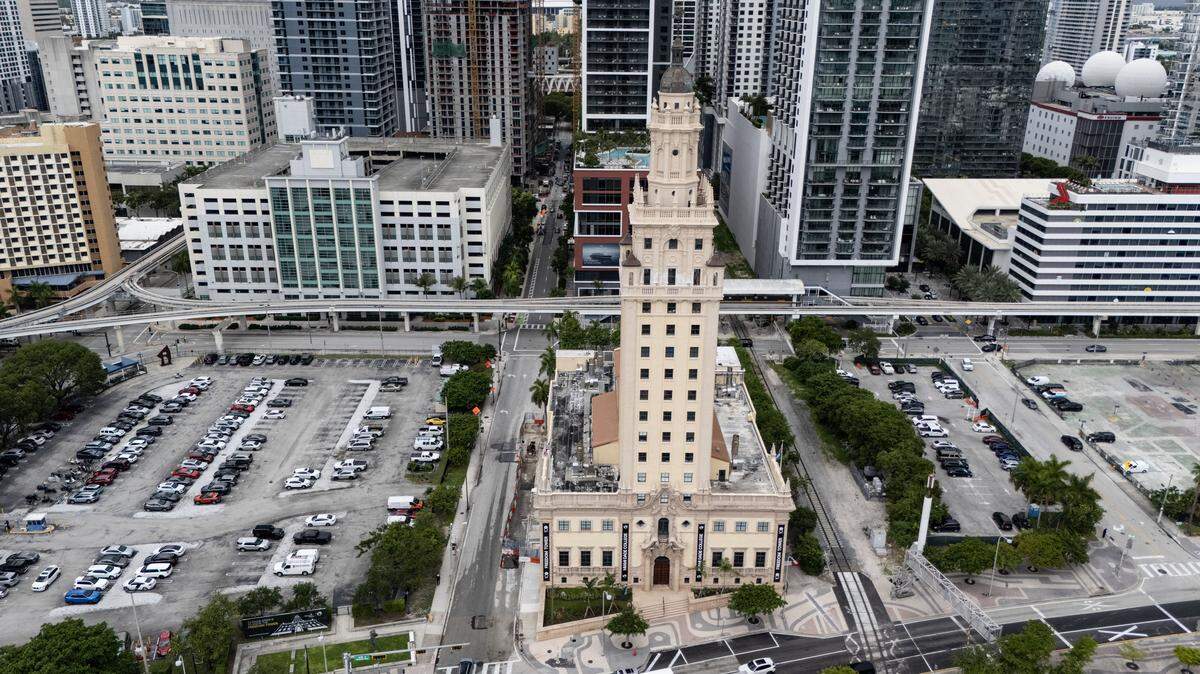
In conveying property potentially valued as high as $300 million for the Trump Library — and getting nothing in return — the Miami Dade College Board of Trustees is confirming the college is financially healthy and needs no further financial assistance. Furthermore, due to their situation, the trustees should pledge free tuition for the next 10 years to all local students in financial need.
MDC, in the past, has been a wonderful asset to our community. By educating our future leaders for free, they will continue to play an important role in making Miami one of the finest cities in the world.
Art Young,
West Kendall
Thankful thought
During this holiday season, I understand how truly blessed I am. However, I still worry about the direction in which our country is going. In the words of Bob Dylan, “For the times they are a-changin’,” but this time, not for the better. It seems like the simple truths about our country are vanishing.
America used to be a place where one could freely speak one’s mind, without any fear of retribution; now, those who protest are silenced and threatened. We used to honor our military heroes, but now, our leaders disrespect and even vilify some of them and, in some cases, accuse them (ironically) of sedition.
America used to be the envy of other nations, but no longer; our leaders abandon our friends and allies and appease our enemies. Those struggling for freedom are no longer able to seek refuge in the land of the free. Now, they are hunted down, separated from loved ones and sent off to faraway lands. Basic needs, like health and “food on the table,” are out of reach for many.
I am thankful for one thought: The future won’t always be like this. That’s what I’ll pray for this holiday season.
Peter M. Brooke,
Doral
Orders kept
When I joined the U.S. military, I took my oath to defend the Constitution of the United States. Many young and impressionable recruits today would tend to question orders, maybe in the heat of battle, perhaps causing great harm in our ability to effectively wage war.
As I understand the Code of Military Justice, an order is to be obeyed and considered legal. When I flew for the Air Force, if I had to drop nukes on an enemy target, I would not hesitate to follow through.
There have been times in our nation’s history in which orders may have been given which resulted in unnecessary harm to civilians, such as in My Lai, Vietnam. This is rare and probably not the reason for the recent statements to question illegal orders. These statements appear political and are an attempt to place doubt in our military about future decisions, maybe in a scenario with Venezuela.
Roger Shatanof,
Coral Gables
Government overreach
United States Congressman Mario Díaz-Balart tried to counter Office of Management and Budget’s (OMB) policy of “pocket rescission,” which involves the impoundment of congressionally-appropriated funds. OMB’s director, Russell Vought, leaned hard on the congressman to try to shut him down. In the 1970s, former President Nixon attempted to do likewise, but lost in the Supreme Court (in the days when justices had moral backbones). In Train v. City of New York (1975), the court decisively rejected Nixon’s claims that he could refuse to spend congressionally appropriated funds. Let’s fight the Trump administration’s overreach — there is a legal basis to do so.
Theron White,
Pompano Beach
Brightline’s sins?
I have no dog in the Miami Herald’s fight with the Brightline train system. I am merely a Herald reader who has ridden Brightline once and probably will do so again.
We have been told that Brightline lacks “empathy,” as indicated by its track-side manners (allusion to medical bedside manners intended) in the handling of a recent car-vs-train crash. This was another article in a series attempting to paint Brightline in a bad light, resulting from the many crashes in which people have been tragically and sadly killed or horribly injured. The piece included the customary call for Brightline and our community (“regulators”) to do something.
I also happen to be a lawyer. The first question I ask my opponents when they accuse a client of wrongdoing is: what did my client do wrong?
The fatalities and injuries in these Brightline-related crashes are a legitimate subject of local and regional journalistic inquiry. However, before the next piece on a crash is written, I hope reporters answer this question: what did Brightline do wrong?
The question is relevant because none of the previous articles have documented Brightline wrongdoing.
Leo Bueno,
Coral Gables
Losing our edge
As the number of people with pertussis (Whooping Cough) explode as a percentage (though not yet in absolute numbers), it is disappointing that smoking can be barred where it’s a hazard to the general non-smoking public, but schoolchildren can avoid vaccination for infectious diseases.
As a 78-year-old who volunteers daily at a public school, working close to mostly first-graders, I have been lucky not to catch their frequent colds. Now, their teachers and I have to consider the ramifications of unvaccinated students who have diseases for which immunizations have been around for decades, all because a parent decided they know more than PhDs and MDs in infectious diseases.
Vaccines and public sanitation have been the greatest boon to public health in the past century. However, to paraphrase an old adage, “These Luddites let hope triumph over experience.”
L. Gabriel Bach,
Key Biscayne
Hospitable culture
The Miami Herald’s Nov. 23 article, “He was ready for heart surgery with Miami’s top surgeon. What went wrong?” regarding Dr. Joseph Lamelas, was enlightening. I’m an ex-UHealth patient, now with Baptist Hospital and its Miami Cancer Institute (MCI). The hospital management culture makes a difference. From phone receptionists to medical specialists, I find Baptist more patient-oriented. That difference in the culture affects from top to bottom.
Only one hospital stay at UHealth’s old Cedar’s hospital prompted a male nurse to tell me I was a difficult patient after one complaint. Hospital efficiency in care and waiting time is better at Baptist and MCI.
American health care and hospitals are run by administrators and insurance companies, not experts in medicine. Doctors run through more patients in less time, given restricted insurance payments. This came about due to fee abuse, prompting insurance control.
The American Medical Association fought the creation of Medicare, fearing government intrusion, until it realized it was a gold mine. The medical profession is now the medical business. And yet, the specific culture makes a difference.
Michael G. Merhige,
Kendall
Building equity
Salim Chraibi’s Nov. 24 op-ed, “Millionaires already sideline Miami’s regular homebuyers,” was correct in stating that, “We need a more responsive process, one that treats affordable homeownership with the same urgency as infrastructure or economic development.” The popular “one size fits all” solution of small rental apartments in high-rise buildings provides families with shelter only, not the path to generational equity.
Creating affordable homeownership will require the same political will and funding as did the G.I. Bill that President Roosevelt signed into law in 1944. Starting with homes built by William Levitt in what famously became “Levittown,” the first substantial equity most veterans ever accumulated was the equity in their homes, including my father’s. One can rightfully say home equity built the foundation for the American middle class, although Black vets were often excluded by local administrators.
I learned some things building homes in the Little Bahamas/West Coconut Grove area. To begin building stability, neighborhood spirit and financial equity for working class families, we will need multiple initiatives, including Land Trusts, “Soft second” mortgage subsidies, fast-track permitting, Accessory Dwelling Units (“Granny flats”) and zoning changes vetted neighborhood by neighborhood. Most importantly, a 3% down payment from new homeowners, to assure they have personally committed to the responsibilities of homeownership.
Anthony Parrish,
Coconut Grove