
A ‘tsunami of opposition’ is Miami’s warning sign. End ICE partnership now | Opinion
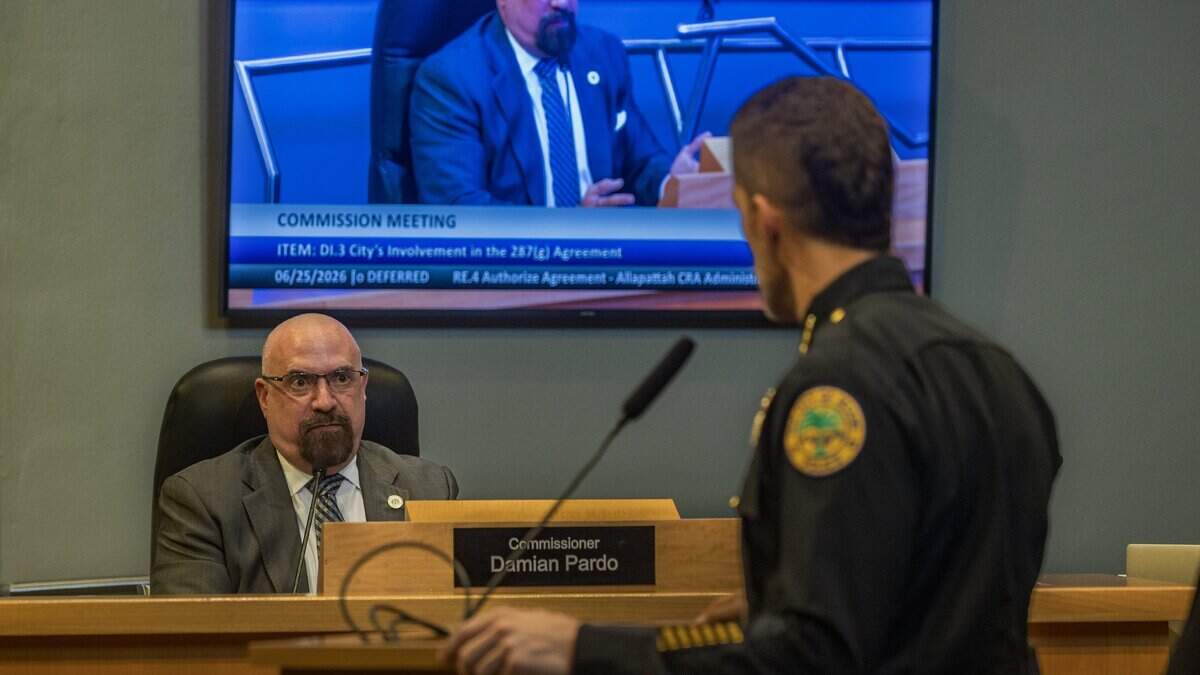
Miami Commissioners heard last week what the Miami Herald deemed as a “tsunami of opposition” to the city’s 287(g) agreement. It authorizes Miami police officers, under the supervision of Immigration and Customs Enforcement (ICE), to perform certain federal immigration enforcement functions, expanding local participation in the federal immigration enforcement system at a time of rapidly growing detention infrastructure.
The city of Miami entered the agreement last year despite widespread public criticism. Hundreds of residents gathered outside City Hall and urged commissioners to reject the measure, warning that it would erode trust between immigrant communities and local law enforcement. Nevertheless, the commission approved the agreement in a 3–2 vote.
A year later, South Florida has become one of the nation’s centers of immigration enforcement. Analysis by The New York Times found Florida is leading the country in immigration arrests, with the Miami field office of Immigration and Customs Enforcement (ICE) averaging approximately 120 arrests per day.
Data published by Florida’s State Board of Immigration Enforcement indicates that the Miami Police Department has become an active participant in immigration enforcement. According to the state’s database, the department ranks 13th among Florida law enforcement agencies in reported immigration-related encounters. It trails behind the Florida Department of Law Enforcement, an agency that prioritizes cooperation with federal immigration authorities.
Immigrant communities in Miami have been heavily affected by federal immigration policies, which have stripped legal protections from hundreds of thousands of people. Cuban nationals have experienced a sharp increase in removals, with more than 1,600 deported in 2025, roughly twice the number deported the previous year.
The U.S. Supreme Court ruled that the Trump administration can rescind Temporary Protected Status (TPS) from 350,000 Haitian immigrants, a majority of them living in South Florida. Miami Commissioners heard the news through public testimony given during the 287(g) hearing at City Hall, and numerous people made the point that thousands of Haitians residing in Miami will now be vulnerable to being picked up by immigration enforcement.
Both Commissioner Damian Pardo and Chairwoman Christine King — she introduced the recent 287(g) discussion item — voted against it last year and say they would vote to rescind it if given the opportunity. Commissioner Ronaldo Escalona was moved to tears when listening to hours of public testimony. Escalona shared that after his wife, a U.S. resident, was called in for an immigration-related appointment, the anxiety they felt left them unable to sleep for a week.
If a Miami commissioner feels that level of fear when his family has to interact with an administrative immigration process, imagine the level of fear our undocumented neighbors experience when they hear that police are collaborating with ICE.
When commenting on the agreement, Escalona said that the issue is “the fear that we see in our community,” adding that if he could be assured that the city could exit the agreement, he would vote for it.
When City Attorney George Wysong shared that Miami could lose around $7 million in state funds, King responded by correctly pointing out that the amount presented is worth saving a family. There are houses in wealthy areas of Miami that cost far more than that amount. Wysong also provided wrong information to commissioners, stating that 33 out of 34 municipalities in Miami-Dade have signed 287(g) agreements, when in reality more than two-thirds of cities in this county have not signed on at all.
Miami’s 287(g) agreement needs to be rescinded. Tens of thousands of people across South Florida, including members of hundreds of thousands of mixed-status families, face an increased risk of detention and deportation as local police become further integrated into the federal immigration enforcement apparatus. Political conditions now favor ending the agreement; the city has the legal authority to do so, and the moral imperative is clear.
Thomas Kennedy is an Argentine writer and immigration advocate based in Miami. He has worked with organizations including the Florida Immigrant Coalition and The Immigration Hub, and previously served as an aide in the Florida Legislature. He is on X and Instagram at @Tomaskenn.