
DeSantis mocked bizarre district, then drew a weirder one to pad Miami GOP seats | Opinion
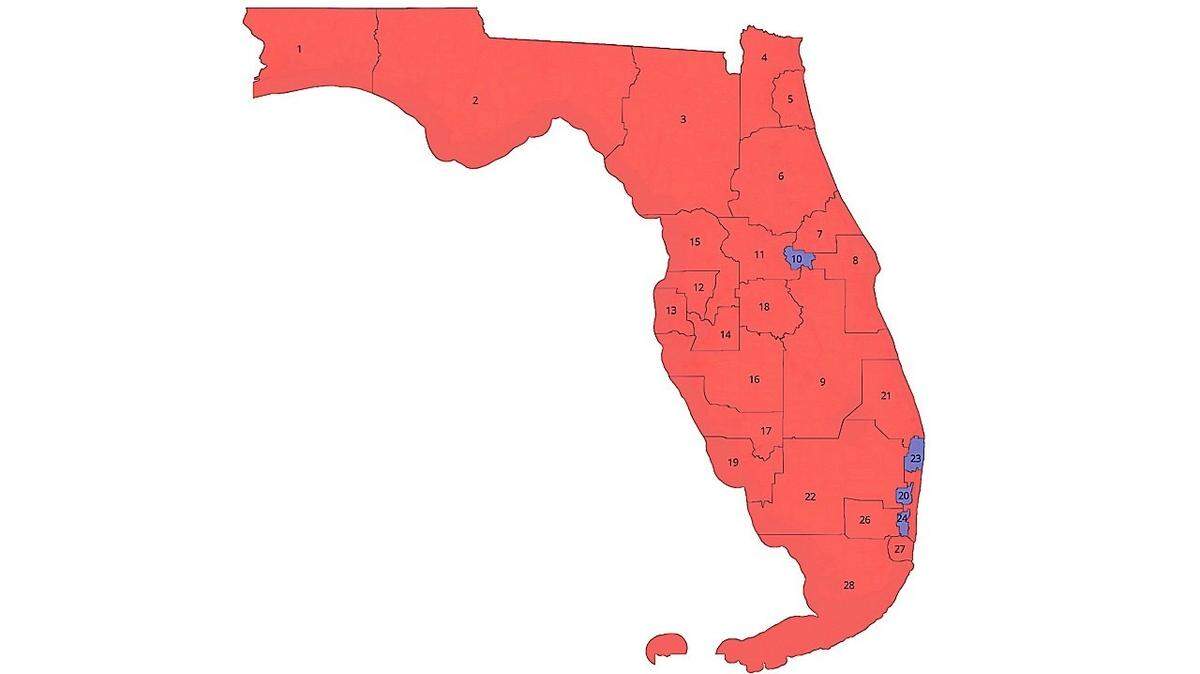
Part of Florida Gov. Ron DeSantis’ justification for redrawing congressional district lines was a “racially gerrymandered” district his new map has “unwound,” he posted on social media.
The governor has often complained about the old shape of District 20, calling it last year “the most irregular shaped district on Florida’s map.” That map is one he drew in 2022, by the way, before President Trump’s edict that states redraw congressional boundaries to help Republicans keep the U.S. House. The district covered much of western Broward and Palm Beach counties and snaked east around predominantly Black communities toward the coast. The lines were drawn so that Black voters could elect a candidate of their choice.
But what DeSantis has done is replace “racially gerrymandered” lines with partisan gerrymandered ones in South Florida and across the state. The new lines are clearly intended to group as many Republican voters as possible into single districts. The results are boundaries that are as oddly shaped as the one he used to complain about.
This isn’t just a matter of poor aesthetics — it impacts representation in Miami-Dade. Part of the county, under the map the Legislature approved Wednesday, is now part of a district that extends as far north as Delray Beach.
District 25, represented by Democratic U.S. Rep. Debbie Wasserman Schultz, previously covered a swath of southern Broward, stretching east to west. The redrawn district, now a skinny shape, stretches from Fisher Island and South Beach across all of coastal Miami-Dade and Broward and into southern Palm Beach. Along the way, it has claws veering west into parts of inland Fort Lauderdale and Boca Raton.
The new lines cut across three of the state’s largest counties and communities that don’t have much in common besides being near or on the coast. District 25 is more than 50 miles long, a distance that in South Florida traffic can require more than a two-hour drive, making these areas harder to represent.
This looks like an example of what Florida voters were trying to avoid when they approved the Fair Districts Amendment in 2010 to ban the drawing of districts for partisan gain.
District 25 was redrawn from solid blue to favor Republicans, though not by much. The district voted for Joe Biden by about five points in 2020 and then for Trump in 2024 by nine points, according to Sabato’s Crystal Ball, a nonpartisan political analysis newsletter that stated District 25 “could very well be a Toss-up” in the November midterms. Wasserman Schultz said Friday she’s running for reelection but did not say in which district, the Sun Sentinel reported.
In the end, with Trump’s low approval ratings and the history of the party in power under-performing in midterms, DeSantis and lawmakers might not get the outcome they anticipated. But voters will not get their old district back.
Before last week’s redistricting, Republicans controlled 20 out of 28 Florida congressional seats. Now they could flip four additional ones. What happened to District 25 isn’t unique to South Florida, Matthew Isbell, a Democratic data analyst, told the Herald Editorial Board.
An even more egregious example of anomalous boundaries is District 9. It stretches from urban Orlando to rural areas surrounding Lake Okeechobee more than two hours away and Vero Beach on the Atlantic coast. That district, currently represented by Democratic Rep. Darren Soto, became solid red — Trump won it by nearly 19 points in 2024, according to Sabato’s Crystal Ball. Another example: District 22, now stretching from western Palm Beach and Broward to Marco Island on the Gulf Coast.
Isbell said he believes these districts are not compact, a standard in redistricting that is meant to prevent bizarrely shaped, gerrymandered maps. It will probably be up to the courts to decide whether that’s the case. DeSantis has stacked the state’s Supreme Court with conservative justices, so the odds are, unfortunately, against voters’ favor.
If these maps are upheld in court, next time lawmakers redistrict they will feel emboldened to manipulate boundaries as much as they want into any unthinkable shape. The only goal has become political dominance, not voter representation.
BEHIND THE STORY
MOREWho decides the political endorsements?
In advance of local and state elections, Miami Herald Editorial Board members interview political candidates, as well as advocates and opponents of ballot measures. The Editorial Board is composed of experienced opinion journalists and is independent of the Herald’s newsroom. Members of the Miami Herald Editorial Board are: Amy Driscoll, editorial page editor; and editorial writers Isadora Rangel and Mary Anna Mancuso. Read more by clicking the arrow in the upper right.
What does the endorsement process look like?
The Miami Herald Editorial Board interviews political candidates to better understand their views on public policy and how their policies will affect their constituents. Board members do additional reporting and research to learn as much as possible about the candidates before making an endorsement. The Editorial Board then convenes to discuss the candidates in each race. Board members seek to reach a consensus on the endorsements, but not every decision is unanimous. Candidates who decline to be interviewed will not receive an endorsement.
Is the Editorial Board partisan?
No. In making endorsements, members of the Editorial Board consider which candidates are better prepared to represent their constituents — not whether they agree with our editorial stances or belong to a particular political party. We evaluate candidates’ relevant experience, readiness for office, depth of knowledge of key issues and understanding of public policy. We’re seeking candidates who are thoughtful and who offer more than just party-line talking points.