
Trump isn’t making money from Florida airport rebranding, right? Maybe ask again | Opinion
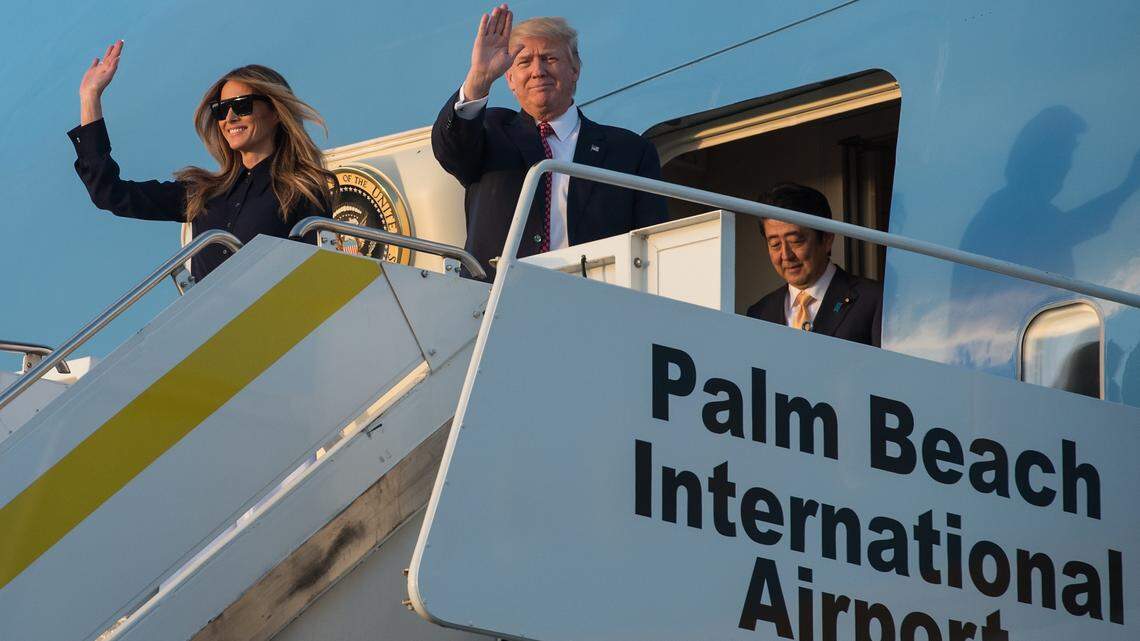
Could President Donald Trump make money from the renaming of Palm Beach International Airport?
His supporters have certainly implied that.
The Florida Republican lawmakers who passed the law to require the airport’s rebranding have insisted that Trump’s companies wouldn’t receive royalties or charge licensing fees for the renaming. The Trump organization has told the Herald the president, who owns Mar-a-Lago in Palm Beach, is “willing to provide this right to his hometown county at no charge.”
But, based on the Herald’s reporting this week, that’s still an open question as Palm Beach County negotiates a deal to license the trademark for Trump’s name.
Will the Trump-affiliated companies not make a cent off of President Donald J. Trump International Airport? The same question applies to the Trump presidential library in downtown Miami, which is planned on valuable land that belonged to Miami Dade College and was donated to his nonprofit foundation with few strings or questions asked. Trump has said the project will likely include a hotel.
You don’t have to suffer from “Trump derangement syndrome” to wonder whether he sees his grip over Florida’s Republican-dominated politics as a business opportunity. The president and his family have made an estimated $4 billion leveraging his position during his time in office, the New Yorker reported in January.
In February, a company managed by Trump’s organization filed three new trademark applications for “DJT,” “Donald J. Trump International Airport,” and “President Donald J. Trump International Airport.” The trademarks cover dozens of goods and services, including airport buses, parking garages, suitcases and more, the Herald reported.
That was an unprecedented move. The trademark for Reagan National Airport in Washington, D.C., for example, is owned by the public entity that operates the facility, the Herald reported. Trump’s team says the trademark was needed in his case to prevent “bad actors” from “misusing” his name. Perhaps they are right — considering the president’s low approval ratings.
Florida’s new law requires Palm Beach County to enter into an agreement with Trump-linked companies that would give the county, at no cost, “the perpetual and unrestricted right” to use the name President Donald J. Trump International Airport.
The details of that agreement are being discussed, including — crucially — how the county and Trump’s companies will split profits from the sale of Trump airport-branded items. The details of a potential profit-share agreement will be ironed out in closed-door negotiations, according to the Herald.
In other words, the county might not have to directly pay to use Trump’s name, but it seems that there other ways for his companies to make a buck. All of that is courtesy of Florida Republicans, tripping over themselves to please the president. And let’s not forget Florida taxpayers are expected to fork over the estimated $5.5 million in logistical costs to implement the name change.
Palm Beach County officials must refuse any agreement that benefits Trump’s businesses to the detriment of the public. County officials told the Herald a deal won’t happen if there aren’t sufficient protections. But those officials are certainly under political pressure from Tallahassee to sign off on the renaming. This, no doubt, gives Trump’s companies leverage.
Palm Beach County Administrator Joseph Abruzzo told the Herald the president and his team have been “excellent” to work with. But lawmakers and Gov. Ron DeSantis, who signed the law last month, put local officials in an uncomfortable situation: negotiating on behalf of their constituents could put them at odds with a president who is known for taking names.
This wouldn’t happen if Florida leaders weren’t in such a rush to brand things after Trump. The Legislature also renamed part of a Palm Beach road after him last year, and Hialeah did the same for a city road in 2024.
Trump still has almost three years left in office, and it’s unclear whether mass deportations, tariffs, a war with Iran and rising gas prices will define his legacy. We hope naming an airport after him is not a decision Florida comes to regret one day.
BEHIND THE STORY
MOREWho decides the political endorsements?
In advance of local and state elections, Miami Herald Editorial Board members interview political candidates, as well as advocates and opponents of ballot measures. The Editorial Board is composed of experienced opinion journalists and is independent of the Herald’s newsroom. Members of the Miami Herald Editorial Board are: Amy Driscoll, editorial page editor; and editorial writers Isadora Rangel and Mary Anna Mancuso. Read more by clicking the arrow in the upper right.
What does the endorsement process look like?
The Miami Herald Editorial Board interviews political candidates to better understand their views on public policy and how their policies will affect their constituents. Board members do additional reporting and research to learn as much as possible about the candidates before making an endorsement. The Editorial Board then convenes to discuss the candidates in each race. Board members seek to reach a consensus on the endorsements, but not every decision is unanimous. Candidates who decline to be interviewed will not receive an endorsement.
Is the Editorial Board partisan?
No. In making endorsements, members of the Editorial Board consider which candidates are better prepared to represent their constituents — not whether they agree with our editorial stances or belong to a particular political party. We evaluate candidates’ relevant experience, readiness for office, depth of knowledge of key issues and understanding of public policy. We’re seeking candidates who are thoughtful and who offer more than just party-line talking points.