
‘TPS changed my life.’ Why would Trump send these Florida workers back to chaos? | Opinion
On Tuesday, the lives of about 350,000 Haitians living in the U.S. are scheduled to change. That’s when the termination of their Temporary Protected Status, or TPS, is expected to go into effect.
Imagine being in the U.S. for 20 years, like Farah Larrieux of Miramar, building a business that employs about 10 contractors and leading a South Florida civic organization — only to wonder whether, in a matter of days, your life will be upended, and you’ll be forced to return to a country you love but that doesn’t have a functioning government and is falling under the control of violent gangs.
The plight of Larrieux and other TPS holders probably does not pull at the heartstrings of President Donald Trump and many of his supporters. “TPS was always meant to be temporary,” many of them will say.
But the program that allows foreigners to live in the U.S. because of unsafe conditions in their country also wasn’t meant to end when those conditions have not changed — and have actually gotten worse. Not when the State Department has issued a travel advisory, urging Americans: “Do not travel to Haiti due to kidnapping, crime, terrorist activity, civil unrest, and limited health care.”
And yet the Trump administration is saying it’s fine for even children on TPS to return?
That defies common sense. Miami’s congressional delegation, which represents one of the nation’s largest Haitian communities, must speak up — and act.
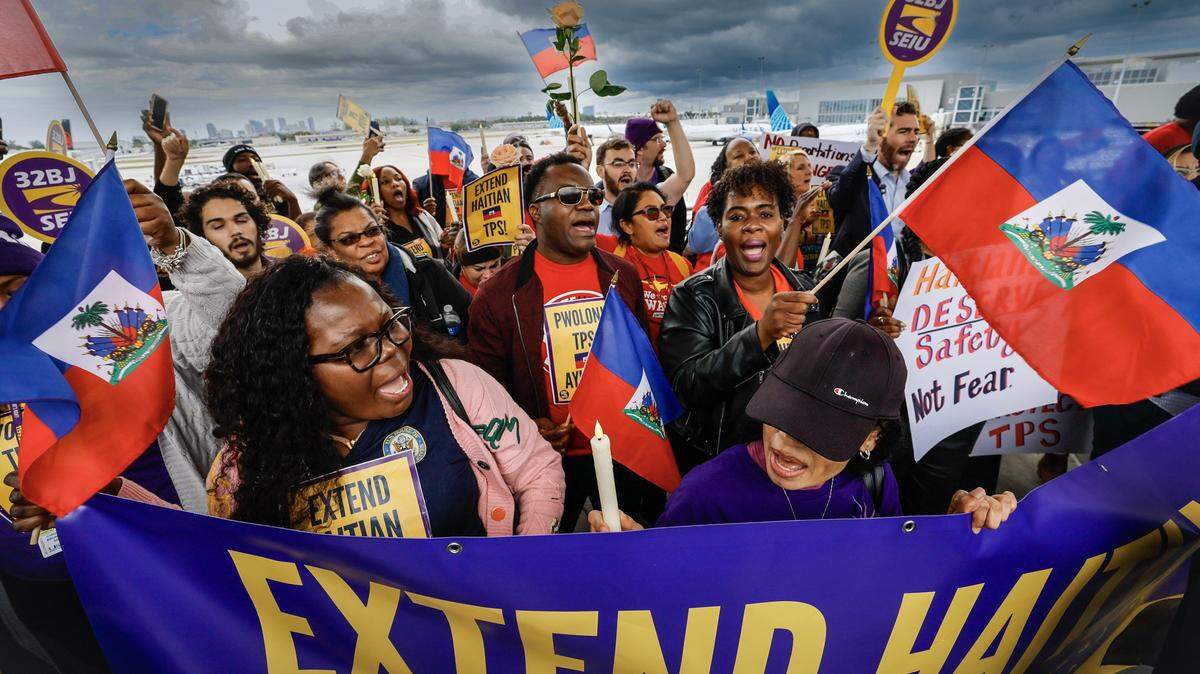
“TPS changed my life,” Larrieux said during a Wednesday rally at Fort Lauderdale-Hollywood International Airport organized by unions representing airport, hotel and nursing home workers. The unions are urging the administration to extend Haitian TPS. They also support a “discharge petition” by U.S. Rep. Ayanna Pressley, D-Massachusetts, that would force the U.S. House to vote on a bill to extend Haiti’s TPS designation for three years.
The measure needs 218 signatures to move forward. No South Florida members of Congress had signed it as of Jan. 22, according to congressional records, though Broward U.S. Rep. Debbie Wasserman Schultz, a Democrat, said at the rally that she would.
Larrieux had been in the U.S. since 2005 and got her TPS status after the 2010 earthquake in Haiti. A former host on Haitian TV, she co-founded a public relations and communications firm that specializes on the Haitian market. She’s also chair of the Association of Miramar Haitian-American Residents and Business Owners.
She told the Herald Editorial Board she considered returning to Haiti in 2018 but changed her mind when the conditions began to deteriorate. Running a business there now feels unfeasible.
“Haiti doesn’t have [reliable] electricity, doesn’t have power, Wi-Fi,” Larrieux said. “Everything costs a lot of money, and, also, because of the current situation — the violence — people don’t invest. Who’s going to invest in doing PR, doing communication?”
Trump claims immigrants threaten national security, painting them as dangerous and violent. That rhetoric groups the small number of immigrants who have committed serious crimes with those like Larrieux, who have achieved the American ideal of owning a small business, or who have steady jobs and contribute to the local economy. To qualify for TPS and to keep it, applicants cannot have a criminal background beyond one misdemeanor.
Fort Lauderdale Airport employs 150 Haitian TPS holders, out of about 1,500 employees, an airport spokeswoman told the Herald Editorial Board. They work as wheelchair agents, concession workers and in janitorial services, among other functions.
Haitians “have always been strong people, they always work the jobs that other people wouldn’t work,” Michelle Pierre, an airport wheelchair assistant said during the Wednesday rally. She said she has an aunt who lost her job as a cleaner at a local university because of the looming expiration of her TPS.
Trump has dehumanized migrants like Larrieux and Pierre’s aunt. He’s spread falsehoods about them — “... they are eating the dogs. The people that came in, they are eating the cats,” Trump said about Haitians in Springfield, Ohio, during a 2024 presidential debate.
But how much safer will we be when 350,000 Haitians lose their protected status, along with their authorization to work for employers that rely on labor that’s hard to find?
Mass deportation and the stripping people’s legal status doesn’t appear to be in the best interest of the U.S economy, businesses or the American people. No one should be saying that louder to the president than South Florida’s members of Congress.
BEHIND THE STORY
MOREWho decides the political endorsements?
In advance of local and state elections, Miami Herald Editorial Board members interview political candidates, as well as advocates and opponents of ballot measures. The Editorial Board is composed of experienced opinion journalists and is independent of the Herald’s newsroom. Members of the Miami Herald Editorial Board are: Amy Driscoll, editorial page editor; and editorial writers Isadora Rangel and Mary Anna Mancuso. Read more by clicking the arrow in the upper right.
What does the endorsement process look like?
The Miami Herald Editorial Board interviews political candidates to better understand their views on public policy and how their policies will affect their constituents. Board members do additional reporting and research to learn as much as possible about the candidates before making an endorsement. The Editorial Board then convenes to discuss the candidates in each race. Board members seek to reach a consensus on the endorsements, but not every decision is unanimous. Candidates who decline to be interviewed will not receive an endorsement.
Is the Editorial Board partisan?
No. In making endorsements, members of the Editorial Board consider which candidates are better prepared to represent their constituents — not whether they agree with our editorial stances or belong to a particular political party. We evaluate candidates’ relevant experience, readiness for office, depth of knowledge of key issues and understanding of public policy. We’re seeking candidates who are thoughtful and who offer more than just party-line talking points.